YugSamvad · Politics & History
Politics & HistoryBharatendu Harishchandra: The Patriarch of Modern Hindi
प्रवक्ता · English edition 18 October 2026 · Hindi original 6 January 2019 · 5 min read
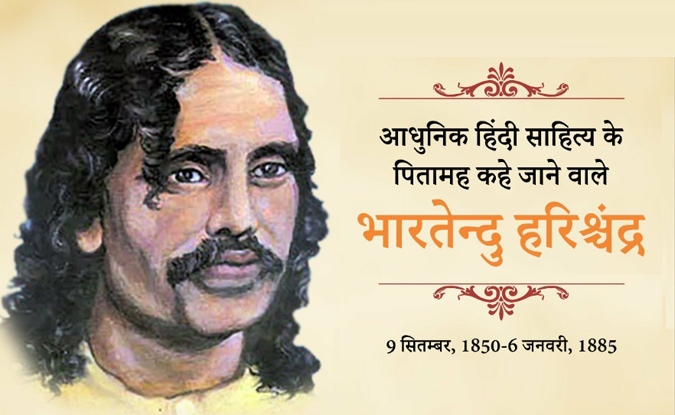
Bharatendu Harishchandra was granted a lifespan of merely 35 years, yet in that brief span he fundamentally transformed the entire landscape of Hindi—from prose to poetry, drama, and journalism. Bharatendu Harishchandra, who sounded the clarion call of renaissance through Hindi literature, was born in Kashi on September 9, 1850. His father, Shri Gopalchandra Agrawal, was an accomplished Brajbhasha poet who composed devotional verses under the pen name ‘Giridhar Das’. The poetic atmosphere of his home left a deep imprint on Bharatendu ji, and at the tender age of five, he composed his first doha (rhymed couplet):
"लै ब्यौड़ा ठाड़े भये, श्री अनिरुद्ध सुजान
बाणासुर की सैन्य को, हनन लगे भगवान्।।"
("Armed with a cudgel stood the wise Shri Aniruddha / And the Lord began to strike down the army of Banasura.")
Hearing this couplet, his father was overjoyed and blessed him, saying, “You will surely bring glory to my name.” Babu Harishchandra was exceptionally generous from his childhood. It was this magnanimity that drew people toward him. He bestowed immense wealth and resources upon various institutions. Deeply impressed by his erudition, scholars conferred upon him the title of ‘Bharatendu’ (Moon of India). Through the excellence of his writings, his renown spread far and wide. An examination of his works reveals that his genius as a poet, prose writer, and dramatist was extraordinary. He was a litterateur endowed with multifaceted brilliance.
Bharatendu ji’s family was financially prosperous. He traveled across various parts of the country, observing closely the condition of society, its traditions, and its socio-political realities. These journeys exerted a profound influence on his life. Penetrating the hearts of the common people, he reached their very soul. It was for this reason that he succeeded in creating a body of literature so transformative that he is hailed as an epoch-maker. At the age of 16, an inner awakening convinced him that he must dedicate his entire life to the service of Hindi. In time, this became the central mission of his life. He wrote:
"निज भाषा उन्नति अहै, सब उन्नति को मूल।
बिन निज भाषा ज्ञान कै, मिटे न हिय को सूल।।"
("Progress in one’s own language is the root of all advancement / Without knowledge of one’s mother tongue, the thorn in the heart remains unplucked.")
Bharatendu launched the publication of the journal ‘Kavi Vachan Sudha’ in Hindi. He was firmly opposed to sycophancy toward the British. In the articles published in his journal, the colonial government detected the scent of sedition. Consequently, the official financial patronage extended to the periodical was abruptly withdrawn; yet he stood unyielding in his convictions. He understood clearly that one could never serve the cause of Hindi and Hindu by depending on the mercy of the colonial regime.
The resonance of Bharatendu Harishchandra’s nationalist sentiment is reflected vividly in his plays ‘Neel Devi’ and ‘Bharat Durdasha’. Indeed, many literary critics trace the very dawn of national consciousness to the play ‘Bharat Durdasha’. Bharatendu Harishchandra authored works across a multitude of literary genres. Impressed by the stature of his literary personality, Pandit Rameshwar Dutt Vyas adorned him with the title of ‘Bharatendu’.
Bharatendu Harishchandra is regarded as the grand patriarch of modern Hindi literature. He was the foremost pioneer of modernity in Hindi. At the time Bharatendu Harishchandra emerged, the country was bound in the chains of foreign subjugation. Under British rule, English held supreme dominion. All functioning of the administrative apparatus was carried out exclusively in English. An unbridled hunger for official rank prevailed under the British Raj. The Indian populace was enamored with foreign civilization. Under British hegemony, reading and comprehending English was considered a badge of prestige. Regard for Hindi was steadily declining, as colonial policy inflicted severe damage on our indigenous literature. We were compelled to lead an enslaved existence. Our culture was being trifled with. In such an environment, when Babu Bharatendu Harishchandra made his appearance, he first reflected deeply upon the condition of society and the nation, and then, wielding the power of his pen, systematically unmasked the foreign regime.
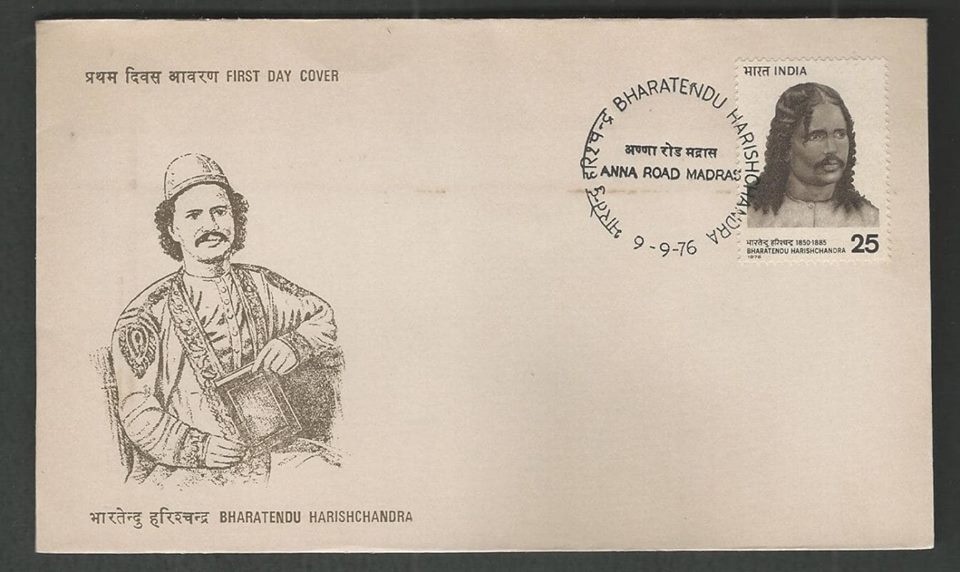
Bharatendu Harishchandra is considered the father of dramatic literature in Hindi as well as of Khari Boli (the standard dialect of modern Hindi prose). Even while deeply immersed in literary creation, he remained attuned to social issues. He consistently championed women’s education. At the age of 17, he founded a school, which has today grown into Harishchandra Degree College. It was the tragic misfortune of our nation, dharma (righteous order), and language that a litterateur of such immense genius was claimed by death at the young age of just 35. Yet even within this brief span, he authored more than 75 works, which remain an invaluable treasure of Hindi literature, encompassing every single domain of the literary arts.
The distinguished scholar Dr. Shyamsundar Vyas wrote: “The day Bharatendu Harishchandra addressed his countrymen at the opening of his play ‘Bharat Durdasha’, inviting them to weep over the fallen state of the nation, is in the history of this land and its literature in no way less momentous than the birth anniversary of any great luminary.”
“Babu Moshai! Life should not be long... it should be large!” This famous dialogue belongs to the acclaimed 1971 film ‘Anand’. In the film, Rajesh Khanna, playing a terminal cancer patient, imparted this philosophy of life to his friend Amitabh Bachchan. But this very philosophy applies with equal precision to the towering luminary of Hindi literature, Bharatendu Harishchandra. He bid farewell to the world at the young age of just 34 years and four months; yet before leaving, he accomplished so much in his domain that one is left astonished at how a human being could achieve so much in so brief a lifespan. Whether we realize it or not, it remains a historical reality that much of the foundation upon which modern Hindi literature stands was erected by Bharatendu Harishchandra and his circle. Few individuals have had the honor of ‘the first time’ associated with their name as frequently as he did. It is for this reason that many critics rightly regard him as the great pioneer and ‘investigator’ of modern Hindi literature.
Prakhar Agrawal
Cite this article
प्रवक्ता. “Bharatendu Harishchandra: The Patriarch of Modern Hindi”. YugSamvad, 18 October 2026. https://yugsamvad.com/en/articles/bhaaratendu-harishchandra-aadhunika-hindee-ke-pitaamaha-jinakee-jindagee-lanbee
https://yugsamvad.com/en/articles/bhaaratendu-harishchandra-aadhunika-hindee-ke-pitaamaha-jinakee-jindagee-lanbee · accessed
Related reading
Vidhi-Vidhan and Niyam of Vrata during Chaturmasya
Chaaturmaasya-Vratavidhaana (Rules and Observances of the Chaaturmaasya Vow) Author: Pandit Gangadhar Pathak 'Vedaadyacharya' Chief Acharya: Shriram Janmabhoomi Shila Pujan, Ayodhya Shri Vrindavan Dham Acharya Shri Gangadhar Pathak, the chief priest who had Prime Minister Shri Narendra Modi perform the foundation stone laying ceremony (shilaanyaas) for the Shriram Janmabhoomi temple in Ayodhya, is, along with a healthy body, of mind
18 October 2026 · 9 min read
Propaganda Against BHU Founder Mahamana Malaviya
I draw the attention of scholars affiliated with Kashi Hindu Vishwavidyalaya who are conducting research on the persona and works of Mahamana Malaviya Ji, as well as history enthusiasts, toward a matter of utmost importance. That matter is this: for some time now, it has been repeatedly observed and read that the Darbhanga royal family and Mithi...
18 October 2026 · 6 min read
Determining the Jati of Shabari – Acharya Gangadhar Pathak
'Shri Ram's Devotee Shabari Was Not a Bhilni, But a Brahmani' Author: Pandit Gangadhar Pathak ‘Vedadyacharya’ Chief Acharya – Shri Ram Janmabhoomi Shila Pujan, Ayodhya Advisor: Shri Sarveshwar Jayaditya Panchang (traditional almanac), Jaipur Conducting the shilanyas (foundation stone laying) of the Shri Ram Janmabhoomi Temple in Ayodhya with Prime Minister Shri Narendra Modi m
18 October 2026 · 1 min read