YugSamvad · Sanskrit & Shastra
Sanskrit & ShastraThe Superstitions of Communist Ideology
Shivpujan Tripathi · English edition 18 October 2026 · Hindi original 16 September 2019 · 6 min read
Just a few days ago, I read Howard Fast's book The Naked God: The Writer and The Communist Party. Fast began writing at the age of 17 and continued writing until the end of his life, authoring a total of 80 books. He was an active member of the Communist Party of the USA from 1943 to 1956, but in 1956, after reading Khrushchev's secret report at the 20th Congress of the Soviet Communist Party, he became disillusioned with Communism and parted ways with the Party. The aforementioned book is a documentation of his experiences during his time as a Communist. Such a succinct and profound analysis of the Communist Party's perspective, activities, psychological traits, and working style is rare to find elsewhere.
Fast writes that if anyone thinks joining the Communist Party brings inner peace or happiness, they are mistaken. The reality is that a person has to sell their soul, under the belief that this alone will lead to the liberation of humanity. In the eyes of the Party, an individual's self-respect, emotional impulses, and consciousness of freedom are mere 'bourgeois baggage'; it is only by freeing oneself from these—or in Communist terminology, by shedding the petty consciousness of the bourgeois class, becoming 'de-classed', and imbuing oneself with the consciousness of the proletariat—that one can become a true Communist.
Fast writes that among Communists, there is a practice of various superstitions and rituals akin to those of a priest. He outlines four types of superstitions.
Superstitions of the Communist Party
1. Superstition of Outcome (sympathetic magic)—
This is the superstition on the basis of which the so-called analysis of the global situation has been conducted. Their presentation and language were such as though they knew every nook and cranny of social events across the world and their eventual outcomes. For instance, "Capitalism is now drawing its last breath", "The socialist wave is spreading rapidly across the whole world", etc.
2. Superstition of Foreknowledge and Esoteric Knowledge (Divination)—
This type of superstition rests on the hypothesis that by continuously speaking about desired outcomes, those outcomes will actually materialize. It also includes certain rituals and charms (Fast's original term being 'spells')—such as passing resolutions, staging demonstrations, printing pamphlets, etc. The greatest example of this superstition of foreknowledge was the belief held by all Marxist organizations that the world is inevitably moving toward Communism, and that Marx's law of social motion is just like Newton's law of motion.
3. Superstition of Incomprehensible Jargon (Thaumaturgy)—
Bourgeois baggage, lumpen bourgeois, party consciousness, feudal-bourgeois alliance, neo-fascist, democratic centralism, etc. Followers reading or listening to these terms derived their meaning merely from context. For instance, in Soviet literature, the use of the term 'cosmopolitanism' signified that something was being directed against Jews.
4. Superstition of Rigid Dogmas and Idioms (Incantation)—
This is the feature with which Communist Party documents are typically embellished, such as Dialectical materialism, surplus value, scientific socialism, proletarian internationalism, etc. Fast writes that these terms acquired the status of religious magic spells. The writings of Marx, Engels, and Lenin were completely severed from their contexts and converted into the recitation of mantras (sacred chants).
Fast noted another distinct trait of the Communist Party: its constant mindset of evading inconvenient questions. When Fast left the Communist Party, the Party drew a veil over the entire news in Soviet society, where Fast had millions of readers and admirers, acting as if nothing had happened at all. No anger, no attack, no debate—simply an outright denial, as if a person named Fast had never existed.
Fast writes that individuals who join the Communist Party have often been very good, idealistic, and dedicated human beings. If this fact is not understood, it is impossible to comprehend the horror of the Communist organization. Yet, this very honest person, in their superstition, collaborates with the most horrific atrocities and falsehoods. Later on, they themselves begin committing such acts, believing that humanity's liberation will come through them. But ultimately, they meet the fate of Comrade Kedrov—unable to see the tormentors even while looking right at them, failing to recognize atrocities and falsehoods as such even while perpetrating them.
Fast makes it clear in the book how Party writers transform into habitual liars. In 1949, when Fadeyev, who led the Soviet delegation, was questioned about several writers, he comfortably spun lie after lie, even though by that time all of them had either been shot or were imprisoned in torture camps awaiting their painful end. Fadeyev himself committed suicide in 1956, just a few days after the Khrushchev report.
Just like the lie spoken by Fadeyev at that conference, Boris Polevoy later told a similar lie about the writer Kvitko. When asked about this writer, Boris claimed that Kvitko was living in an apartment in his own building and had sent greetings to the American comrades, whereas the fact was that Kvitko had been killed several years prior.
After reading the aforementioned book, if one reflects upon the Indian context, precisely the same thing occurred within the Progressive Writers' Association run by the Communist Party of India, particularly between the years 1948 and 1951. According to Shivdan Singh Chauhan, himself a progressive writer, during this period all writers—except staunch followers of the Communist Party line and a few friends of the organization's secretary—were labeled enemies of Marxism and the people; Rahul, Pant, Agyeya, Dinkar, Hazari Prasad Dwivedi, Yashpal, Ashk, Bachchan, and others were declared anti-people criminals. Fortunately, the Indian Bolshevik Revolution organized by the Communist Party of India on 22 February 1949 failed, and thus a revolutionary reckoning for these writers could not take place. Had the February revolution succeeded, the career of Dr. Ramvilas Sharma, Secretary of the Progressive Writers' Association, would likely have been quite different, and history would remember him today in another guise—as a kind of Indian Zhdanov or Fedin.
– Shivpujan Tripathi, The author is a keen scholar and researcher of Indian history and culture
Read also,
Why Can a Muslim Never Be a Leftist?
Shri Guruji Golwalkar's Thoughts on the Hollowness of Communism (Leftism)
Marxist Ideology's Betrayal of India's History and Present
Stalin: Whose Propaganda Machine Murdered 2 Crore People in Russia
When a Communist Said, “Let the People Taste Blood”!
1984 and Animal Farm: Specimens of a Mute and Deaf Leninist Society
Negationists: Criminals Who Deny the Crimes of History
Even Jinnah and Iqbal Will Not Escape the Grip of Islamic Radicalism
Cite this article
Shivpujan Tripathi. “The Superstitions of Communist Ideology”. YugSamvad, 18 October 2026. https://yugsamvad.com/en/articles/kamyunista-vichaaradhaaraa-ke-andhavishvaasa
https://yugsamvad.com/en/articles/kamyunista-vichaaradhaaraa-ke-andhavishvaasa · accessed
Related reading
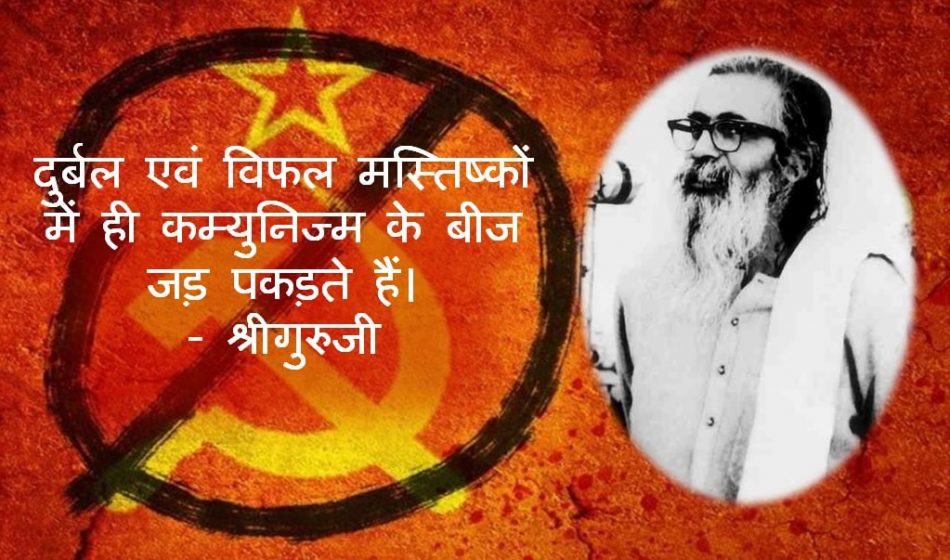
Shri Guruji Golwalkar's Views on the Hollowness of Communism
Among the grave failures of democracy in our country is the rising menace of communism, which is an avowed enemy of the democratic constitution. Lest they lag behind the communists in their economic appeal to the public, in this endeavor our leaders themselves also...
23 October 2026 · 5 min read

Aung San Suu Kyi: Every Indian's Salute to Myanmar's Mother
Salutations to Myanmar’s Nobel laureate Mother Aung San Suu Kyi, who brushed aside international pressure to stand steadfastly with her nation. Defying the stripping of numerous awards already and the threats of global leftist powers to revoke her Nobel, she stood by her country. Today, every citizen of Brahmadesh (traditional name for Myanmar)
17 October 2026 · 3 min read