YugSamvad · Sanskrit & Shastra
Sanskrit & ShastraWas Kumbh Held at 12 Places?
Gunjan Aggrawala · English edition 17 October 2026 · Hindi original 3 January 2019 · 9 min read
Some scholars hold the view that there are twelve Kumbha sites rather than four, and these scholars are striving to initiate Kumbha melas at the remaining eight sites. The most vocal leader in this movement is Swami Chidatman Ji Maharaj, founder of the Akhil Bharatiya Sarvamangala Adhyatma Yoga Vidyapeeth, Simariaghat (Begusarai, Bihar).
Swami Chidatman Ji Maharaj has argued that a manuscript titled Tirthayātrasāroddhāra or Amṛtīkaraṇaprayoga, purportedly from the well-known ancient text Rudrayāmalatantra, has been recovered from Mithila, which mentions twelve Kumbha sites in the context of the narrative of the Turkic invasions. It is evident that this portion was composed between the 12th and 15th centuries and circulated under the name of a section of the Rudrayāmalatantra. No such portion is found in the commonly accepted Rudrayāmalatantra. Proponents of the twelve Kumbha sites cite this Amṛtīkaraṇaprayoga chapter. Translated, edited, and published in 2011 under the title Rudrayāmaloktāmṛtīkaraṇaprayogaḥ: Dvādaśakumbhavivecana by two scholars of Kameshwar Singh Darbhanga Sanskrit University, Prof. Vidyeshwar Jha and Dr. Shrawan Kumar Choudhary, the verses concerning the purported Kumbha from this text are quoted below:
किंचिद्दूरन्ततो गत्वा गहनं शाल्मलीवनम्।
वीक्ष्य तस्थुर्बलिमुख्याः गंगा यत्रोत्तरां गता॥58॥
मायया देवदेवस्य विष्णोरतुलतेजसः।
दैत्याः विमोहिताः सर्वे कुम्भं संस्थाप्य ननृतुः॥59॥
जगुर्गीतं जयमिश्रमुच्चैः शाल्मलीवने।
तत्रैवामृतपानाय बभूवर्हतबुद्धयः॥60॥
Going a short distance from there and beholding the dense Shalmali forest (silk-cotton tree grove), the asuras (demons), led by Bali, halted where the Ganga flowed northward. Deluded by the maya (cosmic illusion) of Lord Vishnu, the god of gods of incomparable splendour, all the daityas set down the kumbha (pot) of amrita (nectar of immortality) and began to dance. Right there in the Shalmali forest, the daityas began singing songs, raising loud cries of victory in between. Their wits were utterly bewildered in their eagerness to drink the amrita.
एतस्मिन्नन्तरे काले विष्णुर्नारायणः स्वयम्।
मोहिनीरूपमासाद्य ययौ दैत्यान् विमोहितान्॥61॥
सर्वलक्षणसम्पन्नां भासयन्तीं दिशं त्विषा।
विचरन्तीं वने दृष्ट्वा स्तनभारभराकुलाम्॥62॥
तामेकां सुन्दरीं तत्र गहने शाल्मलीवने।
विस्मयेन समाविष्टा बभूवस्तृषितेक्षणाः॥63॥
At that moment, the all-pervading Shriman Narayana Himself assumed the form of Mohini and approached the deluded daityas. The daityas saw Mohini, endowed with all auspicious feminine marks, illuminating all directions with her radiance, moving gracefully in the forest, heavy with the weight of her breasts. Beholding that peerless beauty alone in that dense Shalmali forest, they were filled with wonder and gazed upon her with thirsty eyes.
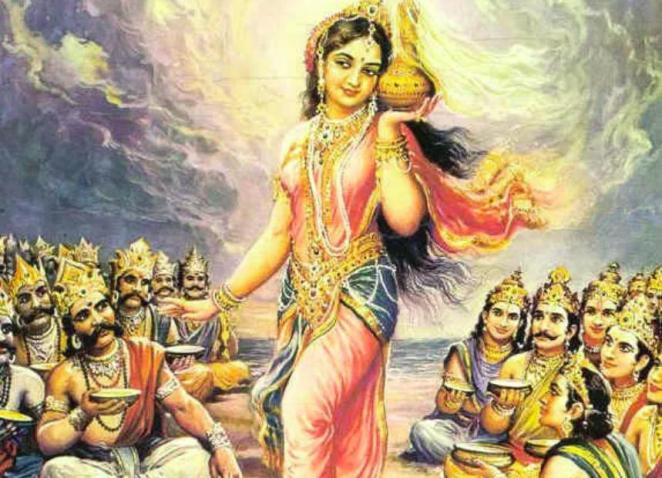
तां सम्मान्य तदा दैत्यराजो बलिरुवाच ह।
सुधा त्वया विभक्तव्या सर्वेषां सममेव च॥64॥
शीघ्रं त्वं महाभागे कुरुष्व वचनं मम।
विष्णोर्माया भगवती तदोवाच बलिं प्रति॥65॥
दिव्यममृतपानन्तु कर्तव्यं नाद्य भूपते।
वर्णाश्रमाणां धर्माणां पालयद्भिर्महाजनैः॥66॥
Then Bali, the king of the daityas, honoured her and said, "You alone must distribute this nectar equally among all of us. O noble lady! Comply with my request without delay." Hearing this, Bhagavati, the maya of the all-pervading Lord, said to Bali, "O King! Noble persons who adhere to the varnashrama dharma (the duties of one's class and stage of life) must not drink this divine amrita today.
अद्योपवासः कर्तव्यः सुधापानसमुत्सुकैः।
रात्रौ जागरणं कृत्वा स्नातव्यं स्वर्णदीजले॥67॥
ततः पारणरूपेण पानं कार्यं महाशयैः।
एवं विष्णोर्वचः श्रुत्वा बलिदै्र्रत्यपतिः सुधीः॥68॥
आज्ञापयामास मयं कर्तुं प्रासादसंहतिम्।
क्षणान्मयासुरस्तत्र गंगायाश्चोत्तरे तटे॥69॥
चकार नगरं रम्यं शाल्मलीवनसंस्थितम्॥70॥
Those eager to drink the amrita should fast today, keep a vigil through the night, and bathe in the waters of the heavenly river Ganga. Thereafter, as the parana (breaking of a ritual fast), you noble souls should drink the amrita." Hearing these words of Vishnu in the guise of Mohini, the wise Bali, protector of the daityas, commanded Maya Danava to erect a cluster of palatial mansions (a city); and in mere moments, on the northern bank of the Ganga, Maya Asura built an exquisite city nestled within the Shalmali forest.
नद्यास्तीरं समाश्रित्य स्नानं कुर्याद् विचक्षणः।
अस्मिन्नमृतयोगे तु स्नात्वा तीर्थे फलं महत्॥120॥
Thereupon, the Sun and the Moon, situated in the sign of Tula (Libra), spoke to Guru (Jupiter). And Guru, discerning all the movements of Rahu positioned in the seventh rashi (zodiac sign), conveyed to Vishnu that—when the conjunction of the Sun with the Moon takes place on the auspicious trayodashi tithi (thirteenth lunar day) of the krishna paksha (waning fortnight), it is known as the Amrita Yoga. O beloved! At that time, a wise person should take refuge on the bank of the river and bathe. Bathing in the tirtha (sacred water-ford) during this Amrita Yoga yields great spiritual fruit.
गुरोरपि यदा योगस्तस्य पुण्यं न वर्ण्यते।
मासं यावद् भवेत्तीर्थं तदामृतमयं शुभे॥121॥
देवाश्चागत्य मज्जन्ति तत्र मासं वसन्ति च।
तस्मिन् स्नानेन दानेन पुण्यमक्षय्यमाप्नुयात्॥122॥
सिंहे युतौ च रेवायां मिथुने पुरुषोत्तमे।
मीने ब्रह्मपुत्रे च तव क्षेत्रे वरानने॥123॥
If there is the conjunction of Guru as well, the merit thereof defies description. O beautiful one! In such a planetary alignment, that tirtha remains imbued with amrita for an entire month. During such an alignment, the devas (gods) arrive, bathe in that tirtha for a whole month, and dwell there. By bathing and giving dana (charitable gifts) during that alignment, a human attains inexhaustible merit. When such an alignment occurs in the sign of Simha (Leo), it applies to the Reva (Narmada); in Mithuna (Gemini), at the Purushottama Kshetra (Jagannath Puri); in Mina (Pisces), at the Brahmaputra (in Guwahati); O fair-faced one! In your sacred realm (Kamakhya).
धनूराशि स्थिते भानौ गंगासागर संगमे।
कुम्भराशौ तु काबेर्यां तुलार्के शाल्मलीवने॥124॥
वृश्चिके ब्रह्मसरसि कर्कटे कृष्णशासने।
कन्यायां दक्षिणे सिंधौ यत्राहं रामपूजितः॥
अथाप्यन्योऽपि योगोऽस्ति यत्रस्नानं सुधोपमम्125॥
मेषराशिस्थिते भानौ कुम्भे च गुरौ स्थितौ।
गंगाद्वारे भवेद्योगो भुक्तिमुक्तिप्रदः शिवे॥126॥
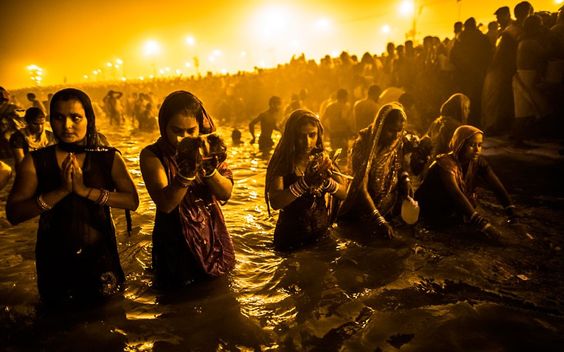
When the Sun is positioned in Dhanu (Sagittarius), at the confluence of Ganga and the ocean (Ganga Sagar); when the Sun is in Kumbha (Aquarius), at the Kaveri; when the Sun is in Tula (Libra), at the Shalmali forest (Semaria); when in Vrishchika (Scorpio), at the Brahmasarovar (Kurukshetra); when in Karka (Cancer), at Krishnashasana (Dwaraka Puri); when in Kanya (Virgo), in the southern ocean (Rameshwaram) where I was worshipped by Shri Ram; and there are other yogas (planetary alignments) as well wherein bathing is akin to amrita. When the Sun enters the sign of Mesha (Aries) and Guru enters Kumbha, O Shiva! This yoga occurs at Gangadwara (Haridwar), bestowing both worldly enjoyment and moksha (liberation).
मेषेगुरौ तथा देवि मकरस्ये दिवाकरे।
त्रिवेण्यां जायते योगः सद्योऽमृतफलं लभेत्॥127॥
शिप्रायां मेषगे सूर्ये सिंहस्थे च बृहस्पतौ।
मासं यावन्नरः स्थित्वामृतत्त्वंयान्ति दुर्लभम्॥128॥
पार्वत्युव्वाच
कथमेताः महापुण्याः नद्यो योगेषु भाषिताः।
तत्सर्वं श्रोतुमिच्छामि त्वत्तो देव नमोऽस्तु ते॥129॥
O Devi! When Brihaspati (Jupiter) is in Mesha and the Sun is in Makara (Capricorn), this yoga occurs at the Triveni Sangam, instantly granting the fruit of amrita. When the Sun is in Mesha and Brihaspati is in Simha, this yoga lasts for a month at the Shipra, and by dwelling there for a month, people attain the rare state of immortality. Parvati said—O Lord! Salutations to you. How are these rivers declared to be supremely sacred during these alignments? I desire to hear all of that from you.
ईश्वर उवाच
सुधावितरणे देवि घटारूढे गुरावपि।
विष्णुर्दृष्टवान् क्षिप्रं राहु च देवमध्यगम्॥130॥
चमसं सुधया पूर्णं धारयन् दक्षिणे करे।
राहोश्चाग्रस्थिते पात्रेऽमृतं वीक्ष्य च शाश्वतम्॥131॥
विष्णुरादेशयाँचक्रे चक्रं नाम सुदर्शनम्।
छिन्धिच्छिन्धीति शब्दोऽभूत् पद्मापतिमुखाग्रतः॥132॥
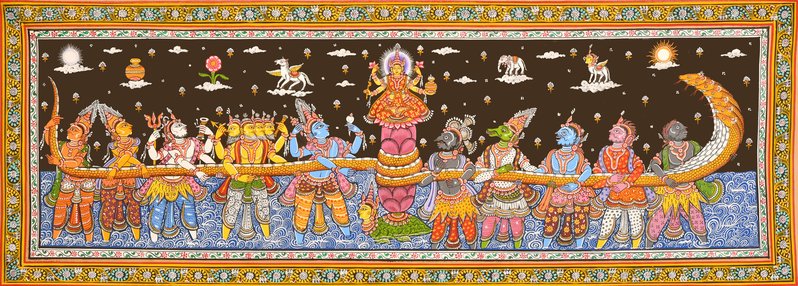
Ishvara said—O Devi! At the time of the distribution of amrita, since Guru was also situated upon the ghata (vessel), Vishnu quickly spotted Rahu seated amongst the devas. Holding the chamasa (serving ladle/cup) filled with amrita in His right hand, seeing the everlasting amrita in the vessel positioned before Rahu, Vishnu commanded His renowned discus named Sudarshana. At that moment, the words "Sever! Sever!" issued forth from the mouth of Padmapati Narayana.
चक्रश्च तं द्विधा चक्रे यावत्पिबति सोऽमृतम्।
तथाप्यमृतलेशस्तु कण्ठे जातः क्षणेन हि॥133॥
राहोः कबन्धः सहसा दधावोत्थाय मोहिनीम्।
विष्णुश्चाप्यसुरोत्पातान् वीक्ष्य दैत्यकृतान् तदा॥134॥
चमसं दक्षिणे हस्ते वामे कुम्भं गुणोज्जवलम्।
द्वित्राणां देवमुख्यानामंश आसीत्तदा घटे॥135॥
आरुरोह वैनतेये ततो दिव्युत्पपात ह।
कलशन्तु विचिक्षेप तत्रैव जाह्नवीजले॥136॥
Even as Rahu was drinking the amrita, Vishnu's discus cleaved him into two pieces. Nevertheless, a trace of amrita reached his throat in that instant. The kabandha (headless trunk) of Rahu suddenly sprang up and lunged toward Mohini. Vishnu, witnessing the havoc wreaked by the daityas, holding the kumbha that shone with virtues—which still contained portions meant for two or three chief deities—in His left hand, and the chamasa in His right hand, mounted Garuda, the son of Vinata, vaulted into the sky, and cast the amrita kalasha (pitcher) right there into the waters of the Jahnavi (Ganga).
ऋषीणां पितृणाञ्चैव मुनीनाञ्चैव देहिनाम्।
सुधापानार्थमुद्दिश्य कुम्भन्तत्रोत्ससर्ज ह॥137॥
तस्मात् शाल्मलीतीर्थे जलम जलमस्ति सुधामयम्।
चमसे यदमृतं देवि तद्देशेषु पपात ह॥138॥
तस्मादेतेषु तीर्थेषु जलं नद्याः सुधोपमस्॥139॥
पार्व्वत्युवाच
ततः किमकरोद्राहुः किञ्चित्पीतसुधालवः।
दैत्याश्चामृतपानाद्धि वञ्चिताः परमेश्वर॥140॥
For the purpose of providing amrita to the rishis (sages), the pitris (ancestors), the munis, and all embodied beings, Vishnu abandoned that kumbha right there. Therefore, in the Shalmali Tirtha (Semaria), the water of the Jahnavi is filled with amrita; and O Devi, the amrita that remained in the chamasa spilled across various other regions. Hence, the waters of the rivers at those respective tirthas are akin to amrita. Parvati said—What did Rahu do after having consumed a small drop of amrita? And O Parameshvara, what did the daityas do thereafter, having been deprived of drinking the amrita?
ईश्वर उवाच
राहो: कबन्ध उत्प्लुत्य शान्तोऽभूद्देवसन्निधौ।
कण्ठादूध्र्वं तु लोकेस्मिन्नमर: कण्ठगतामृतात्॥141॥
Ishvara said—The headless trunk of Rahu leaped up and became pacified in the presence of the devas, while the portion above the throat attained immortality in this world on account of the amrita lodged within the throat.
The renowned Sanskrit scholar from Patna, Pt. Bhavanath Jha, has cited numerous evidences to suggest that this text belongs between the 14th and 16th centuries.
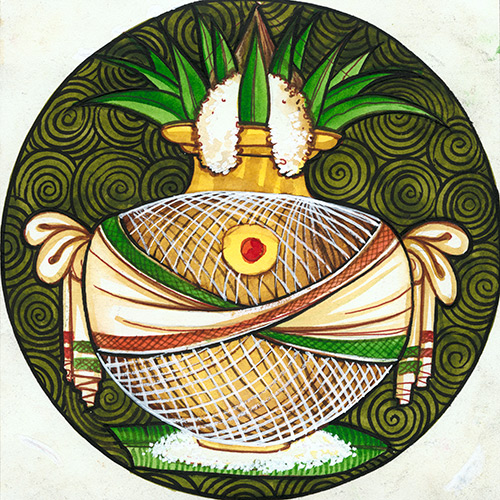
It is cited in the Vishnuyaga that Kumbha parvas (festivals) occur twelve in number—every twelve days for the devas and every twelve years for mortals. Among them, four are on the soil of Bharat to wash away the sins of humans, and eight are in other lokas (realms), accessible only to the devas and none else—
देवानां द्वादशाहोभिर्मत्यैद्र्वादशवत्सरैः।
जायन्ते कुम्भपर्वाणि तथा द्वादशसंख्यया॥
तत्राघनुत्तये नृणां तुर्यः स्युभुवि भारते।
अष्टौ लोकान्तरे प्रोक्ता देवैर्गम्या न चेतरैः॥
It is further stated—owing to the falling of amrita at four locations in Bharat, four divisions of the Kumbha yoga on earth are enumerated. At Haridwar, Prayag, Dharanagari (Ujjain), and the banks of the Godavari (Nashik), the yoga named Kalasha (Kumbha) has been proclaimed by Shankaracharya and others—
पृथिव्यां कुम्भयोगस्य चतुर्धा भेद उच्यते।
चतुःस्थले निपतनात् सुधाकुम्भस्य भारते॥
गंगाद्वारे प्रयागे च धारागोदावरीतटे।
कलशाख्यो हि योगोऽयं प्रोच्यते शंकरादिभिः॥
Apart from this, no panchang (traditional almanac) or treatise of jyotisha (astronomy and astrology) speaks of the occurrence of Kumbha at any place other than the aforementioned four sites. Thus, we observe that there is no solid shastric basis whatsoever for any festival bearing the name 'Kumbha' anywhere in Bharat outside of these four locations.
Read also,
Why and when does Kumbha occur in Prayag, Haridwar, Ujjain, and Nashik?
This Ardha Kumbha of Prayagraj is extraordinarily significant
What really is the esoteric secret of the Aghori tradition..
How the Yogi government addressed the grievance of the Puri Shankaracharya regarding Kumbha..
Cite this article
Gunjan Aggrawala. “Was Kumbh Held at 12 Places?”. YugSamvad, 17 October 2026. https://yugsamvad.com/en/articles/kyaa-12-sthaanon-para-hotaa-thaa-kumbha
https://yugsamvad.com/en/articles/kyaa-12-sthaanon-para-hotaa-thaa-kumbha · accessed

Related reading
Vidhi-Vidhan and Niyam of Vrata during Chaturmasya
Chaaturmaasya-Vratavidhaana (Rules and Observances of the Chaaturmaasya Vow) Author: Pandit Gangadhar Pathak 'Vedaadyacharya' Chief Acharya: Shriram Janmabhoomi Shila Pujan, Ayodhya Shri Vrindavan Dham Acharya Shri Gangadhar Pathak, the chief priest who had Prime Minister Shri Narendra Modi perform the foundation stone laying ceremony (shilaanyaas) for the Shriram Janmabhoomi temple in Ayodhya, is, along with a healthy body, of mind
18 October 2026 · 9 min read
Propaganda Against BHU Founder Mahamana Malaviya
I draw the attention of scholars affiliated with Kashi Hindu Vishwavidyalaya who are conducting research on the persona and works of Mahamana Malaviya Ji, as well as history enthusiasts, toward a matter of utmost importance. That matter is this: for some time now, it has been repeatedly observed and read that the Darbhanga royal family and Mithi...
18 October 2026 · 6 min read
Determining the Jati of Shabari – Acharya Gangadhar Pathak
'Shri Ram's Devotee Shabari Was Not a Bhilni, But a Brahmani' Author: Pandit Gangadhar Pathak ‘Vedadyacharya’ Chief Acharya – Shri Ram Janmabhoomi Shila Pujan, Ayodhya Advisor: Shri Sarveshwar Jayaditya Panchang (traditional almanac), Jaipur Conducting the shilanyas (foundation stone laying) of the Shri Ram Janmabhoomi Temple in Ayodhya with Prime Minister Shri Narendra Modi m
18 October 2026 · 1 min read