YugSamvad · News & Media
News & Media16 Major Development Projects of India
प्रवक्ता · English edition 23 October 2026 · Hindi original 30 January 2019 · 9 min read
What has the Modi government accomplished for development thus far? This is a question that frequently arises in the minds of many of us. Here, we present to our readers an accounting of those projects that the Modi government initiated, completed, or resurrected from near-abandonment to bring to fruition.
1. Kishanganga Project:-
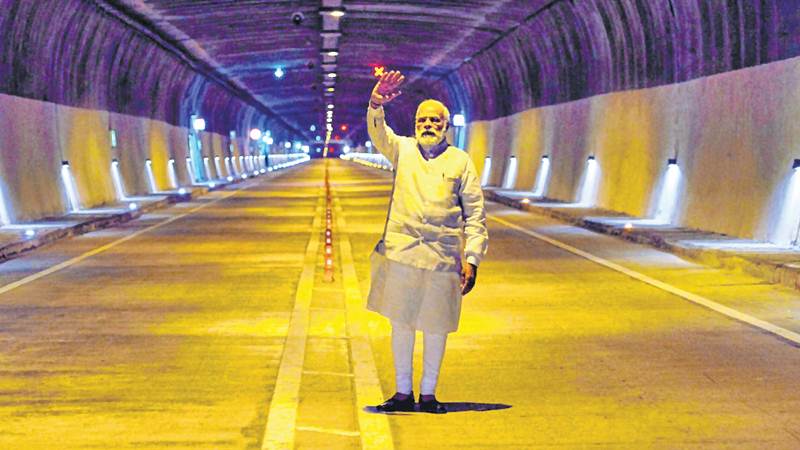
First on this list is the Kishanganga Project. Work on this 330 MW hydroelectric power plant commenced in 2007. Although scheduled for completion by 2016, this development project suffered persistent delays amidst India-Pakistan disputes. Despite objections raised by Pakistan, the Council of Architecture permitted India to proceed with construction, and on 19 May 2018, Prime Minister of India Narendra Modi inaugurated the Kishanganga Hydropower Plant.
2. Bhawan-Bhairon Passenger Ropeway:-
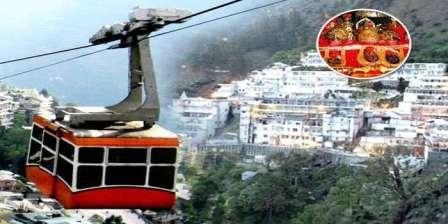
On 24 December 2018, the Governor of Jammu and Kashmir inaugurated the Bhawan-Bhairon Ghati Passenger Ropeway. With a carrying capacity of 800 passengers per hour, this ropeway project reduced the earlier travel time from one hour to half an hour. The greatest beneficiaries of this development project have been elderly and differently-abled pilgrims, who previously had to negotiate a steep ascent of 6,600 feet.
Vaishno Devi-Bhairon Ghati ropeway inaugurated, 3-hour journey to be completed in 3 minutes
3. Kollam Bypass:-
The proposal for this joint venture between the Central and state governments connecting Mevaram and Kavanad was first mooted 47 years ago in 1972. Three kilometres were constructed in 1993 and 1.5 kilometres in 1999. The third phase of construction began in May 2015, and the remaining 8.6 kilometres of the project were completed in 2019. Prime Minister Narendra Modi inaugurated this 13.14-kilometre bypass on 15 January 2019.
Prime Minister inaugurates 13 km rugged Kollam Bypass in Kerala
4. Bansagar Canal Project:-
Three states—Uttar Pradesh, Madhya Pradesh, and Bihar—are stakeholders in this canal project, sharing both water and power allocations among them. The dam project was proposed in 1956, when it was designated the Dimba Project. An agreement among the three states was reached in 1973, and work could only begin in 1978. On 15 July 2018, Prime Minister Modi inaugurated this 425 MW development project. Through this canal project, 1,500 square kilometres of land in Uttar Pradesh, 2,490 square kilometres in Madhya Pradesh, and 940 square kilometres in Bihar are brought under irrigation.
Asia's largest canal project 'Bansagar' completed, UP to benefit immensely
5. Bogibeel Rail-Road Bridge:-
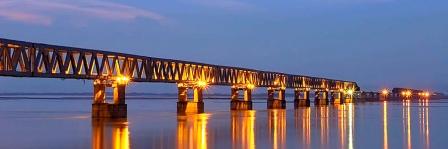
Built over the Brahmaputra River in Assam, the Bogibeel Bridge is a combined rail and road bridge. The largest of its kind, this bridge spans 4.94 kilometres and links Dhemaji and Dibrugarh districts. Construction of this bridge commenced in 2002 with an expected completion timeline of 6 years; however, due to financial constraints and various other factors, work remained stalled for an extended period. On 25 December 2018, on the birth anniversary of former Prime Minister Atal Bihari Vajpayee, Prime Minister Narendra Modi inaugurated the bridge.
Country's longest rail-road bridge (Bogibeel Bridge) opens: 10 salient points
Bogibeel Bridge across the Brahmaputra proves a boon for railways
6. Pakyong Airport, Sikkim:-
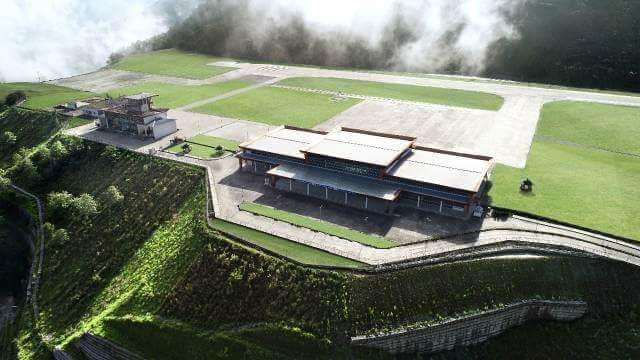
Spanning an area of 990 acres, Pakyong Airport is a greenfield airport. It is the country's hundredth operational airport. Prior to its construction, Sikkim was the sole state without a functional airport. Although an airport was proposed here in 2012, protests by local residents deferred the project. Work resumed thereafter in October 2015. On 24 September 2018, the airport was inaugurated. The first commercial flight took off from here on 4 October 2018.
10 special features of Sikkim's Pakyong Airport
Pakyong Airport: An airport beautiful as paradise
7. Eastern Peripheral Expressway:-
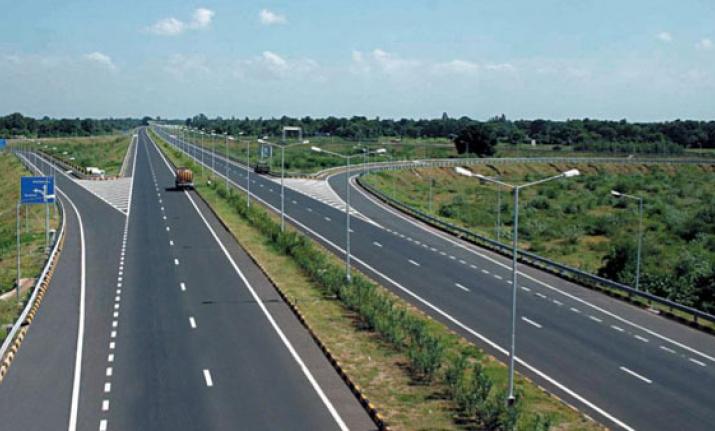
The Eastern Peripheral Expressway is expected to divert 50,000 trucks away from Delhi. This is projected to improve Delhi's air purity by up to 27 percent. Its foundation stone was laid in November 2015. Construction began in February 2016. The Supreme Court had stipulated July 2018 as the deadline for its completion. Despite numerous allegations, this development project was completed ahead of schedule and inaugurated on 27 May 2018.
Spectacular Eastern Peripheral Expressway: A 4-hour journey reduced to an hour and a quarter, 10 salient points
8. Kota-Chambal Bridge:-
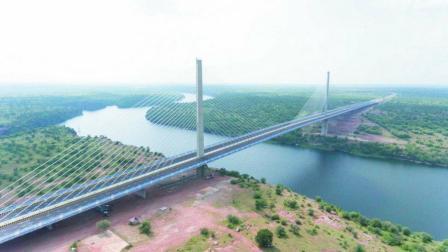
The proposal for this 1.5-kilometre cable-stayed bridge in Kota was mooted in 2006. A duration of 40 months was stipulated for its construction, and it was slated to open in 2012. Owing to numerous hurdles, its execution faced persistent delays. Ultimately, on 29 August 2017, Prime Minister Modi inaugurated this bridge.
Country's largest hanging bridge inaugurated, here are its features
Three bridges worth ₹330 crore realised on the Chambal River
9. Namami Gange Programme:-
Formulated to cleanse the Ganga, this programme was launched by the Central government in June 2014. Alongside the purification of the Ganga, the eradication of pollution was the paramount objective of this programme. The Namami Gange programme was announced with an outlay of ₹20,000 crore, encompassing sewerage treatment infrastructure, riverfront development, river surface cleaning, biodiversity conservation, public awareness, and Ganga Grams.
Proceeds from auction of gifts received by PM Modi to be dedicated to ‘Namami Gange’
Ganga water significantly cleaner during Kumbh
Mathura: Nitin Gadkari lays foundation stones for Namami Gange projects
10. Mundra LNG Terminal:-
This terminal has the capacity to handle five million tonnes of LNG annually. Furthermore, this development project marks a major stride toward India's objective of evolving into a gas-based economy. Construction of this terminal began in September 2015, and it was inaugurated in October 2018.
11. National Cancer Institute, Haryana:-
The National Cancer Institute in Haryana is the largest cancer hospital in the country. Built at an outlay of ₹2,035 crore, this institute has a capacity of 710 beds. Among these, two hundred beds are reserved for cancer patients under research protocols. The institute was inaugurated in January 2019. All OPD services of the hospital are scheduled to commence in three phases. The first phase is expected to feature 250 beds, with indoor admissions reaching 500 beds by December.
Country's largest Cancer Institute ready in Jhajjar
12. Sardar Vallabhbhai Patel Hospital:-
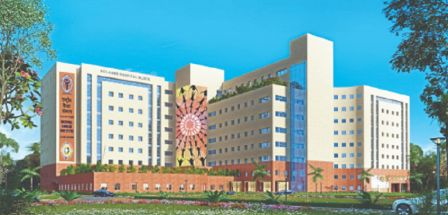
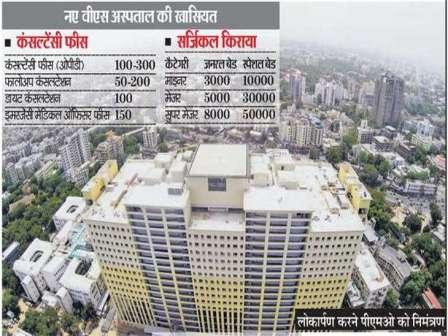
Prime Minister Narendra Modi inaugurated this hospital on 17 January 2019. Dedicated to the venerable leader Sardar Vallabhbhai Patel, this state-of-the-art hospital, built at a cost of ₹750 crore, is located in Ahmedabad. Housed in an 18-storey edifice, the hospital has a capacity of 1,600 beds.
18 floors, 1,600 beds: the facilities featured in the hospital inaugurated by Prime Minister Modi
13. Solapur-Tuljapur-Osmanabad Highway:-
On 9 January 2019, the Prime Minister inaugurated the four-lane Solapur-Tuljapur-Osmanabad Highway. Construction of this 58-kilometre highway commenced in 2014. Built at a cost of ₹972.50 crore, the highway was completed in four years.
14. Second Jharsuguda Airport:-
Designated as the Veer Surendra Sai Airport, the second Jharsuguda Airport was inaugurated on 22 September 2018 by Prime Minister Modi. Although the airport had secured clearance from the state government as early as 2012, this development project required an additional 275.75 acres of land alongside the terminal building and air traffic control tower for full-scale development. On 30 July 2014, an agreement was executed between the Government of Odisha and the Airports Authority of India (AAI), and the Ministry of Environment and Forests also accorded its approval. In 2018, the DGCA granted Jharsuguda Airport the status of the state's second functional airport.
Jharsuguda Airport to connect six cities
15. Western Peripheral Expressway:-
This six-lane expressway stretches 135.6 kilometres. Running from Kundli to Palwal, the expressway features 52 underpasses, 23 overpasses, and 10 toll points. It was first proposed in 2003, but remained subject to delays until 2016. The Supreme Court subsequently intervened in the matter, and in April 2016, Nitin Gadkari inaugurated one section of it. The entirety of the expressway was, however, completed by November 2018.
Western Peripheral Expressway operational, Delhi to gain relief from heavy vehicles by Diwali
16. Varanasi Multi-Modal Port:-
Constructed under the Jal Marg Vikas Project, this inland riverine port provides direct connectivity to the ports of Kolkata and Haldia. The project has the capacity to berth two vessels simultaneously and handle cargo of 1.2 MTPA. Additional facilities include a parking area, commodity transit sheds, a storage area, and a floating jetty.
Construction of the Varanasi Multi-Modal Port began in 2016 and was completed by November 2018.
Read also:
These 13 major tasks undertaken by the Central government in the past five years
What did the nation gain from Prime Minister Modi's foreign tours?
How to avail the benefits of the Modi government's Mudra Yojana?
Cite this article
प्रवक्ता. “16 Major Development Projects of India”. YugSamvad, 23 October 2026. https://yugsamvad.com/en/articles/kyaa-aapako-pataa-hain-desha-ke-vikaasa-ke-ye
https://yugsamvad.com/en/articles/kyaa-aapako-pataa-hain-desha-ke-vikaasa-ke-ye · accessed
Related reading
Mandaviya's Poor English and Indian Inferiority Complex
Mansukh Mandaviya, who has become a minister in the Modi government, is being continuously targeted by a so-called elite class in the country due to his poor English. In reality, this is a problem of the entire Indian subcontinent, whose DNA has rotted during a long period of slavery, bending the very bone of its self-respect. A few years ago
18 October 2026 · 4 min read
What does Narendra Modi think about Israel?
Prime Minister Narendra Modi writes on Israel in his book 'Setubandh', "Two thousand years ago, invaders devastated Israel. Some of its people had been scattered across different parts of the world, yet, filled with their sense of self-pride, taking advantage of the circumstances of the First and Second World Wars...
17 October 2026 · 3 min read
Jerusalem's Al-Aqsa Mosque and the 1969 Gujarat Riots
What is the connection between the Al-Aqsa Mosque in Jerusalem, which remains in the news, and the 1969 Gujarat riots? It was the 21st of August 1969 when a Christian missionary from Australia named Denis Michael Rohan set fire to the Al-Aqsa Mosque. Rohan believed that burning the Al-Aqsa Mosque would hasten the Second Coming of
17 September 2026 · 4 min read