YugSamvad · Sanskrit & Shastra
Sanskrit & ShastraThe Story of Madalasa Proves the Supreme Place of the Mother in Hindu Culture
Abhijeet Singh · English edition 23 October 2026 · Hindi original 2 August 2018 · 5 min read
माता गुरूतरो भूमेः (Mātā Gurūtaro Bhūmeḥ — The Mother Is Weightier than the Earth)
In the Mahabharata, when the Yaksha asks Dharmaraja Yudhishthira, "Who is weightier than the earth?", Yudhishthira replies, "Mātā gurūtarā bhūmeḥ"—the mother is weightier than the earth. Yudhishthira’s articulation of the mother’s supreme eminence is not without profound reason. If you study the Vedas, they extol the mother's glory by affirming that a mother’s conduct and thoughts exert the deepest influence upon her child. Whatever an offspring becomes, the mother's imprint upon them remains paramount. The mother is weightier even than the earth because her samskaras (formative cultural impressions) and teachings wield the power to dissolve the relevance of any entrenched convention, assumption, or dogma.
A formidable example of this truth is found in the narrative of Queen Madalasa chronicled in our Puranas (ancient sacred lore). Madalasa was the consort of Prince Ritudhvaja. Once, Ritudhvaja marched into battle against the Asuras (demons). In the conflict, his forces were overpowering the demonic ranks. To shatter the morale of Ritudhvaja’s army, the deceitful Asuras spread a false rumor that Ritudhvaja had been slain. When this report reached Madalasa, she could not bear the grief, and in her anguish, she gave up her life. When Ritudhvaja returned victorious over the Asuras, he found Madalasa no more. Shattered by her loss, he fell unconscious; forsaking his royal duties, he wandered in the agonizing pangs of separation like a man possessed. Ritudhvaja had a dear friend, the Nagaraja (serpent king). Unable to witness his friend’s pitiful state, Nagaraja went to the Himalayas to perform austerities to propitiate Mahadeva Shiva. Shiva manifested before him and bade him ask for a boon. Asking nothing for himself, Nagaraja pleaded for Madalasa to be restored to life for his friend Ritudhvaja. By Shiva’s boon, Madalasa returned to human life at the very age she had left it, and was reunited with Ritudhvaja.
Madalasa Imparting True Knowledge to Her Infants
The rebirth granted after death had awakened Madalasa to the ephemeral nature of the mortal frame and the essential truth of existence. She was no longer the Madalasa of old, though she never let this inner shift show in her outward conduct. She extracted a solemn promise from her husband: the responsibility of nurturing and rearing their future progeny would be entirely hers, and he would not intervene. When Madalasa conceived, she began instilling sacred samskaras in the child within her womb. She imparted to the unborn infant the very knowledge with which she herself was replete. Singing lullabies to her child in the womb, she would say: "O my son, you are pure, you are enlightened, you are untainted by the maya (cosmic illusion) of this world." Three sons were born in succession. Their father was a Kshatriya (warrior-ruler varna) and believed that his sons' names must reflect martial virtues; accordingly, he named them Vikranta, Subahu, and Shatrumardana. Yet all her sons were molded by Madalasa’s samskaras. She had transformed them into seekers of nivrittimarga (the inward path of spiritual renunciation), entirely unattached to worldly illusion; consequently, all of them renounced the palace and embraced sannyasa (renunciation). The father was stricken with grief, wondering how things could go on if this continued.
When Madalasa conceived once again, her husband pleaded with her: if all their progeny became wanderers on the path of nivrittimarga, who would govern this vast realm? He begged her to instruct at least this son in the art of statecraft. Madalasa consented to her husband's plea. When the fourth son was born, the father wished to bestow a martial name upon him as he had done with the first three. Madalasa laughed and remarked: "You named the first three sons similarly—what difference did it make? What will be achieved by giving him a martial name?" King Ritudhvaja said, "Then you name him yourself." Madalasa named the fourth son Alarka and instructed him in rajadharma (the ethical duties of statecraft) and kshatriyadharma (the duties of the warrior class).
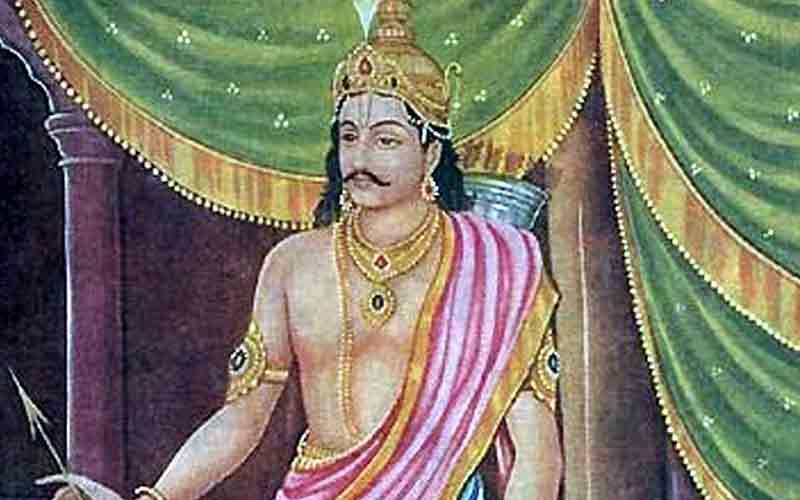
The Great and Illustrious King Alarka
Because Alarka was consecrated by the samskaras of a divine mother, he is counted among the most accomplished monarchs endowed with every noble virtue. Alongside statecraft, his mother instilled in him justice, compassion, and charity. The Valmiki Ramayana records an episode wherein a visually impaired Brahmana came to Alarka, and Alarka offered both his eyes in charity. In this manner, Alarka became the world’s first eye donor. The capacity for such extraordinary sacrifice was nurtured in Alarka solely by the samskaras of Mother Madalasa.
Conventional assumptions held that a boy born into a Kshatriya lineage must be steeped in martial prowess rather than spiritual wisdom, and that bearing the names of valorous warriors would inevitably dictate his conduct. Madalasa shattered all these entrenched dogmas at once, demonstrating that if a mother so desires, she can forge her child into a warrior and conqueror of foes; and if she so wills, she can fashion him into a tranquil sage, a mahatma, a brahmajnani (knower of the Supreme Reality), and an ascetic. The rare feat of imbuing a son simultaneously with the virtues of a spiritual seeker and an enlightened ruler can only be accomplished through a mother’s samskaras—the very imprint that Mother Madalasa bestowed upon Alarka. It was not without reason that Swami Vivekananda proclaimed that had he fathered a child, he would have sung Madalasa’s lullaby from birth into its ears: tvam asi nirañjanaḥ... ("Thou art untainted...").
The soil of Bharat is sanctified by the sagas of countless such mothers like Madalasa, who have kept this sacred land and the great Hindu dharma immortal. It is not mere coincidence that in the Rigveda, an ocean of hymns to the Supreme Reality and the devatas, the rishi (seer) beseeches the Mother for everything that is conventionally deemed the domain of the Supreme Father to grant. In his prayer, the rishi supplicates the Divine Mother:
O Mother, life-giver like the dawn (Usha)! Inspire us to walk upon the supreme path of righteousness; make us observant of duty and order, and bestow upon us renown and wondrous opulence.
Could there exist a greater testament anywhere to the eternal glory of the Mother?
– Shri Abhijeet Singh, author, profound scholar of Indian culture, Hinduism, Islam, and Christianity, jyotirvid (astrologer) and nationalist writer.
Read Also,
Jabala, Satyakama, and Maharshi Gautama Explained the Core of Hindu Dharma
Vivekananda Rock Memorial, Kanyakumari: A Symbol of Historic Struggle
Cite this article
Abhijeet Singh. “The Story of Madalasa Proves the Supreme Place of the Mother in Hindu Culture”. YugSamvad, 23 October 2026. https://yugsamvad.com/en/articles/madaalasaa-kee-kahaanee-siddha-karatee-hai-hindoo-sanskriti-men
https://yugsamvad.com/en/articles/madaalasaa-kee-kahaanee-siddha-karatee-hai-hindoo-sanskriti-men · accessed
Related reading
How is Om correctly pronounced?
The *Ashtadhyayi* (Panini's foundational Sanskrit grammar) (1.2.34) states that "except for *japa* (muttered recitation), *nyunkha* (a specialized prolonged chanting of the syllable 'O'), and *sama* (melodic Vedic chanting), *ekashruti* (monotone recitation) may be employed in *yajna-karma* (sacrificial ritual performance)." When a long "Om" (or short "u" or "o") has to be appended to any *veda-mantra* (Vedic hymn), that "Om" is called "*nyunkha*". *Ekashruti* means reciting by treating all accents as a single tone.
18 October 2026 · 2 min read
Yudhishthira's Dyuta: The Esoteric Vedic Akshavidya
It is wrong to call Dharmaraja Yudhishthira a gambler. How many times in his life did Dharmaraja Yudhishthira play dyuta (the traditional game of dice)? How many times must one play to be called a vyasani (addict)? It is also wrong to call dyutavidya (the science of dice) gambling. Why did Dharmaraja Yudhishthira have to learn dyutavidya from a rishi (seer)? Why was no teacher to be found other than a rishi? Shaku...
18 October 2026 · 1 min read

Be It Kanyadaan or Vardaan: What Is Wrong with It?
Is *kanyadan* (the ritual offering of the bride) merely charity? Why is *kanyadan* performed, and is it an insult to women? Understand the true meaning of *kanyadan* in the Hindu *vivaha sanskara* (marriage sacrament), along with its cultural and Vedic significance. Read the authentic exposition of *vardan* (boon) versus *kanyadan*, the mystery of *Brahma vivaha* (the Brahma form of marriage), and a definitive response to the fallacies that seek to misrepresent Hindu traditions.
18 October 2026 · 5 min read