YugSamvad · Dharma & Culture
Dharma & CultureShri Ram Eating the Tasted Ber of the Bhilni Shabari Is Proved from the Valmiki Ramayana
Mudit Agrawal · English edition 18 October 2026 · Hindi original 3 July 2021 · 13 min read
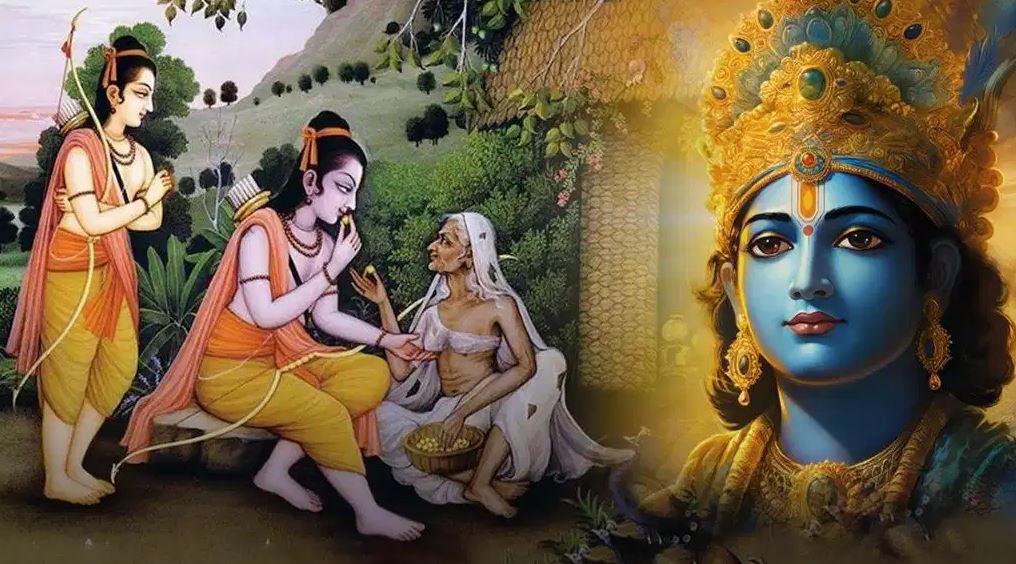
Nowadays, certain hyper-scholars are propagating the delusion in society that the legend of Shabari’s "tasted berries" is absent from the Ramayana, and that Shabari was not a devotee of a lower varna (social order), but a woman of a high varna. This is not only contrary to the supreme purport of the shastras (sacred texts), but is also extremely detrimental to social samrasya (harmony) and forms the root of arrogance and malice.
Based on pseudo-arguments and pseudo-evidences, this same category of eminent persons is also spreading the falsehood that the accounts of Shabari’s tasted berries and her being a Bhil woman are novel inventions. The truth, however, is that all ancient shastras establish that Shabari was born in a lower caste and that Shri Ram partook of the tasted berries of a crest-jewel of a devotee just like her, who existed in an esoteric form.
This very view is unanimously propounded in the ancient commentaries composed by all our great purvacharyas (pre-eminent teachers), as well as in the texts and traditions of the Vaishnava sampradayas (sects). If Shabari were a Brahmin woman, this view might belong to a few modern smarttas (followers of smriti), but it can never belong to the Vaishnavas.
Acharya Shri Vinay Jha writes: "An examination of what the Valmiki Ramayana indicates on this subject is necessary.
मया तु विविधं वन्यं सञ्चितं पुरुषर्षभ। तवार्थे पुरुषव्याघ्र पम्पायास्तीरसम्भवम्।। एवमुक्तस्स धर्मात्मा शबर्या शबरीमिदम्। राघवः प्राह विज्ञाने तां नित्यमबहिष्कृताम्।। -Valmiki Ramayana 3.74.17-18
The Valmiki Ramayana states that Shabari said to Shri Ram, 'O bull among men, I have gathered various forest products (fruits and roots) growing on the banks of the Pampa (lake) for your sake, O tiger among men.' The next verse states that Shabari was ever "'a-bahishkrita' (not ostracized) in vijnana (supreme spiritual consciousness)." This means that while Shabari was ostracized from a worldly perspective—meaning cooked food touched by her was forbidden—the context here is not of cooked food, but of natural forest fruits. Natural fruits brought by anyone, regardless of varna or caste, can be eaten after washing. Therefore, the direct meaning of "bahishkrita" in this context is simply that the wild fruits Shabari brought were tasted, but since that elderly female devotee was a "siddha" (accomplished) yogini absorbed in "nitya vijnana" (unbroken deep meditation), she was a-bahishkrita; hence, even her tasted remnants were acceptable.
Maharshi Valmiki employed adjectives such as "सिद्धा" (siddha), "धर्मसंस्थिताम्" (established in dharma), "तापसी" (ascetic), "सिद्धसम्मता" (respected by the siddhas), and "संशितवृताम्" (practicing praised, austere vows) for Shabari, and finally recounted that at Shri Ram's bidding, Shabari offered her body as an oblation into the fire, attained a divine body, and departed for the divine realm. Goswami did not contradict Valmiki; he made the matter even clearer. The question arises: if Shabari possessed brahmajnana (knowledge of the ultimate reality), why did she not know about tasted food? The simple answer is: consideration of whether food has been tasted applies when making offerings to deities, but when the deity is personally present, whose leftover is it? The remnants of one who remains in constant meditation are the remnants of the Supreme Lord Himself; they cannot be considered tasted or impure.
She was a poor old woman, and it was the final day of her life—the hour of departure. It was enough that she had gathered fruits for Shri Ram.
तेषां गतानामद्यापि दृश्यते परिचारिणी।। श्रमणी शबरी नाम काकुत्स्थ चिरजीविनी। -Valmiki Ramayana 3.73.25
In the previous chapter, Kabandha called Shabari "चिरजीविनी" (long-lived), meaning Shabari had been performing austerities there for an immensely long time. Even when the sage Matanga was alive, food was not cooked over fire in that hermitage; people ate only forest fruits. Shabari had never even seen food being cooked. She acted according to the extent of her knowledge, but she did so with absolute devotion.
Do you have the courage to immolate your body in the fire and attain a divine body? The fire will not accept your body as an oblation; by doing so, you would incur the sin of suicide. Becoming a Shabari is not easy.""
Evidences from the Purvacharyas in the Ancient Commentaries on the Valmiki Ramayana Regarding the Above Article
◆ Evidence from Govindaraja’s Bhushana Commentary
In the seventeenth century, Shri Govindaraja wrote in his Bhushana commentary on the Valmiki Ramayana, while glossing the aforementioned verses:
"विज्ञाने विषये । अबहिष्कृताम् अन्तरङ्गभूताम् । जात्या हीनामप्याचार्यप्रसादलब्धब्रह्मज्ञानामिति भगवताप्यादरणीयत्वोक्तिः ।। 3.74.18 ।।" Govindaraja explicitly stated that Shabari was born in a low caste and attained brahmajnana through the grace of her preceptor, thereby declaring her worthy of respect even by the Lord.
Shri Govindaraja himself wrote in his commentary on the preceding verse:
"सञ्चितमित्यनेन रामस्य चित्रकूटागमनात् प्रभृति सम्पादितत्वम् आदरेण गुप्तत्वं च तत्तत्फलजातीयमाधुर्यं परीक्ष्य स्थापितमिति सम्प्रदायः ।। 3.74.17 ।।" Meaning: "By the word 'sanchitam' , the tradition holds that were procured ever since Ram's arrival at Chitrakuta, and having carefully tested the sweetness of each variety of fruit, they were preserved with reverence." Testing the sweetness of a fruit without tasting it—that is, without consuming it—is utterly impossible.
◆ Evidence from Nagesha Bhatta’s Tilaka Commentary
The greatest grammarian of the eighteenth century, Nagoji Bhatta (Nagesha Bhatta), also wrote in his Tilaka commentary that Shabari tested the sweetness of the fruits and roots by tasting them herself before offering them to Shri Ram:
एवमुक्ताहं यतः, अतो मया स्वदर्थं वन्यं सम्यक्परोक्ष्य माधुर्ययुतं संचितमित्यर्थः । तदुक्तं पाद्मेशबरी प्रस्तुस्य--' प्रत्युद्गम्य प्रणम्याथ निवेश्य कुशविष्टरे । पादप्रक्षालनं कृत्वा तत्तोयं पापनाशनम् ।। शिरसा धार्य पीत्वा च वन्यैः पुष्पैरथार्चयत् । फलानि च सुपक्वानि मूलानि मधुराणि च ।। स्वयमास्वाद्य माधुर्यं परीक्ष्य परिभक्ष्य च । पश्चान्निवेदयामास राघवाभ्यां दृढव्रता ।। फलान्यास्वाद्य काकुत्स्थस्तलस्यै मुक्तिं परां ददौ' इति ।। 3.74.17,18 ।
Even from the Valmiki Ramayana, Shabari is clearly established as being other than a dvija (twice-born) and born in a lower caste such as the Bhils. In the chapter immediately preceding this, Kabandha also calls Shabari a shramani; ascetics other than Brahmins are called shramanas. This is why later ascetic monks among Buddhists and others came to be called shramanas. Shabari was in no way a Brahmin.
To know more about this subject from the Valmiki Ramayana, watch this YouTube video by the supreme scriptural scholar and pundit Swami Shri Siyaramdas Naiyayik.
Shabari’s Caste in the Shriramcharitmanas
In the Aranya Kanda of the Ramcharitmanas, Shabari herself says, "अधम जाति मैं जड़मति भारी।" Meaning: "I am of an extremely adhama (low, base, degraded) caste and of dull intellect." She further says:
"अधम ते अधम अधम अति नारी। तिन्ह मह मैं मतिमन्द अघारी॥34.2॥" "जाति हीन अघ जन्म महि। मुक्त कीन्हि अस नारि ॥36॥"
Meaning: "Among the lowest of the low, I am a woman of the very lowest kind. And even among them, O destroyer of sins, I am dull-witted." And: "Of low birth and a birthplace of sins—such a woman too was liberated by Shri Ram."
The repeated use of the word *adhama* in the first Doha employs the *yamaka* alankara (figure of speech involving homonyms). If only being born in the female gender were intended here by *adhama*, Goswami Tulsidas would not have had Shabari utter the word *adhama* four times. It is evident that when she calls herself *adhama* four times, she is presenting her physical or caste-based baseness to Shri Ram in multiple senses. In all the commentaries of the most esteemed and recognized purvacharyas of the Ramcharitmanas, Shabari is portrayed as born in a low caste yet being a supreme devotee of Ram.
◆ The Vijaya commentator of the Ramcharitmanas has written: "By the first *adhama*, she expressed being devoid of a high caste. By the second *adhama*, she spoke of being born in sin (*agha janma mahi*). The third word *adhama* was spoken on account of being a woman, because being a woman adds to one's faults." Further, the Vijaya commentator wrote in the gloss of , "Who was of low caste and a birthplace of sins—such a woman too He liberated."
Pandit Shri Vijayananda Tripathi, the prominent commentator of the Ramcharitmanas known as *Manas Rajahansa*, wrote the Shri Vijaya commentary.
◆ The Siddhantatilaka commentary of the Ramcharitmanas states: "'Adhama te adhama'—she has already stated that her caste is low, as the Bhil caste is low. Among those low ones, I am the lowest, meaning I am outcast and fallen even from my caste; as it is said: *'Jati hina agha janma mahi...' (Doha 36)*; or else I am low by virtue of being a woman, and furthermore, being born in a varna-sankara (mixed caste) family, I am extremely low." It is further stated: "This lowness of caste means that the Shabar caste is counted among the lowest of varnas."
Mahatma Pandit Shri Kantasharan Ji Maharaj, a prominent commentator of the Ramcharitmanas, authored the Shri Siddhantatilaka commentary.
◆ Swami Shri Rambhadracharya has written in the Bhavarthabodhini commentary: "Shabari said, 'O Lord! Born in a low caste with an exceedingly dull intellect, how can I sing Your praise? I am a woman low by varna, low by ashrama, and exceedingly low by lineage. O enemy of Aghasura, among them too I am a woman of the dullest intellect.'" It is further written: "When Lord Shri Ram liberated even such a cultureless woman, born in the lowest of castes, a birthplace of sins, nurtured in the lineage of violence-prone Kols and Kiratas, what happiness do you seek by forsaking such a Lord?"
Jagadguru Ramanandacharya Shri Rambhadracharya Ji Maharaj, a renowned commentator of the Ramcharitmanas, authored the Shri Bhavarthabodhini commentary.
When Shabari, overwhelmed by deep self-deprecation regarding her low caste, expresses her devotion to the Lord with great hesitation, the Lord says:
"जाति पाँति कुल धर्म बड़ाई। धन बल परिजन गुन चतुराई ॥ भगति हीन नर सोहइ कैसा। बिनु जल बारिद देखiर जैसा ॥34.3॥
Caste, lineage, family, dharma, greatness, wealth, strength, relatives, virtues, and cleverness—despite possessing all these, how does a person devoid of devotion appear? Just like a raincloud without water ."
Therefore, in the Ramcharitmanas, Shri Goswami Tulsidas has not left even a shadow of doubt regarding any kind of caste-based high birth for Shabari, and has given a tangible expression to Shri Shabari’s utterly unblemished, faultless, loving devotion (*premabhakti*).
Shabari’s Low Caste in the Adhyatma Ramayana
In the Adhyatma Ramayana as well, Shabari described herself as born in a low caste: "हीनजातिसमुद्भवा" -(A.Ra. Aranya Kanda 10.17). Thereafter, Shri Ramachandra Himself states there: "पुंसत्वे स्त्रीत्वे विशेषो वा जातिनामाश्रमादयः। न कारणं भजने भक्तिरेव हि कारणम्" Meaning: "Neither manhood nor womanhood, nor caste, name, ashrama, and the like are causes for worshipping Me; devotion alone is the sole cause." In the Adhyatma Ramayana itself, Shabari is also referred to as "अधमजन्मा," meaning one born in sin.
Here too, it is evident that Shabari feels immense hesitation due to her birth in a lower caste, to dispel which hesitation the Lord declares that gender, caste, name, etc., have no entry into His devotion. Had Shabari felt hesitation merely on account of her female gender, she could have called herself *stri-jati-samudbhava* (born of the female gender), rather than explicitly defining her caste-inferiority as stated in every shastra.
Evidence from the Samgraha Ramayana of the Srimadhva Sampradaya
Written in the fourteenth century by Shri Narayana Panditacharya (1290 - 1370)—who was the son of Trivikrama Panditacharya, one of the direct disciples of Sriman Madhvacharya, and an authoritative acharya of the Madhva sampradaya—the Samgraha Ramayana uses the adjective *avaidiki* (outside the Vedic pale) for Shabari, which clearly indicates her Bhil identity and places her in the *antyaja* (outcaste) category outside the chaturvarnya (fourfold social order).
अवैदिक्यै शबर्यै च दयालुः स्वगतिं ददौ। तस्या भक्त्या भृशं प्रीतो भक्तिर्हि भवमोचनी।। (Samgraha Ramayana, Aranya Kanda, 6.39) Meaning: "Being immensely pleased by the devotion of Shabari, who was born and raised in an avaidika (non-Vedic) tradition, the compassionate Lord Shri Ram granted her His own state ." Even in such an ancient and authoritative text composed by an esteemed acharya of the Madhva sampradaya, Shabari is described as born in a lower caste.
Evidences from the Puranas
◆ In the fourteenth chapter of the Venkatachala Mahatmya of the Bhavishyottara Purana, a Shudra devotee of Hari named Kulala prays and says:
किमर्थमगमो देव ! गृहं मे शूद्रजन्मनः । न चाहं विदुरो देवो न चाहं शबरी प्रभो ! ॥ (14.224) Meaning: "O Lord, why did you come to the house of me, born as a Shudra? I am neither the wise Shudra Vidura, nor am I the female Shudra devotee Shabari, O Lord!"
It is clear that Shabari too belonged to a lower varna; otherwise, Kulala, while describing himself as belonging to a lower varna, would never have cited the devotion of lower-varna devotees as an example. Nor would Kulala, while calling himself a Shudra, have ever compared himself to devotees like Vidura and Shabari.
◆ In chapter 56 of the Rewa Khanda within the Avanti Khanda of the Fifth Book of the Skanda Purana, another righteous Shabari is described, who was the wife of a forest-dwelling hunter (vyadha) and Bhil (व्याधः शबरः सह भार्यया॥५६.५९॥). This Bhil couple did not want to accept payment in return for holy coconuts, flowers, and other items, and were devoted to dharma. Both these Shabar and Shabari relinquished their lives at a tirtha (pilgrimage site) and attained a supreme realm via a celestial chariot. It is evident that wherever the name Shabari appears in the shastras, it has been used exclusively for a Bhil woman of a lower varna.
◆ In the Lakshminarayana Samhita / Book 1 (Kritayuga Santanah) / Chapter 451, there is the narrative of a righteous Shudra Bhil couple named Shabar and Shabari:
शबरी स्वामिवशगा दत्वा कान्ताय खादति । कान्तं विष्णुं सदा मत्वा करोति सेवनं सती॥९॥ शूद्रधर्मं पुरस्कृत्य वर्तेते दम्पती सदा । निष्कपटौ शाट्यहीनौ सत्यमार्गपरायणौ ॥1.451.10॥ यथा यथाऽभवद् भीलः सुखी साधनवाँस्तथा । पूजनं प्राकरोन्नित्यं नियमेनाऽर्हणं मुहुः ॥३३॥
This Bhil woman Shabari, much like the Shabari of the Ramayana, was an ardent devotee of the Lord. This Bhil couple worshipped Shiva daily using funeral ashes, but one day when funeral ashes were unavailable, Shabari offered her own body as an oblation into the funeral pyre. However, by the grace of Shiva, the fire could not touch her, and Lord Shiva was immensely pleased with their untainted devotion. Therefore, it is clear that wherever the narrative of Shabari appears in the shastras, they all belonged to a lower varna born in the Bhil caste, rather than being of a high caste derived through pseudo-evidence. For the forest-dwelling Bhil caste alone is designated as Shabar.
Comparing Shambuka’s Austerities with Shabari’s is Incorrect
Shabari, the supreme devotee of Shri Ram, was not performing tamasic austerities. She was simply worshipping Shri Ram through a mood of devotion under the instructions of her preceptor. All four varnas have the right to devotion and service at all times. From ancient times, Shabari was engaged in the dharma of serving the sages in the hermitage of sage Matanga. Shabari was performing nishkama (desireless) spiritual practice and was merely waiting for the arrival of Shri Ram.
In contrast, Shambuka’s austerities were fierce. Overstepping his entitlements, Shambuka desired to conquer Devaloka (the realm of the gods). Only asuras (demons) could desire the conquest of Devaloka. He clearly possessed a rakshasic (demonic) nature. When asked by Shri Ram about the purpose of his austerities, Shambuka, hanging upside down while practicing penance, says, "I wish to go to Svargaloka (heaven) in this very body and attain divinity. I do not lie. Driven by the desire to conquer Devaloka, I am engaged in austerities." There is no similarity whatsoever between the spiritual practices of an asura like Shambuka and a devotee like Shabari.
Proving every great personality to be of a high caste does not establish the greatness of high castes. High castes already possess millions and billions of great personalities—millions of sages, millions of ascetics; all shastras are filled with the greatness of upper varnas like Brahmins. If the so-called lower varnas—Shudras, forest-dwellers, and others—find two or four great personalities and claim them as their ancestors, a modern trend is afoot to prove them of high-caste origin as well.
When Shri Ram Himself says that caste has no bearing on His devotion, what is the objection to Shabari being of a lower caste? Where will the Shudra community go? If it does not find its own great personalities in history, it will naturally end up making villains into its great personalities.
Cite this article
Mudit Agrawal. “Shri Ram Eating the Tasted Ber of the Bhilni Shabari Is Proved from the Valmiki Ramayana”. YugSamvad, 18 October 2026. https://yugsamvad.com/en/articles/bheelanee-shabaree-ke-jhoothe-bera-shreeraama-dvaaraa-khaanaa-vaalmeeki
https://yugsamvad.com/en/articles/bheelanee-shabaree-ke-jhoothe-bera-shreeraama-dvaaraa-khaanaa-vaalmeeki · accessed
Related reading
Vidhi-Vidhan and Niyam of Vrata during Chaturmasya
Chaaturmaasya-Vratavidhaana (Rules and Observances of the Chaaturmaasya Vow) Author: Pandit Gangadhar Pathak 'Vedaadyacharya' Chief Acharya: Shriram Janmabhoomi Shila Pujan, Ayodhya Shri Vrindavan Dham Acharya Shri Gangadhar Pathak, the chief priest who had Prime Minister Shri Narendra Modi perform the foundation stone laying ceremony (shilaanyaas) for the Shriram Janmabhoomi temple in Ayodhya, is, along with a healthy body, of mind
18 October 2026 · 9 min read
Determining the Jati of Shabari – Acharya Gangadhar Pathak
'Shri Ram's Devotee Shabari Was Not a Bhilni, But a Brahmani' Author: Pandit Gangadhar Pathak ‘Vedadyacharya’ Chief Acharya – Shri Ram Janmabhoomi Shila Pujan, Ayodhya Advisor: Shri Sarveshwar Jayaditya Panchang (traditional almanac), Jaipur Conducting the shilanyas (foundation stone laying) of the Shri Ram Janmabhoomi Temple in Ayodhya with Prime Minister Shri Narendra Modi m
18 October 2026 · 1 min read
Be It Kanyadaan or Vardaan: What Is Wrong with It?
Is *kanyadan* (the ritual offering of the bride) merely charity? Why is *kanyadan* performed, and is it an insult to women? Understand the true meaning of *kanyadan* in the Hindu *vivaha sanskara* (marriage sacrament), along with its cultural and Vedic significance. Read the authentic exposition of *vardan* (boon) versus *kanyadan*, the mystery of *Brahma vivaha* (the Brahma form of marriage), and a definitive response to the fallacies that seek to misrepresent Hindu traditions.
18 October 2026 · 5 min read