YugSamvad · Politics & History
Politics & HistoryJournalist Ganesh Shankar Vidyarthi Inspired Bhagat and Azad
विशाल अग्रवाल · English edition 23 October 2026 · Hindi original 25 October 2017 · 8 min read
Literature has always played a prominent role in society. During the freedom movement, the flame of revolution present in newspapers and periodicals was no less intense than that of the revolutionaries themselves. While the writings published in them provided a solid foundation to the independence movement, they also accomplished the task of awakening the masses exceedingly well. Ganesh Shankar Vidyarthi was one such towering pillar of literature and journalism, whose newspaper *Pratap* played a leading role in the freedom struggle. While countless revolutionaries came face-to-face with the freedom movement through *Pratap*, from time to time this newspaper also served as a protective shield for the revolutionaries.
Born on 26 October 1890 in Allahabad to Shri Jaynarayan and Mata Gomti Devi, Ganesh Shankar Vidyarthi was not only a fearless and impartial journalist but also a social worker, freedom fighter, and an adept politician. Ganesh Shankar Vidyarthi was a freedom fighter who, alongside his pen and speech, actively supported both the non-violent supporters of Mahatma Gandhi and the revolutionaries in equal measure for the country's independence, and as a result became the target of the Gandhians' wrath several times. Originally a resident of the Hathgaon region in Fatehpur district, Ganesh Shankar's father, Munshi Jaynarayan Srivastava, was a teacher at a place called Mungavali in Gwalior state.
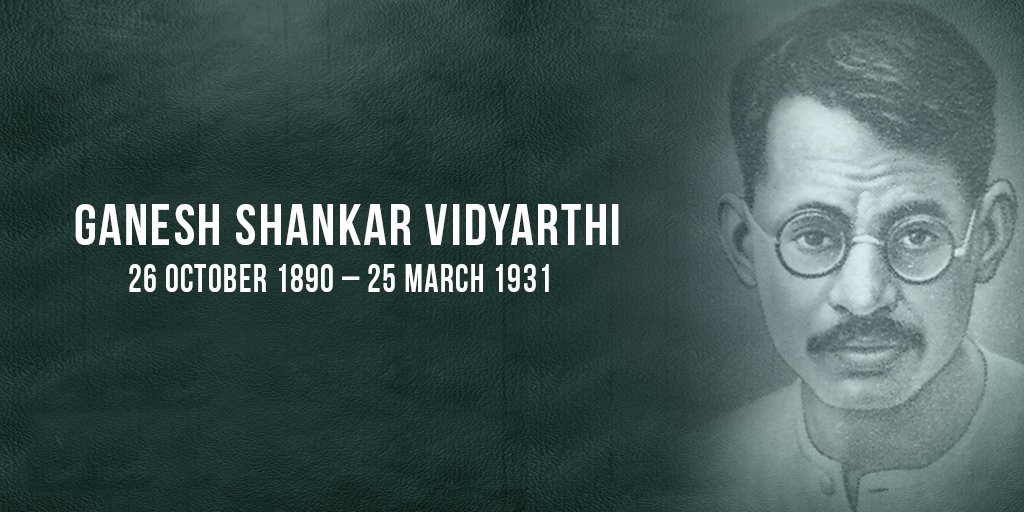
Ganesh Shankar Vidyarthi was fond of reading books from the very beginning, which is why his friends called him 'Vidyarthi'. Later, he began appending this pen name to his name. Vidyarthi Ji's early education took place at his father's school in Mungavali, where he was a teacher in the Anglo-Vernacular Middle School. Vidyarthi Ji had a good command of Urdu, Persian, and English. In 1904, he passed the English Middle examination from Bhalesa, where Hindi was introduced as a second language for the first time. Subsequently, his father sent Vidyarthi Ji to Kanpur to join his elder brother Shivvrat Narayan so that he could work alongside his studies. Arriving in Kanpur, Vidyarthi Ji took the entrance examination for Christ Church College, but since his brother was transferred to Mungavali, his further studies continued there once again. In the year 1907, Vidyarthi Ji went to Kayastha Pathshala for higher studies.
During his stay in Allahabad, Ganesh Shankar Vidyarthi Ji met Sundar Lal, the editor of the weekly *Karmayogin*, and during this period he also came into contact with the Urdu journal *Swarajya*. It is worth noting that due to its revolutionary ethos, eight editors of the journal *Swarajya* were sentenced, three of whom were given the sentence of Kalapani (transportation to the Andaman Islands). Sundar Lal was among the distinguished editors of that era. He had been expelled from college for inviting Lokmanya Tilak to Allahabad, and it was precisely for this reason that his studies were also disrupted. Coming into contact with Sundar Lal, Vidyarthi Ji began writing for *Swarajya* and *Karmayogin*. It was from here that his devotion to journalism and the revolutionary movement kept growing. From Allahabad, Ganesh Shankar 'Vidyarthi' came to Kanpur and made it his *karmasthali* (field of action).
In Kanpur, through the weekly *Pratap* starting in 1913, Vidyarthi Ji not only breathed new life into the revolution but made it such a newspaper that it became the symbol of faith and strength for all Hindi journalism. In the Pratap Press, gunpowder was kept underneath the compartments of composing letters, with the type metal letters placed above it. In place of block-making, various materials for making bombs were also kept. Yet during searches, the police could never lay their hands on these things. Vidyarthi Ji had to go to prison five times between 1921 and 1931, and this was usually due to some news report published in *Pratap*. Vidyarthi Ji always practiced fearless and unbiased journalism. He possessed neither wealth nor adequate resources, but he had an infinite energy that was channeled towards the attainment of independence. In the basement near the *Pratap* Press, a library was also established, housing all banned revolutionary literature and periodicals.

Alongside being a journalist, Vidyarthi Ji was also a revolutionary at heart. He was the first national leader who arranged legal representation for the accused in the Kakori conspiracy case and got the revolutionaries' hunger strike broken in jail. Vidyarthi Ji made an immense contribution to turning Kanpur into a hub of revolutionary activities. Revolutionaries like Sardar Bhagat Singh, Chandrashekhar Azad, Vijay Kumar Sinha, and Rajkumar Sinha kept drawing inspiration from Vidyarthi Ji. In fact, the very architecture of Pratap Press was such that one could stay hidden inside, and in the event of a search in the densely populated neighborhood, one could easily move from the roof of one house to another.
Suresh Chandra Bhattacharya, who had fled from the Banaras Conspiracy, was a sub-editor at the *Pratap* newspaper. Later, Bhattacharya and Pt. Ram Dulare Tripathi, who was also associated with the *Pratap* newspaper, were sentenced in the Kakori episode. Bhagat Singh worked for nearly two and a half years at the *Pratap* newspaper under the pseudonym Balwant Singh. First, Bhagat Singh traveled to Delhi to gather news regarding the riots in Daryaganj, Delhi, and upon returning, prepared a two-column news report for *Pratap* with the assistance of Sachin Da.
It was Ganesh Shankar Vidyarthi Ji who introduced Bhagat Singh to Chandrashekhar Azad in Kanpur; thereafter, numerous revolutionaries, including Shiv Verma, kept joining. It was Vidyarthi Ji who went and met in jail to secretly bring out the autobiography of the revolutionary Ram Prasad Bismil and had it published through *Pratap* Press. When the need arose, Vidyarthi Ji assisted Ram Prasad Bismil's mother and performed the *kanyadaan* of Roshan Singh's daughter. Not only this, Vidyarthi Ji also had the grave of Ashfaqulla Khan constructed.
It is appropriate here to recount the episode of Roshan Singh's daughter's marriage, as it further clarifies Vidyarthi Ji's character. This incident occurred when the revolutionary Roshan Singh was awarded the death penalty in the Kakori case. As soon as he was martyred, a mountain of troubles broke over his family. There was a young daughter at home, and a search for a groom was underway. With great difficulty, a match was finalized. Seeing the alliance fixed, the local Sub-Inspector threatened the groom's family, saying that marrying the daughter of a revolutionary would be considered treason and could be punished accordingly. However, the groom's side was not intimidated by the Sub-Inspector's threats and remarked, 'It will be our good fortune that the feet of a girl whose father laid down his head at the feet of Bharat Mata shall enter our home.' Seeing the firm resolve of the groom's side, the Sub-Inspector left, but kept making attempts to break this alliance by any means.
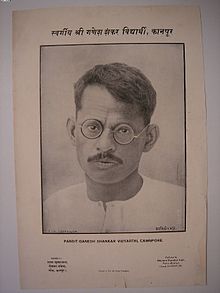 Ganesh Shankar Vidyarthi
When Ganesh Shankar Vidyarthi Ji came to know of this, he flew into a rage and immediately went to the Sub-Inspector, saying, 'Being a human, what kind of man are you if you do not even know humanity? People like you consider your life successful by doing evil deeds, but fail to realize that through these actions you have sown so many thorns for your future that even if you start uprooting them now, you will not be able to clear them till your end. If you cannot give anything to someone, at least do not try to snatch from them.' His sharp words opened the Sub-Inspector's eyes, and he not only apologized to the girl's mother but also agreed to bear the entire cost of the wedding himself. The preparations for the wedding commenced. At the time of *kanyadaan*, when the question of the bride's father arose, that editor stood up and said, 'In the absence of Roshan Singh, I am the father of the bride. I shall perform the *kanyadaan*.' And he did so despite intense opposition from Congress leaders.
Ganesh Shankar Vidyarthi died on 25 March 1931 during the Hindu-Muslim riots in Kanpur while saving helpless victims, when religious fanatic Muslim thugs pounced on him like wild wolves while he was trying to save some Hindus, and laid Ganesh to rest in the lap of the earth. Three days later, his corpse was found lying on the road, so bloated that it was beyond recognition. In the Moolganj area of Kanpur where he was murdered, there is no trace of him today, because in this country, monuments can only be built in the name of people from the Nehru-Gandhi dynasty. Yes, in his memory, Kanpur's medical college was named Ganesh Shankar Vidyarthi Medical College, which the students there and other people call GSVM College, and hardly anyone knows even a bit about Vidyarthi Ji.
In his memory, the Ganesh Shankar Vidyarthi Award is conferred by the Kendriya Hindi Sansthan, Agra, to those who make notable contributions and outstanding work in the field of Hindi journalism and creative literature, which is presented by the President of India himself. Among others, this award has been conferred upon eminent literateurs such as Shri Dharmavir Bharati, Ratanlal Joshi, Kanhaiyalal Mishra 'Prabhakar', Asharani Vhora, Alok Mehta, and others. Hundreds of obeisances and humble tributes to him.
- Vishal Agarwal (The author is a keen scholar of Indian history and culture, an educationist, and a voice for national interests. The author's Rastra Aradhaka series on great Indian personalities is worth reading.)
Read this also,
Cite this article
विशाल अग्रवाल. “Journalist Ganesh Shankar Vidyarthi Inspired Bhagat and Azad”. YugSamvad, 23 October 2026. https://yugsamvad.com/en/articles/ganesha-shankara-vidyaarthee-vaha-patrakaara-jo-bhagata-aura-aazaada
https://yugsamvad.com/en/articles/ganesha-shankara-vidyaarthee-vaha-patrakaara-jo-bhagata-aura-aazaada · accessed
Related reading
"The City of God" - Augustine's Attack on the Pagans
"The City of God" in A.D. 410 was a significant moment in Western history, when the Vandals, under the leadership of their king, Alaric, captured the city of Rome. Rome was known as the Eternal City because the Romans thought that it would truly never fall, and the year 410 shook this belief to its foundation
10 September 2026 · 6 min read