YugSamvad · Politics & History
Politics & HistoryGokula Jat – A Forgotten Hero of Indian History
विशाल अग्रवाल · English edition 23 October 2026 · Hindi original 6 January 2019 · 17 min read
India has made a significant contribution to the creation and development of the world's civilizations and cultures. Being among the oldest countries, this land has been a sanctuary for many of the world's nomadic tribes, clans, and caravans. Greeks, Iranians, Shakas, Hunas, Pathans, and Mughals infiltrated India from time to time, but they all either soon assimilated into the public life here or were defeated and fled.
At the beginning of the 16th century, the Mughal Babur also came to India as a foreign invader and plunderer. Driven by religious frenzy and the spirit of jihad (holy war), he plundered parts of this country, but he could not disrupt the core of public life here.
If we analyze just a few major events from the period of Babur to Aurangzeb (1526–1707 CE), it will become readily apparent that the prominent Hindu society of that time fiercely resisted and struggled against them. This struggle was on both political and cultural planes, and for this reason, the Mughal invaders could neither turn this country from Dar al-Harb (land of war) into Dar al-Islam (land of Islam) nor destroy its cultural life.
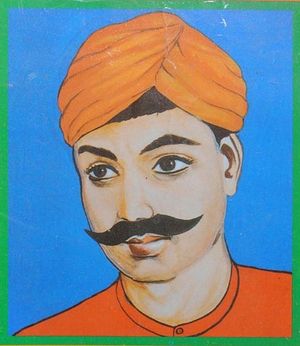
The greatest struggle and resistance of the Hindus occurred during the reign of the bigoted and cruel tyrant Aurangzeb. This resistance took place in both North and South India. Among the heroes of this struggle and resistance for Hindu asmita (identity) against foreign invaders is the brave Gokul Singh (popularly known as Gokula Jat), who, through his organizational ability, courage, and indomitable valor, shook the very foundations of a cruel ruler like Aurangzeb, and whose balidan diwas (martyrdom day) was on January 1.
It is believed that he was born in Sinsini and was an ancestor of the historically famous Maharaja Surajmal, who took the Jat empire to new heights. His father's name was Madu, who had four sons—Sindhuraj, Ola, Jhaman, and Saman. This second son of Madu, Ola, later came to be known as Gokul Singh alias Gokula Jat, a symbol of Hindu resistance.
Around 1650–51, Madu and his uncle Singha fought a fierce struggle against the Rajput King Jai Singh, who was aided by the Mughal regime, in which Madu's eldest son Sindhuraj died, and after this, Singha, along with other Jat families, moved across the Yamuna towards a fort named Girsa. The responsibility of managing Madu's legacy fell upon Gokula Jat, and he too came to this fort along with Singha.
In the decade of 1660–70, he came to be regarded as an influential zamindar (landlord) of the area called Tilpat. The truth is that Gokul Singh was the leader of the entire Hindu population of Mathura, Vrindavan, Govardhan, Hindaun, and Mahavan, and the garhi (mud fort) of Tilpat was his center.
It was the year 1666, when the Hindu populace was crying out in agony under the atrocities of the Islamic monster Aurangzeb. Temples were being demolished, and Hindu women were being violated, defiled, and forcibly converted to Islam. Aurangzeb and his soldiers were advancing like mad elephants, crushing the Hindu populace. Hindus were persecuted solely because they were Hindus. By appointing equally cruel men to high positions in his army, Aurangzeb was rapidly advancing towards his dream of converting Hindustan from Dar al-Harb to Dar al-Islam.
The Rajput servants of the Mughal Empire were also growing internally dissatisfied, but as Dalpat Singh, the author of "Dalpat Vilas", clearly states, the Rajput leaders did not dare to rebel against the Mughal rule. In such a scenario, the credit for taking up the mantle of rebellion against the intolerant religious policy goes to some Jat leaders and zamindars of Uttar Pradesh. During the war of succession in the final years of Shah Jahan, the brave Jat leader Nandram refused to pay land revenue in protest against the exploitative religious policy and raised the banner of revolt.
After him, his place was taken by Uday Singh and Gokula Jat. Today, if anyone deserves credit for protecting the temples of Mathura and Vrindavan and Indian culture, and for turning the tide against the contemporary exploitation, tyranny, and state high-handedness, it is solely and exclusively 'Gokul Singh'.
History is witness that as a result of the bigoted policy of the Muslims, the sacred land of Mathura has always faced special assaults, because being situated on the highway from Delhi to Agra, Mathura always attracted special attention. To suppress the Hindus there, Aurangzeb appointed a fanatical Muslim named Abdun Nabi as the faujdar (military commander) of Mathura. At the beginning of 1678, a contingent of Abdun Nabi's soldiers set out to collect land revenue across the Mathura district.
Abdun Nabi had established a new cantonment near Gokula Jat's territory the previous year, and this was the headquarters for all operations. When the farmers, at the call of Sardar Gokula Jat, refused to pay land revenue, the Mughal soldiers began plundering and even seizing the farmers' cattle, and ultimately, a clash ensued. At this very time, Aurangzeb's devilish Mughal farman (imperial decree) arrived—"Let the temples of the kafirs (infidels) be demolished." Consequently, several ancient temples and monasteries of the Braj region were destroyed.
The treasures of the Kushan and Gupta eras, invaluable heritages of history, were devastated. Throughout the entire Brajmandal, Mughal cavalry and vultures and eagles were seen flying, along with clouds of smoke and leaping flames—with imperial horsemen emerging from them. Abdun Nabi and his soldiers used to roam the city in Hindu attire and, finding an opportunity, would abduct women and flee. The height of tyranny had now been reached.
It was then, right under the nose of the Delhi throne, that the righteous warrior of battle, Gokula Jat, and his peasant army made the tyrannical Aurangzeb realize the power of Hindutva (Hindu essence). In May 1669, Abdun Nabi attacked Sihora village, and the brave Gokula was in the village at that time. A fierce battle ensued, but the Islamic demon Abdun Nabi and his army could not stand before the brave Jats of Sihora and were all cut down like carrots and radishes.
The screams of the tyrant Abdun Nabi were heard even by the tyrannical Sultanate of Delhi, and the smoke from the burning Mughal cantonment shook Aurangzeb to his core. And why wouldn't it be visible? After all, even the trace of the cantonment of the empire's Wazir (minister) Sadullah Khan (from Shah Jahan's era) had been erased. Not only in Mathura, but even in Agra district, the symbols of the imperial flag were razed to the ground.
Aurangzeb too was terrified because Gokula Jat's army included Gurjars, Ahirs, Thakurs, Meos, etc., alongside the Jats. Meanwhile, life was infused into the despondent and near-dead Hindus, as they saw that the venomous fangs of the invincible Mughal power could be broken. They saw the guardian of their future hopes—a restorer, Gokul Singh.
Aurangzeb appointed Saif Shikan Khan as the new faujdar of Mathura and sent Radandaz Khan with him to face Gokul. After this, fierce battles raged for five months, but all the preparations of the Mughals and their chosen generals proved ineffective and unsuccessful. A terror of Gokula Jat's valor and military leadership settled over everyone, soldiers and generals alike.
Finally, utterly despondent, Aurangzeb sent a peace proposal to the great warrior Gokula down through Saif Shikan Khan, stating that if he returned the booty he had collected, he would be pardoned. Assurances of future good conduct were also demanded, but Gokula Jat rejected Aurangzeb's proposal because they were fighting not for power or jagirdari (fiefdom) but for the protection of dharma (righteousness), and this task would be impossible after making peace with Aurangzeb.
Gokula Jat asked, "What is my crime that I should beg the Emperor for forgiveness? Your Emperor should beg me for forgiveness, because he has insulted and harmed my dharma without cause. Secondly, who in this world trusts his pardon and entreaties?" Further talk of peace was futile, as Gokula Jat had left no room for it.
Now Aurangzeb himself set out with a large army, cannons, and gunners to deal with this unprecedented adversary, leaving Delhi and reaching Mathura on November 28, 1669. Aurangzeb established his camp here and sent his general Hasan Ali Khan to Mursan with a strong and massive army. Many of Gokula Jat's soldiers and commanders, who were not salaried but people inspired by the spirit of revolution, had gone to the neighboring Agra district for the sowing of the rabi (winter crop).
In this situation, Hasan Ali Khan launched a sudden dawn attack on three garhis/villages of Gokula Jat's army—Rewara, Chandrakh, and Sarkaru. Before the imperial cannons of Aurangzeb, these small mud forts could not prove very useful and fell very quickly. The peasant warriors too could not hold out for long with their modest weapons, and the Jats were defeated. Encouraged by this victory, Aurangzeb now decided to clash directly with Gokula.
Pleased with Hasan Ali Khan's successes, he made him the faujdar of Mathura in place of Saif Shikan Khan, and also summoned Amanullah Khan from Agra pargana (administrative unit), Namdar Khan the faujdar of Moradabad, and Hoshiyar Khan the faujdar of Agra city to assist him. This massive army began to advance, surrounding Gokula Jat from all sides.
This campaign against Gokul Singh was on a scale far grander than the invasions launched against major states and their kings. This brave heart possessed neither grand forts, nor the Aravalli hills, nor a diverse geographical terrain like Maharashtra. Despite these disadvantageous conditions, the patience and battle-craft with which he confronted the central power of a mighty empire and achieved equal results is entirely unprecedented.
This campaign of Aurangzeb against the brave Gokula was even grander than the campaigns launched against great kings like Shivaji. In the last week of December 1669, Gokul Singh confronted the imperial armies 20 miles away from Tilpat. A fierce battle of Tilpat broke out between Aurangzeb's massive army equipped with cannons, archers, and elephants, and Gokula's peasant army of 20,000.
The fierce battle raged for 4 days, and Gokul's small unpaid army, relying solely on their crude and domestic weapons, was proving heavy upon the highly trained Mughal army equipped with state-of-the-art weapons. In this fight, not only the men but also their chaudhuranis (wives of village headmen) displayed great valor. The battle went on from morning to evening but no decision could be reached. The next day, the fierce clash broke out again. The Jats were fighting with supernatural valor.
Despite having artillery and armored cavalry, the Mughal army could not achieve victory over Gokula Jat. There have been few battles in the history of India where a side so disadvantaged and weak in many ways fought with such calm determination and unwavering patience. The Battle of Haldighati was decided in just a few hours, all three battles of Panipat ended in a single day, but the battle of the brave Gokula Jat continued even on the third day.
The European historian Manucci, mentioning the valor of the Jats and their chaudhuranis, wrote: "For their defense, the villagers would hide in thorny bushes or take refuge in their weak mud forts; the women, holding spears and arrows, would stand behind their husbands. When the husband had fired his gun, the wife would hand him a spear and begin reloading the gun herself.
In this manner, they defended themselves until they were absolutely unable to continue the fight. When they became completely helpless, they would cut the throats of their wives and daughters and then fall upon the enemy lines like hungry lions, and by virtue of their fearless valor, they succeeded in winning battles many times."
Despite such state-of-the-art weapons, artillery, and a massive trained force, the Mughal army was failing to overcome the Jats. After 4 days of battle, when Gokul's army seemed to be winning, a new massive Mughal contingent arrived under the leadership of Hasan Ali Khan, and with the arrival of this contingent, Gokula Jat's army began to lose.
The walls of the Tilpat mud fort also could not withstand the blows of the imperial cannons any longer and came crumbling down. Seeing their army losing the battle, the Jat women, sisters, and young girls also began to give up their lives. Thousands of women were reduced to ashes in the sacred fire of jauhar (self-immolation). After the fall of Tilpat, Gokula Jat and his uncle Uday Singh, along with 7,000 companions, were taken prisoner. They were all brought to Agra.
When all the prisoners in iron chains were presented before Aurangzeb, Aurangzeb said, "If you want your lives spared, accept Islam and walk on the path shown by the Prophet. Tell me, what is your intention—Islam or death?" The majority of the righteous Jats said in one voice, "Emperor, if the path of your God and Prophet is the one you are walking on, then we do not wish to walk on your path."
The next day, that is, on January 1, 1670, Gokula Jat and Uday Singh were brought to the Agra Kotwali (police station)—their hands bound in the same way, their bodies shackled in iron from neck to foot. When the executioner's spear struck Gokul's powerful arm, thousands of shrieks shook the sky with clamor. Severed by the spear, falling and quivering on the platform, Gokula Jat's arm cried out, testifying to the boundless purushartha (human effort) and strength contained within it.
While the people trembled at this inhumanity, Gokula Jat's fearless and radiant face made them realize the power of Hindutva. Gokula Jat cast a glance at his armless, blood-soaked shoulder and then looked at the executioner with great pride, signaling him to strike the second blow. As the second spear struck, the crowd standing there wailed in agony, and then every single joint of Gokula Jat's body was hacked. Many closed their eyes, many fled weeping.
Around the Kotwali, it was as if doomsday had arrived. No one was conscious of the other. Here in Agra, Gokul Singh's head fell; there in Mathura, the temple of Keshavrai Ji. The same was done to Uday Singh and the rest of the prisoners. This Kotwali has now become the post office of Johri Bazar.
Gokula Jat did not become a martyr only for the Jats, nor had anyone snatched away his kingdom, nor had his pension been stopped; rather, the unprecedentedly powerful Mughal authority had begged and pleaded before him with the desire to make peace. But it is shameful that we could not give any honor to such an incomparable hero.
The truth is that most Hindus do not even know who Gokula Jat was, who sacrificed his all to save their ancestors from the cruel rule of the Mughals. However, it is a matter of good fortune that the brilliant and high-minded poet of Rajasthan, Shri Balveer Singh 'Karun', has revived this neglected chapter of the seventeenth century by composing the prabandha kavya (epic poem) titled 'Samarveer Gokula'. 'Samarveer Gokula' is the national epic poem of the seventeenth-century peasant revolution.
The poet writes in the introduction: 'Apart from Maharana Pratap, Maharana Raj Singh, Chhatrapati Shivaji, Hasan Khan Mewati, Guru Gobind Singh, Mahaveer Gokula, and the Jat rulers of Bharatpur, not many more names can be counted who openly challenged the Mughal power. The name of the brave Gokula Jat should be taken prominently because he roared right under the nose of Delhi and raised an army of 20,000 peasant soldiers who were unpaid, untrained, and equipped with domestic weapons. They had come not for territorial expansion but to lay down their lives for the defense of the nation.'
This epic poem of eight sargas (cantos) is an important contribution of the first decade of the twenty-first century. The poet has felt the pain of the neglect of the struggle of Gokul, born in a peasant family of Mathura. That pain has attempted to offer a poetic tribute to the neglected hero in the national context. Recall the compassion of the Adi Kavi (first poet), and then the significance of the inspiration behind the pain of the poet 'Karun' will become clear. Therefore, in the first canto, the poet has presented Gokul's peasant personality before the Mughal Emperor.
In the second canto, the poet has depicted the adverse conditions of the era and Indian optimism in historical and natural contexts through his poetic art. The third canto is a gallery of Gokula Jat's peasant life—in imagery and pictures, while the description of anger, outrage, and rebellion resulting from direct tyranny is done in the fourth canto. In the next three cantos, the poet has given an authentic description of the freedom struggle of Gokula Jat and his peasant revolutionary army.
From a national perspective, the description of the oppressive nature of the Mughal regime, the outrage of the peasants, and the valor of the collective struggle are the hallmarks of this war. In the fifth and sixth cantos, the poet has brought to life the fierce struggles of Sadabad and Tilpat in his familiar descriptive style with image-rich craftsmanship. The seventh canto is the proof. The eighth canto—the final canto—is the climax of the epic poem.
As a prelude to the death sentence pronounced due to the freedom struggle, the poet has narrated the discourse on nature, the mystical consciousness of nature, and the immortality of the soul according to Indian thought. The poet says—
तुम तो एक जन्म लेकर बस
एक बार मरते हो
और कयामत तक कर्ब्रों में
इन्तजार करते हो
लेकिन हम तो सदा अमर हैं
आत्मा नहीं मरेगी
केवल अपने देह-वसन ये
बार-बार बदलेगी
(You take birth but once / And die only once, / And wait in your graves / Until the Day of Judgment. / But we are forever immortal, / The soul shall never die; / It will only change these bodily garments / Time and time again.)
Therefore, Gokula Jat will not abandon his dharma. Rather, he wishes to become immortal by accepting punishment. Though Gokula was defeated, his blood was not shed in vain. He watered the new seeds of freedom in the hearts of the Jats, and also sent a message to the entire country that the Mughal army, deemed invincible, was not invincible.
This sentiment laid the foundation for future resistance, after which the Satnamis embraced martyrdom, Shivaji's struggle succeeded in 1674, Guru Tegh Bahadur made the ultimate sacrifice for Kashmir in 1675, and later Maharaja Surajmal of Bharatpur unfurled the banner of freedom. Perhaps August 15, 1947, was the culmination of this very chain of struggles. History must not be allowed to forget this chain of struggles, and Balveer Singh 'Karun's' epic poem proves its relevance right here.
Once again, the time has come for us to protect our country, dharma, and self-respect by showing valor like our ancestor, the brave Gokula Jat. A society that waits for a miracle is wiped out, because God also helps only those who step forward to confront tyranny themselves. Now the time has come for us to forget impractical ahimsa (non-violence) and eradicate the extreme tolerance that has rendered us impotent.
With these lines, millions of salutations and humble tributes to the great warrior Gokula Jat:
यह गाल पिटे वह गाल बढ़ाओ, यह तो आर्यों की नीति नही,
अन्यायी से भी प्रेम अहिंसा, यह कब गीता की नीति रही।
हे राम बचाओ जो कहता, वह कायर है, अपना हत्यारा है,
जो करे वीरता और अति साहस, बस वही राम का प्यारा है।
(To turn the other cheek when one is struck is not the policy of the Aryas,
When has love and non-violence toward the oppressor ever been the policy of the Gita?
He who cries "O Ram, save me!" is a coward, his own killer,
Only he who displays valor and extreme courage is beloved to Ram.)
– Vishal Agarwal (The author is a deep connoisseur of Indian history and culture, an educationist, and raises his voice for national interests. The author's Rashtra Aradhaka series on great Indian personalities is a must-read.)
Hemchandra Vikramaditya – The Last Hindu Emperor
Peshwa Bajirao, the Greatest Hindu General of the Last Millennium
Cite this article
विशाल अग्रवाल. “Gokula Jat – A Forgotten Hero of Indian History”. YugSamvad, 23 October 2026. https://yugsamvad.com/en/articles/gokulaa-jaata-bhaarateeya-itihaasa-ke-eka-bhoole-hue-naayaka
https://yugsamvad.com/en/articles/gokulaa-jaata-bhaarateeya-itihaasa-ke-eka-bhoole-hue-naayaka · accessed
Related reading
Suicidal Flaws in Countering Sarvadharmasamabhava
Over the past 90 years, the rise of the politics of Muslim appeasement has caused immense damage to Indian culture. By equating 'Ali, Maula, Allah' with Ishvara (the Supreme Godhead), pseudo-secularism has paralyzed our core spiritual and cultural consciousness. Even from a definitional perspective, 'religion' and 'mazhab' (confessional faith) are distinct from dharma (righteous duty and cosmic order)—
18 October 2026 · 8 min read

"The City of God" - Augustine's Attack on the Pagans
"The City of God" in A.D. 410 was a significant moment in Western history, when the Vandals, under the leadership of their king, Alaric, captured the city of Rome. Rome was known as the Eternal City because the Romans thought that it would truly never fall, and the year 410 shook this belief to its foundation
10 September 2026 · 6 min read