YugSamvad · Politics & History
Politics & HistoryHemchandra Vikramaditya - The Last Hindu Emperor
विशाल अग्रवाल · English edition 23 October 2026 · Hindi original 8 October 2017 · 10 min read
Your history textbooks must have told you that after Humayun, Sher Shah Suri seized the throne of Delhi. In these very books, you must have also read that Humayun handed over the empire for a single day to a boatman or *bhishti* (water-bearer) who minted leather coins. In those same books, you might have read that Prithviraj Chauhan was the last Hindu king to sit upon the throne of Delhi. But not a single history book has properly told you that between Sher Shah Suri and Akbar, a Hindu emperor ascended the throne of Delhi, having his *rajyabhisheka* (consecration rite) solemnized in full accordance with Vedic rituals, uprooting 350 years of Islamic rule. These books will not have told you that after ascending the throne of Delhi, this last Hindu emperor of medieval India assumed the title of "Vikramaditya", minted coins in his own name, and decreed capital punishment for the slaughter of cows. Nor will they have told you that this valorous ruler led 24 battles in his lifetime and emerged victorious in 22.
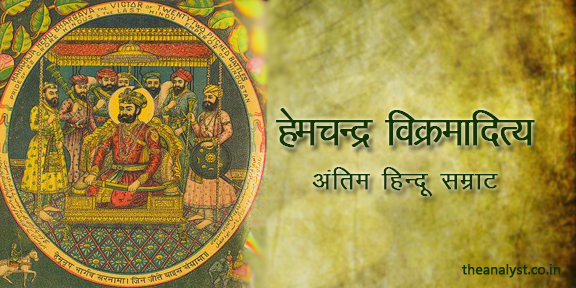
Evidently, when neither history books told us about this emperor nor our history teachers taught us, how could we know anything at all? A son born in a destitute household rose through his merit and dedication to attain the offices of supreme commander and then Prime Minister of the Suri Sultanate by 1553. When the Mughal emperor Humayun died in 1555 CE, he was in Bengal; marching out from there with an army with the resolute aim of expelling the Mughals from the soil of Bharat, he ground the Mughals into the dust and ascended the throne of Delhi on 7 October 1556. After hundreds of years, the Purana Qila of Delhi witnessed the *rajyabhisheka* of a Hindu emperor conducted in accordance with complete Vedic rites, and following his consecration, Hemu assumed the title of 'Hemchandra Vikramaditya' after the unvanquished Emperor Vikramaditya.
Hemu was born in 1501 in a village named Machheri in the Alwar district of Rajasthan, to Rai Puran Das. His father performed *paurohitya* (hereditary priesthood), but later, owing to the harassment of priests by the Mughals, relocated to Rewari (Haryana) and entered the salt trade. The education of 'Hemu' (Hemchandra) began in Rewari. Along with Sanskrit, Hindi, Persian, Arabic, and mathematics, he mastered horsemanship. Over time, Hemu began contributing to his father's new enterprise. From a very young age, Hemu joined his father in the trade of supplying grain and potassium nitrate (for gunpowder) to Sher Shah Suri’s army. In 1540, Sher Shah Suri defeated Humayun and forced him to flee to Kabul. At that very time, Hemu laid the foundation in Rewari for manufacturing various kinds of metal weapons, an industry that endures there to this day in the crafting of brass, copper, and steel utensils.
By the time Sher Shah Suri died in 1545, Hemu had expanded his influence considerably. This was why, when Sher Shah Suri's son Islam Shah ascended the Delhi throne after his father's death, recognizing Hemu's competence, he appointed him *shahangah-i-bazaar*, that is, 'Superintendent of the Market' in Delhi. Sometime later, alongside Market Superintendent, Hemu was also appointed Chief Officer of Internal Security, and his post was accorded status equivalent to that of a *wazir* (chief minister).
In 1553, a momentous ascending turning point arrived in Hemu's life. Following the death of Islam Shah, Adil Shah sat upon the throne of Delhi. Adil Shah was an utterly debauched, drunken, and dissolute ruler. To quell the swelling rebellions against him and secure revenue collection, he desperately needed a trusted counselor and capable administrator like Hemu.

At the Gwalior fort, he not only appointed Hemu his prime minister but also made him supreme commander of the Afghan army. The entire administration of the state now fell into Hemu's hands, and in practice, he became the undisputed master of the realm. Taking the reins of power into his hands, Hemu ruthlessly crushed the rebel Afghan chieftains who refused to pay taxes. He vanquished formidable rebels like Ibrahim Khan, Sultan Muhammad Khan, Taj Karrani, and Rukh Khan Nurani in battle, putting them to death one by one. In the Battle of Chhapparghatta, Hemu slew Muhammad Shah, the Subahdar of Bengal, seized the vast territory of Bengal, and appointed his own governor, Shahbaz Khan. Meanwhile, Adil Shah’s mental balance deteriorated, and Hemu came to be regarded as the de facto Badshah. He commanded immense loyalty from both Hindu and Afghan commanders alike. While Hemu was occupied in crushing the rebellion in Bengal, Humayun took advantage of his absence in July 1555 to re-establish his control over Punjab, Delhi, and Agra.
Barely six months later, Humayun died and his minor son Akbar succeeded him. Hemu saw this as a propitious moment to crush the Mughals and establish his undisputed rule over Delhi. Leading a massive army from Bengal, sweeping across present-day Bihar, eastern Uttar Pradesh, and Madhya Pradesh, he advanced toward Delhi. Before his martial brilliance, Mughal commanders were thrown into headlong flight. The Mughal commander of Agra province, Iskandar Khan Uzbek, fled Agra without even putting up a fight. Hemu seized the provinces of Etawah, Kalpi, and Bayana with effortless ease, establishing his control over the central and western parts of present-day Uttar Pradesh. Now it was Delhi's turn. On 6 October 1556 near Tughlaqabad, in a battle that lasted just a single day, Hemu routed Akbar’s forces and conquered Delhi. At the Purana Qila, facing Pragati Maidan, amidst Afghan and Rajput commanders, his *rajyabhisheka* was solemnized in full accordance with religious rites.
Liberating Bharat from the shackles of foreign servitude that had bound it for centuries, he assumed the title of Hemchandra Vikramaditya and established a Hindu Raj in North India on the model of the Vijayanagara Empire founded in South India. On this occasion, Hemu struck coins bearing his portrait, carried out an effective reorganization of the military, and appointed Hindu officials without removing a single Afghan military commander. By virtue of his skill, valor, and prowess, Hemu now stood at the absolute zenith of sovereign authority under the name of Hemchandra Vikramaditya. According to Abul Fazl, following the conquest of Delhi, Hemu was planning an invasion of Kabul.
Meanwhile, Akbar, terrified by Hemu's waxing power, was preparing to retreat to Kabul on the counsel of his generals, when his guardian Bairam Khan insisted on taking one more chance. War preparations were underway in full fury on both sides. Hemu marched from Delhi to Panipat with a vast host. On 5 November 1556, the two armies confronted each other on the plains of Panipat. Out of fear and concern for their safety, Akbar and Bairam Khan did not participate in the battle themselves, remaining at a camp in the village of Saudhapur, some 8 to 10 miles away from the battlefield; Hemu, however, commanded his army in person. With initial successes in the fierce fighting, it seemed the Mughal army would soon flee the field, but by a tragic stroke of misfortune, an arrow suddenly struck Hemu in the eye as he sat atop his elephant. Tearing the arrow out, Hemu continued to fight, but overcome by the wound, he lost consciousness. Hemchandra Vikramaditya was murdered in Akbar's presence by Bairam Khan and Ali Quli Khan (later the husband of Nur Jahan). Hemu's severed head was sent to Kabul in Afghanistan, where it was suspended outside a fortress, while his torso was hung outside the Purana Qila of Delhi, where his coronation had taken place. Thus came to an end the glorious journey of an extraordinary personality, an Emperor of Bharat.
Bairam Khan dispatched an armed contingent to Hemchandra's eighty-year-old father. He was given the choice to embrace Islam or face execution. The aged father replied with pride, "I will not abandon the Devas whom I have worshipped for eighty years merely for the greed of living a few years longer." With that answer, he was butchered on the spot.
Upon reaching Delhi, Akbar ordered a *qatl-e-aam* (general massacre) to terrorize the populace so that they would never dare rebel again. Minarets of severed heads were erected. A painting depicting this event remains preserved in the Panipat War Museum as a monument to the plight of the Hindus; yet it is a matter of profound shame for Hindu society that there is no memorial to Hindu Emperor Hemchandra Vikramaditya anywhere, neither in India’s capital Delhi nor in Haryana. What could be more disgraceful than the fact that the film *Jodhaa Akbar* portrayed Akbar as great and Emperor Hemchandra as a villain?
Had the glorious Emperor Hemu not been deceitfully slain in the Second Battle of Panipat, the history of Bharat today would have been entirely different. But such is our misfortune: we neither know anything of our history nor possess any interest in learning about it, which is why any Irfan Habib, Bipan Chandra, or Romila Thapar can teach us whatever they please, and a Bhansali dares to violate our historical figures.
They can dare to do so because the *haveli* (traditional mansion) of that emperor, situated in the Qutubpur locality of Rewari, is reduced today to housing goats and chickens, while we lavish coats of paint every year on the tombs, bathhouses, and harems of Mughals and invaders.
October 7 is the ascension day of Hemchandra Vikramaditya. To expiate the sin of consigning him to oblivion—since our duplicitous historians are never going to accord Hemu his rightful place—it is vital that you read about the last Hindu emperor 'Hemchandra Vikramaditya' yourself, teach your children about him, grab historians by the scruff of their necks and interrogate them over their neglect of Hemu, and if possible, visit Hemu's *haveli* to pay him homage. Otherwise, Maa Padmini will not be the last in the list of those desecrated by the Bhansalis and Habibs; tomorrow they will turn even Hemu into a slave of the Mughal court and peddle him in their cinematic marketplace.
– विशाल अग्रवाल (The author is an educationist and a profound scholar of Indian history and culture. The author's राष्ट्र आराधक series on great Indian personalities is well worth reading.)
Also read,
Peshwa Bajirao: The Greatest Hindu General of the Last Millennium
The One Who Made the Sangh Nationwide: Former Sarsanghchalak Balasaheb Deoras
Gokula Jat – A Forgotten Hero of Indian History
Swami Vivekananda – Through Whom the World Recognizes Bharat
Cite this article
विशाल अग्रवाल. “Hemchandra Vikramaditya - The Last Hindu Emperor”. YugSamvad, 23 October 2026. https://yugsamvad.com/en/articles/hemachandra-vikramaaditya-antima-hindoo-samraata
https://yugsamvad.com/en/articles/hemachandra-vikramaaditya-antima-hindoo-samraata · accessed
Related reading

Be It Kanyadaan or Vardaan: What Is Wrong with It?
Is *kanyadan* (the ritual offering of the bride) merely charity? Why is *kanyadan* performed, and is it an insult to women? Understand the true meaning of *kanyadan* in the Hindu *vivaha sanskara* (marriage sacrament), along with its cultural and Vedic significance. Read the authentic exposition of *vardan* (boon) versus *kanyadan*, the mystery of *Brahma vivaha* (the Brahma form of marriage), and a definitive response to the fallacies that seek to misrepresent Hindu traditions.
18 October 2026 · 5 min read
"The City of God" - Augustine's Attack on the Pagans
"The City of God" in A.D. 410 was a significant moment in Western history, when the Vandals, under the leadership of their king, Alaric, captured the city of Rome. Rome was known as the Eternal City because the Romans thought that it would truly never fall, and the year 410 shook this belief to its foundation
10 September 2026 · 6 min read