YugSamvad · Sanskrit & Shastra
Sanskrit & ShastraWhen a communist said, "Let the people taste blood!"
Shivpujan Tripathi · English edition 23 October 2026 · Hindi original 16 September 2019 · 5 min read
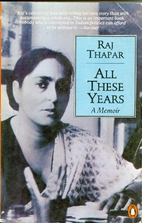
Recently, I read Raj Thapar's book All these years. Compiled from her diaries after her demise, this memoir of Raj Thapar (1926–1987) was published in 1991. The book contains a total of 24 chapters, with the final chapter left incomplete owing to Raj Thapar's untimely death from cancer. Raj and her husband Romesh Thapar remained active at the highest echelons of the Communist Party for several years. Initially based in Mumbai, they brought out the leftist journal Crossroads, but after becoming disillusioned with the Left, they founded the journal Seminar in 1959, which Raj affectionately called her third child. Yet, Marxist dogma and the leftist prejudices fostered by its activism were realities from which the Thapar couple remained unfree till the very end. The book contains fascinating accounts concerning numerous prominent communists and other figures such as P.C. Joshi, B.T. Ranadive, Dange, Ajoy Ghosh, Litto Ghosh, Mohan Kumaramangalam, Romesh Chandra, Perin Romesh Chandra, Mulk Raj Anand, Sajjad Zaheer, Rajani Palme Dutt, P.N. Haksar, Fidel Castro, Inder Gujral, Rafiq Zakaria, Krishna Menon, Nehru, Indira Gandhi, Sanjay Gandhi, D.D. Kosambi, and others. The first 9 chapters of the book deal primarily with communists, as the Thapars were committed communists during that period. In this post, I shall touch upon only those episodes relating to these communists.
Raj Thapar observes that barring P.C. Joshi and R.P. Dutt, all of them were mediocre men of utterly ordinary intellect. Their contributions to the nation were hardly ever positive. Most were consumed by petty vices—jealousy, greed, falsehood, and deceit. All of them kept concocting blueprints of socio-economic exploitation, revolutionary situations, and class struggle solely in their imagination. In this same delusion, the Communist Party of India in 1943 lent vigorous theoretical and practical support to the Muslim League's demand for Pakistan. Raj Thapar was 19 years old at the time and found the pro-Pakistan stance of the communist leaders incomprehensible. She knew enough then to understand that Marxism is opposed to religion. Why, then, were all these Marxists so enthusiastic about the partition of India on explicitly religious lines? Raj found it bizarre and utterly wrong. At the time, Mohan Kumaramangalam was regarded as a formidable intellectual and dedicated communist. While arguing with him on this issue, Raj often felt like hurling everything within reach straight at him.
Regarding Dange, it is recounted that one day he visited their home while the Thapars were living in London. The partition of the country was settled by then, and riots had erupted in Punjab and elsewhere. Raj expressed her anguish to him. At that, the renowned communist leader said: "Don't worry, Raj. Let our people taste blood; let them learn how blood is shed. It will bring the revolution closer."
Similarly, under Ranadive's leadership, the Communist Party drew up a plan to seize power across India on 22 February 1949. Communist leaders and intellectuals were unanimous in their conviction that the masses of the country were yearning for a socialist revolution. The people, they believed, were merely waiting for a single call to cast off the yoke of the country's exploitative bourgeois regime and its foreign masters—though who these 'masses' actually were, Raj notes, not a single communist had the faintest idea. Based on this very assessment, Ranadive's leadership resolved to seize power in the country by mimicking the 1917 Bolshevik coup in Russia. Romesh Thapar too was instructed to wake up in the morning and position himself at the very top of the Hanging Gardens opposite their residence. Party leaders assigned him the task of rushing to capture the radio station the moment he spotted the secret signal. Raj Thapar offers a delightful account of this episode in her book. How utterly ludicrous it all was, how childish the entire fantasy! It illustrates just how divorced the communist leadership was from reality.
In short, it requires little effort to understand that the anti-India, anti-social disposition of communist politics and Marxist intellectualism remains as catastrophic in its consequences today as it ever was. Even today, they cling to their superstitious and dogmatic fantasies as unalterable gospel truth, just as the preceding generation did. And indeed, just as our national leaders, intellectuals, and educated classes remained oblivious then to the harm it wrought, more or less the same state of affairs prevails today.
– Shivpujan Tripathi, The author is a scholar and deep connoisseur of Indian history and culture
Read also,
Superstitions of Communist Ideology
Why Can a Muslim Never Be a Leftist?
Shri Guruji Golwalkar's Thoughts on the Hollowness of Communism (Leftism)
Marxist Ideology's Betrayal of India's Past and Present
Stalin: Whose Propaganda Machine Murdered Two Crore People in Russia
1984 and Animal Farm: Specimens of a Leninist Deaf-and-Mute Society
Negationists: The Criminals Who Deny Historical Crimes
Even Jinnah and Iqbal Will Not Be Spared from the Clutches of Islamic Radicalism
Nobel Laureate Vidyadhar Naipaul Was a Formidable Hindu Visionary
Cite this article
Shivpujan Tripathi. “When a communist said, "Let the people taste blood!"”. YugSamvad, 23 October 2026. https://yugsamvad.com/en/articles/jaba-eka-kamyunista-ne-kahaa-logon-ko-khoona-kaa
https://yugsamvad.com/en/articles/jaba-eka-kamyunista-ne-kahaa-logon-ko-khoona-kaa · accessed
Related reading
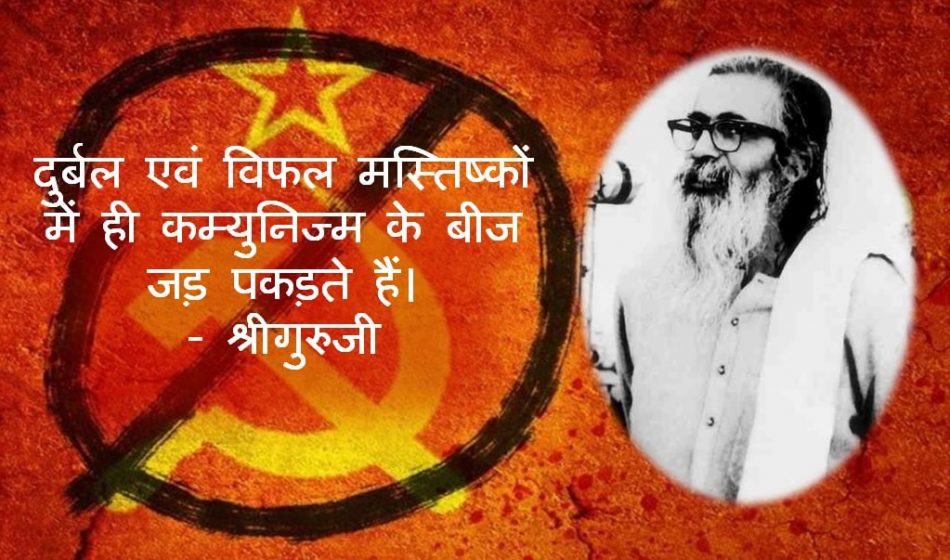
Shri Guruji Golwalkar's Views on the Hollowness of Communism
Among the grave failures of democracy in our country is the rising menace of communism, which is an avowed enemy of the democratic constitution. Lest they lag behind the communists in their economic appeal to the public, in this endeavor our leaders themselves also...
23 October 2026 · 5 min read
Microsoft's step-motherly treatment of Mithilakshara and Indian scripts
Microsoft allows typing in its Mangal font (Devanagari), but neither typing nor copy-pasting is possible in Mithilakshara of the SMP plane, because LOOKUP has been restricted in its Word, without which typing in any Indian script is impossible, because in Indian scripts, mu
23 October 2026 · 10 min read