YugSamvad · Sanskrit & Shastra
Sanskrit & ShastraAncient Idols of Lord Ram and Sita Unearthed in Jharkhand
Murari Sharan Shukla · English edition 23 October 2026 · Hindi original 5 January 2019 · 7 min read
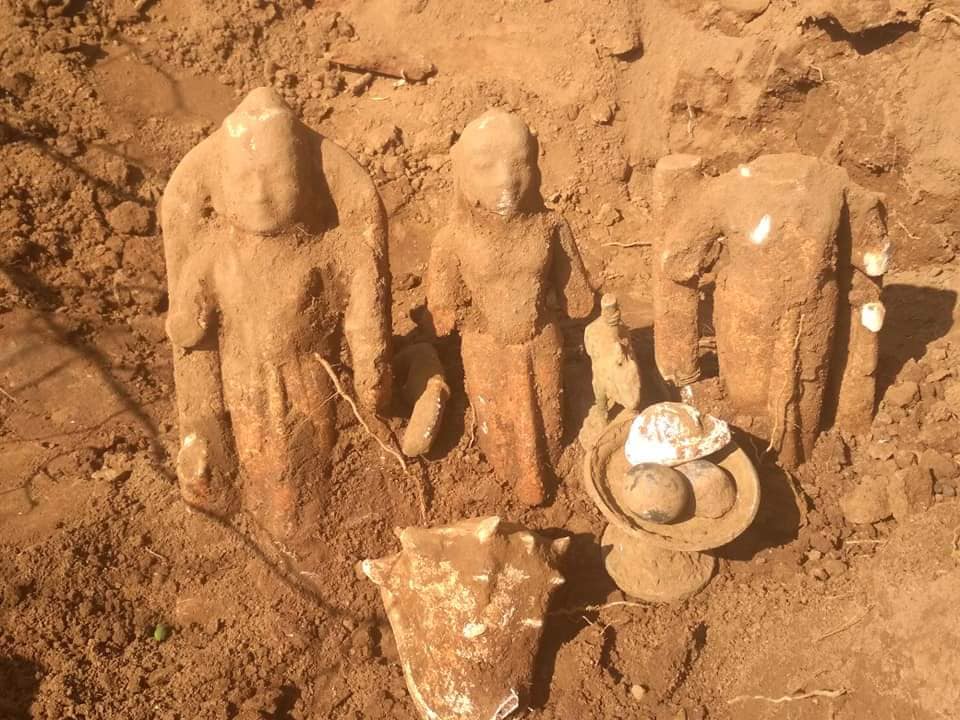
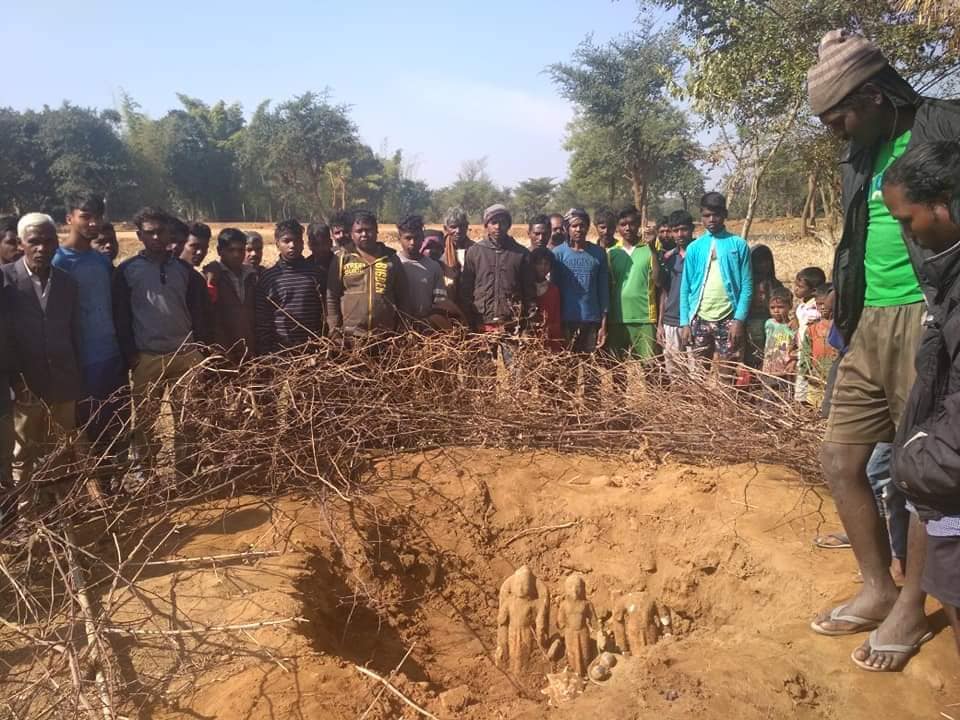
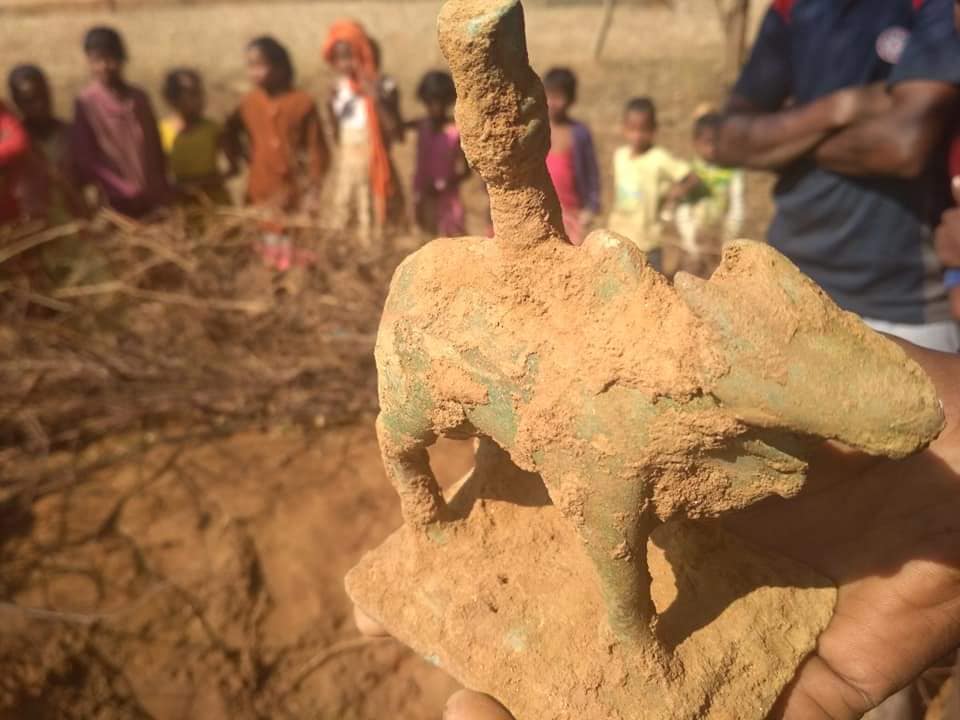
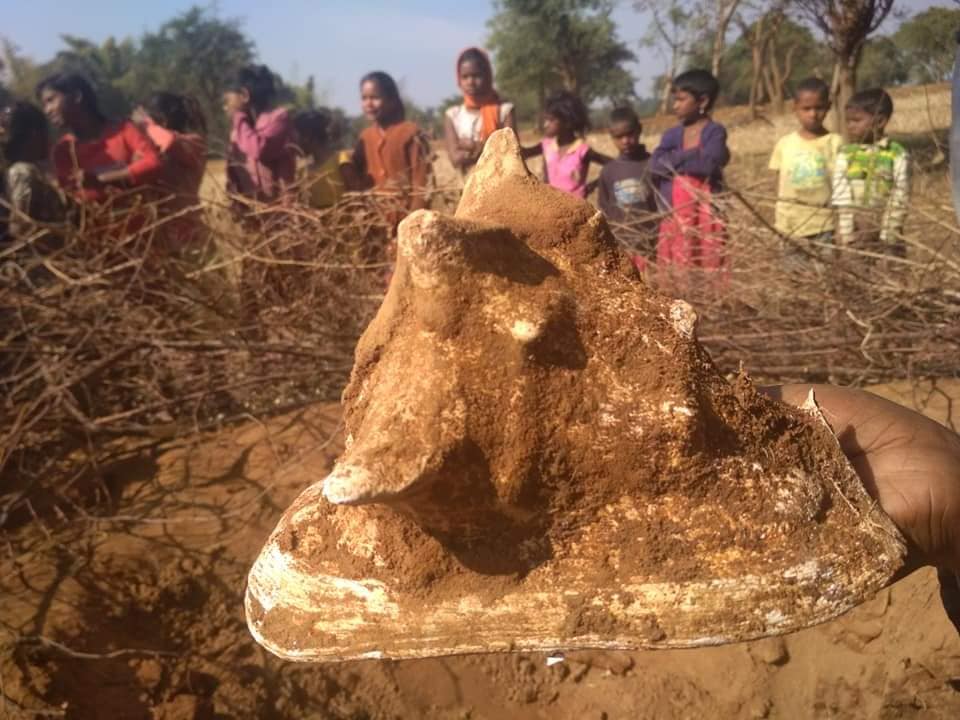
Shri Ram resides in every vein of this country. He is present in every atom. Ram is in every heart. Ram dwells in every breath. Ram is in every pore of the body on this land of Bharat. Ramlalla still plays in the courtyard of every home today. Where all will you cast a veil? How long will you delay the hearing? Ram manifested in Treta (the second of the four cosmic ages). Ram is manifesting even today. Ram is omnipresent even today. While the title suit of Shri Ram Janmabhoomi in Ayodhya is entangled in the Supreme Court, Shri Ram manifested from within the earth on Friday, 4 January, in Jilinga village of Bhandra Panchayat in Khunti district of Jharkhand state. The vigraha (consecrated icon) of Shri Ram, Lakshman, and Sita was found by a villager named Soma Tuti when he was digging soil for plastering in preparation for the Ind Mela (traditional fair) to be organized in the village. While digging the soil, his spade struck a hard object. When he cleared the soil, he saw the murtis (deities) of Shri Ram, Lakshman, and Sita. Along with them, one large and one small shankha (conch shell), a dhoopdani (incense burner), a bull made of some metal, and two small spherical stones were found, which appear to be shaligram (sacred ammonite stone representing Vishnu). The shaligram stone has been worshipped in Bharat for centuries as the direct manifestation of Vishnu.
Village head Jhirga Munda stated that about five generations ago, Raja Mahendra Nath Thakur was the king of Jilinga village. The head expressed the possibility that these murtis belonged to the temple of that very king. The village head mentioned that some bricks were also found there along with the murtis. It seems that the king had built a temple here. As soon as the murtis were discovered, Soma Tuti informed everyone in the village. A crowd gathered for the darshan (beholding a sacred deity or person) of the murtis. Once everyone realized the antiquity of the murtis, village head Jhirga Munda immediately called a meeting of the villagers. This subject was discussed in detail in the meeting of the Jilinga gram sabha (village assembly). The gram sabha decided to call journalists so that the information could reach everyone. The gram sabha decided to fence the murtis with bamboo at the site itself. Immediately, the murtis have been secured by making a bamboo enclosure amidst the bushes. Due to poverty in the village, the issue of funds is posing a hurdle. The villagers want to rebuild the temple there. The poor Sudama had found Krishna, and the poor residents of Jilinga in Jharkhand have found Shri Ram.
Regarding the murtis found in Jilinga, Jharkhand, Dr. Anand Vardhan, Professor of Art History at the Delhi Institute of Heritage Management and Research, considers these murtis to belong to the 18th century. Dr. Anand Vardhan, who is also the National General Secretary of the Museum Association of India, believes that in the 18th century, across the entire region from Ayodhya to Bengal, kings and landlords used to govern the state as representatives of Shri Ram, Lakshman, and Sita, considering their vigraha as the actual ruler of the state. Since Shri Ram had incarnated in human form, instead of building a temple for Him at that time, there was a tradition of building His *bari*, meaning home, which was called thakur bari (temple-home of the deity). In this, the murti of Sita was in the center. Ram was seated as the king, which is why a Ram Darbar (the court of Shri Ram) was established. Since Ram was a worshipper of Shiva, Shiva was also installed along with Vrisheshwar Nandi. This is why a statue of the bull (Vrish) was also found there. Shri Ram is considered a representation of Vishnu, which is why the shaligram is also respectfully consecrated there in an excellent vessel.
When Dr. Anand Vardhan was asked why the chest contours of Sita Ji's murti are not prominent in the recovered icon, he explained that while the chest contours were clearly carved in temple murtis, in the case of thakur bari murtis, due to the concept of home and court, those murtis were adorned with clothes. Therefore, the chest contours in these murtis were made very simple. Thakur bari means the home of Thakur Ji. Here, despite having a sense of sanctity like a temple, the feeling of it being Thakur Ji's home held sway in the tradition of devotion. And the clear influence of this belief was visible in the sculpture style as well. The bhog (sanctified food offering) of the grain available in that region was offered to Thakur Ji.
Although the head of Lakshman Ji's murti is broken among the murtis found in Jilinga, Jharkhand, Sita Ji is also seated alongside the bow-wielding Shri Ram. These are murtis of the thakur bari sculpture style. In those days, the king, considering Shri Ram as the Thakur (lord/master), ruled the state as His representative. By accepting the lordship of Shri Ram and being the bearer of that Thakur tradition, the king or landlord would then use the word 'Thakur' as a title with their name. The word 'Thakur' used in the name of Raja Mahendra Nath Thakur is indicative of that very thakur bari tradition. Here, the word 'Thakur' is not caste-indicative. It is an administrative term used by the then landlords and kings in their administrative capacity.
Now, these murtis found in Jilinga, Jharkhand, make it clear that before the arrival of missionaries in Jharkhand, the tribal society there considered Shri Ram as their deity of worship. The vanvasi (forest-dweller) Ram was their ideal. The tribal society ran the administrative system in that region only by seating Ram in place of the king. Such an extraordinary proof of Ram-bhakti among the people of the Mundari region is a living testimony of them being Hindu veera pungava (eminent heroes). Even to this day, the Mundari region has adopted the bow of Shri Ram as its primary weapon. Archery is still alive in the Mundari region. Bhagwan Birsa Munda, who manifested in the Mundari region, also carried a bow. This is a living proof of Raja Ram's Thakur tradition. This automatically leads to the moolochhed (uprooting) of the fabricated conspiracies of the missionaries who consider tribals to be distinct from Hindu society. Even today, the description of Ram appears repeatedly in the wedding songs, auspicious songs, and religious songs of the Mundari region.
Attesting to this heritage of Ram, Anjandham, the birthplace of Hanuman Ji, is located nearby in the Gumla district. The reference *Vane nivasati narah iti vanarah* (He who lives in the forest is a human, thus a vanara) is also available in the shastras (scriptures), which proves that Hanuman was the kuldeepak (pride of the lineage) of the tribe named Vanara. It appears that this tribe was famous by that name in Jharkhand at that time. Ramrekha Dham is also located in the same Mundari region. Additionally, Tanginath, a famous site of Shiva, is also close by. In the same Jharkhand lies Baidyanath Dham, one of the twelve jyotirlingas (radiant representations of Shiva), which is called Chitabhoomi in the shastras. This geography of tirthas (pilgrimage sites) declares this entire region as a Vaishnava (worshipper of Vishnu) region, where there has been a tradition of installing Raja Ram as the administrator in the thakur bari of every village, the remains of which have now been found in Jilinga. There is a wonderful harmony of the non-distinct, simultaneous worship of Vishnu and Shiva in this Jharkhand state, where the narrative of division between Shaiva (worshipper of Shiva) and Vaishnava is proven false. Fortunately, the society that turns this division into non-division is the tribal society here, where both are established together.
Currently, a fair named Ind is about to be organized in Jilinga village, Jharkhand, in the preparation of which this murti was found. The Ind Mela is a parivrajak (itinerant) fair celebrated in the form of a Jatra. Jatra means yatra (journey). This fair is associated with the joy of the arrival of crops. At this time, everyone gathers to worship the village deity at certain designated places, seeking blessings for crop protection and village security. After worshipping at one place, everyone departs collectively for the next fair location. This is an extremely ancient tribal custom fair, which is similar to other festivals of Bharat. The entire tradition of this fair is a reflection of the Hindu customs of the tribal society. It is worth noting that Bhandra is the very village where the first anti-national pathalgadi (stone-slab installation tradition) was carried out in Jharkhand by instigating the villagers through Maoists and missionaries. Now, the discovery of the murti of Shri Ram there seems to demolish the conspiracies of those heretics.
– Shri Murari Sharan Shukla, the author is a senior journalist and nationalist thinker.
Read also,
Veer Birsa Munda
Cite this article
Murari Sharan Shukla. “Ancient Idols of Lord Ram and Sita Unearthed in Jharkhand”. YugSamvad, 23 October 2026. https://yugsamvad.com/en/articles/jhaarakhanda-men-khudaaee-men-mileen-bhagavaana-raama-seetaa-kee
https://yugsamvad.com/en/articles/jhaarakhanda-men-khudaaee-men-mileen-bhagavaana-raama-seetaa-kee · accessed
Related reading
Vidhi-Vidhan and Niyam of Vrata during Chaturmasya
Chaaturmaasya-Vratavidhaana (Rules and Observances of the Chaaturmaasya Vow) Author: Pandit Gangadhar Pathak 'Vedaadyacharya' Chief Acharya: Shriram Janmabhoomi Shila Pujan, Ayodhya Shri Vrindavan Dham Acharya Shri Gangadhar Pathak, the chief priest who had Prime Minister Shri Narendra Modi perform the foundation stone laying ceremony (shilaanyaas) for the Shriram Janmabhoomi temple in Ayodhya, is, along with a healthy body, of mind
18 October 2026 · 9 min read
Determining the Jati of Shabari – Acharya Gangadhar Pathak
'Shri Ram's Devotee Shabari Was Not a Bhilni, But a Brahmani' Author: Pandit Gangadhar Pathak ‘Vedadyacharya’ Chief Acharya – Shri Ram Janmabhoomi Shila Pujan, Ayodhya Advisor: Shri Sarveshwar Jayaditya Panchang (traditional almanac), Jaipur Conducting the shilanyas (foundation stone laying) of the Shri Ram Janmabhoomi Temple in Ayodhya with Prime Minister Shri Narendra Modi m
18 October 2026 · 1 min read
The Meaning of Medha, Kautuhala, Jigyasa and Herd Mentality
*Medha* (intellect) and the Herd “He who protects *dharma* (righteousness/cosmic order), *dharma* protects him.” The meaning of *dharma* is Vedic *yajna* (sacrificial ritual), that is, the *karma-kanda* (ritual section) of the Vedas. There are ten characteristics of *dharma* — *dhriti* (fortitude), *kshama* (forgiveness), *dama* (self-control), *asteya* (non-stealing), *shaucha* (purity), *indriya-nigraha* (sensory control), *dhi* (intellect), *vidya* (knowledge), *satya* (truth), and *akrodha* (absence of anger). But these are merely characteristics on the basis of which we can recognize that a particular...
18 October 2026 · 8 min read