YugSamvad · Dharma & Culture
Dharma & CultureMurtipuja: An Important Part of Sanatana Dharma
Shri Vinay Jha · English edition 23 October 2026 · Hindi original 17 October 2019 · 6 min read
It is a hundred percent false propaganda that there was no murtipuja (image worship) in Sanatana Dharma (eternal cosmic order). The oldest murtis (sacred images) of India do not belong to the Jains or the Buddhists. This propaganda was first started by the British, claiming that Greek kings introduced murtipuja in India, and later, many misguided Hindus, such as the pseudo-Christians of the Brahmo Samaj and the Arya Samajis, also fanned this propaganda. The opposition to murtipuja among Hindus is a result of the influence of Islam and, later, Christianity.
In a Vedic yajna (sacrificial ritual), no murti of the Ishta Devata (chosen deity) of the yajna is made. In a Vedic yajna, the devas (deities) manifest in person to accept the havi (sacrificial offering). Beholding them with physical eyes is not possible unless the devas themselves wish it. In the Vajasaneyi Samhita of the Yajurveda, it is said of the Parama Purusha (Supreme Being) that He has no pratima (image), but this remains the belief to this day—no pratima of Brahman (the ultimate reality) and Ishvara (the personal God) has ever been made because Brahman and Ishvara never manifest in a manifest form (the only difference between Brahman and Ishvara is that the aspect of Brahman that "wills" the welfare of the world is called Ishvara; the word "Ishvara" is derived from the root "ish" of the word "ichchha" (will)). A murti can only belong to those devas or other beings who can manifest in a manifest form. However, not everyone has the capacity to perform a Vedic yajna, especially in Kaliyuga (the age of darkness).
Those who say that deities are omnipresent and therefore murtipuja is improper should be asked: if deities are omnipresent, why can they not be in a murti? The word "murti" is mentioned in many Vedic texts, such as the Tandya Brahmana, several Upanishads, Manusmriti (code of Manu), Puranas, and Mahakavyas (epics). Those wicked people who do not consider the Vedic texts authoritative will surely accept the Mauryan-era Panchatantra, will they not? The Panchatantra mentions murtis, and no Jain or Buddhist murtis up to that period have been found. The word "murta" (manifest/form) is mentioned in the Taittiriya Samhita of the Yajurveda (the primary Veda of South India) and also in the Shatapatha Brahmana of the Vajasaneyi Samhita of the Shukla Yajurveda (the primary Veda of North India). The word "pratima" is mentioned in the Maitrayani and Vajasaneyi Samhitas of the Yajurveda, the Taittiriya Aranyaka, the Atharvaveda, and other texts.
For a manifest form (murta rupa), four elements are essential—earth, water, fire, and air (space is not considered manifest, yet space also resides within a murti). Therefore, "murta" means taking a panchabhautika (five-elemental) form. Divine powers are not panchabhautika; hence, the murti is not their actual form, but is meant solely for the purpose of human beings. Meditating on the formless (amurta) is not within everyone's capacity. Therefore, in accordance with divine law, various divine powers manifest in different forms, and their pratimas are made accordingly. Divine power cannot enter a pratima unless the pratima is crafted correctly and consecrated through proper prana-pratishtha (consecration ceremony). Thus, Hindus do not worship the murti itself; they worship the divine power established within the murti. The murti is merely a symbol (pratika). A symbol can be of any kind—a form, a word, etc. In Islam, the symbol of "Allah" is a word, but among Hindus, the symbols of Brahman and Ishvara, along with those words, include "Om" or Pranava (the sacred syllable Om), and the symbols of other deities include their pratimas in addition to their names. Therefore, symbol-worship exists in all sects of the world; even atheists and scientists worship their own symbols. Modern scientists also worship "physical matter," but in their worship, instead of incense, lamps, and betel leaves (dhupa-dipa-tambula), instruments like telescopes are used. All concepts, thoughts, expressions, etc., are possible only through symbols. No truth can be expressed without symbols. Truth is formless (amurta), and its expressed form is "murta". The expressed form can consist of any panchabhautika element or elements. Just as "Allah" is a symbol, so too is the murti of a deity a symbol, but after prana-pratishtha, a relationship is established between that deity and that specific murti installed in that particular place. If, instead of worshipping a divine power through the medium of a murti, only the murti is worshipped, then it is contemptible.
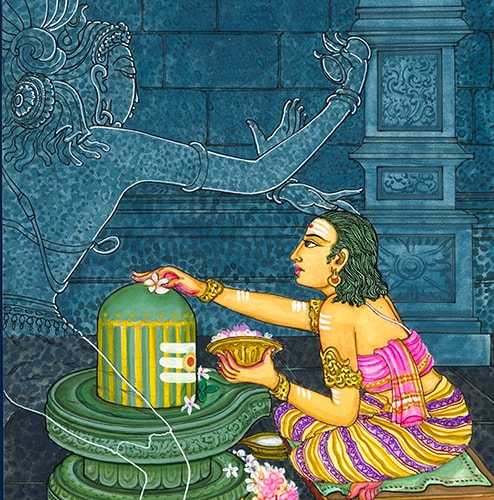
The Gayatri Mantra is the foremost Vedic mantra. In it, there is a prescription for meditating on the "bharga" (brahmatejas) of Savita Deva. Thus, here too, the meditation is on the manifest form of a formless deity—the effulgence. It is not necessary for a murti to be human-shaped. The communication of formless emotions through manifest mediums is called art. Anyone can express an emotion, but the one who has the ability to communicate it is called an artist. Similarly, a devotee also tries to convey his feelings to his Ishta (chosen deity), in which mediums like a murti are helpful. Those who have the capacity to meditate on the formless without a murti do not oppose murtipuja, because they know that others benefit from it, and they also know that divine power remains established in correctly installed murtis. Breaking a consecrated murti or otherwise insulting a deity does not cause any harm to the deity, because no deity is limited to that single murti alone, but the merit (punya) of the one who insults is destroyed.
Vedavyasa states that in Satyayuga (the age of truth), people primarily meditated, while in Tretayuga (the second age), yajna was predominant. Therefore, as long as dharma (righteousness/cosmic order) was strong, temples and murtis were unnecessary, although murtipuja had already begun in Tretayuga (such as at Rameshwaram). In Kaliyuga, the ritualistic Vedic path remains blocked, and business is often conducted in the name of yajnas; hence, murtipuja remains predominant. This happens in every mahayuga (great epoch). Therefore, calling any single historical period the "Vedic Age" or Satyayuga is an idea contrary to Sanatana Dharma. In one creation cycle, Kaliyuga occurs a thousand times, and then murtipuja remains the primary support of the astikas (believers), because the jnanamarga (path of knowledge) is only for a rare few.
Read verse 39 of the fourth chapter of the Manusmriti, where, describing the duties of a snataka (consecrated graduate), it is mentioned that a snataka "should circumambulate a mound of earth, a cow, a deity's image (deva-pratima), a Brahmana, clarified butter, honey, a crossroads, and well-known vegetation (while passing by them) (pradakshina means walking around them keeping them to one's right)." The verse contains the word "daivatam," which Buhler also translated as "idol," which is correct, because while walking, it is only a deva-pratima that one can encounter and circumambulate. Thus, it is clear that even during the time of Manu Maharaj, the progenitor of human civilization and the human race, there was a rule to circumambulate the images of deities. Manu Maharaj is praised in numerous mantras in the Vedas. One Manu lives for 71 mahayugas (an Indra also has the same lifespan); therefore, only beings of divine origin can become Manu. Download the English translation of Manusmriti (by Buhler) for free from the internet and search for the word "Temple"; you will find evidence of temples in six verses of the Manusmriti.
Read also,
Cite this article
Shri Vinay Jha. “Murtipuja: An Important Part of Sanatana Dharma”. YugSamvad, 23 October 2026. https://yugsamvad.com/en/articles/moortipoojaa-sanaatana-dharma-kaa-eka-mahatvapoorna-anga
https://yugsamvad.com/en/articles/moortipoojaa-sanaatana-dharma-kaa-eka-mahatvapoorna-anga · accessed
Related reading
How is Om correctly pronounced?
The *Ashtadhyayi* (Panini's foundational Sanskrit grammar) (1.2.34) states that "except for *japa* (muttered recitation), *nyunkha* (a specialized prolonged chanting of the syllable 'O'), and *sama* (melodic Vedic chanting), *ekashruti* (monotone recitation) may be employed in *yajna-karma* (sacrificial ritual performance)." When a long "Om" (or short "u" or "o") has to be appended to any *veda-mantra* (Vedic hymn), that "Om" is called "*nyunkha*". *Ekashruti* means reciting by treating all accents as a single tone.
18 October 2026 · 2 min read
Yudhishthira's Dyuta: The Esoteric Vedic Akshavidya
It is wrong to call Dharmaraja Yudhishthira a gambler. How many times in his life did Dharmaraja Yudhishthira play dyuta (the traditional game of dice)? How many times must one play to be called a vyasani (addict)? It is also wrong to call dyutavidya (the science of dice) gambling. Why did Dharmaraja Yudhishthira have to learn dyutavidya from a rishi (seer)? Why was no teacher to be found other than a rishi? Shaku...
18 October 2026 · 1 min read
Be It Kanyadaan or Vardaan: What Is Wrong with It?
Is *kanyadan* (the ritual offering of the bride) merely charity? Why is *kanyadan* performed, and is it an insult to women? Understand the true meaning of *kanyadan* in the Hindu *vivaha sanskara* (marriage sacrament), along with its cultural and Vedic significance. Read the authentic exposition of *vardan* (boon) versus *kanyadan*, the mystery of *Brahma vivaha* (the Brahma form of marriage), and a definitive response to the fallacies that seek to misrepresent Hindu traditions.
18 October 2026 · 5 min read