YugSamvad · Politics & History
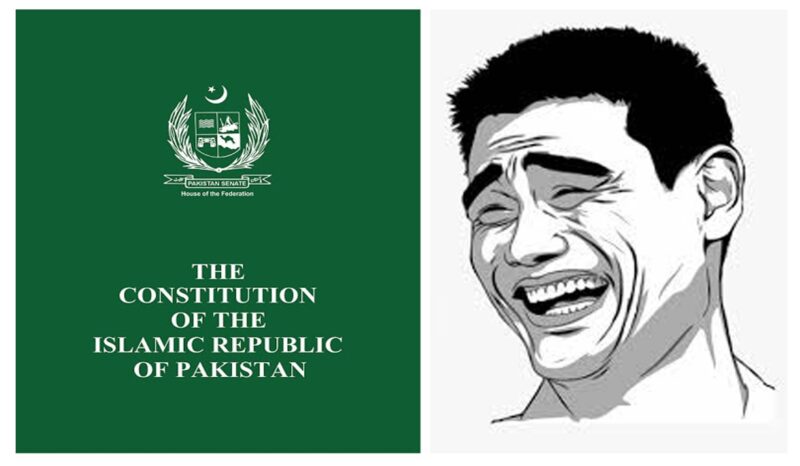
Politics & HistoryThe Constitution of Pakistan: A World-Class Joke
Shri Dwivedi · English edition 23 October 2026 · Hindi original 31 August 2020 · 5 min read
Pakistan was created on the basis of that doctrine of mazhabi fanaticism which holds that Islam cannot coexist with any other culture. This very doctrine remained the primary motivating element of its constitution. Amidst the partition accompanied by massacres, killings, and rapes, the first meeting of the Constituent Assembly of the nascent Islamic state of Pakistan took place on August 11, 1947. Muhammad Ali Jinnah, the chief architect of partition, remained its president until his death, after which Liaquat Ali became its president, under whose leadership its objectives resolution was drafted. Its foundational principle was to make Pakistan a state governed by the mazhabi principles of Islam. The non-Muslim members of the Constituent Assembly opposed this, but they did not realize that they were no longer in Hindu-majority Bharat and that their words held no significance. In October 1951, Prime Minister Liaquat Ali Khan was assassinated, after which Khawaja Nazimuddin became Prime Minister.
First Constitution
Meanwhile, Pakistan's Constituent Assembly continued its work, and after nine years of arduous labor, formulated Pakistan's great constitution, which remained in force for the next two years.
Anyway, meanwhile, Pakistan's Constituent Assembly continued its work, and after nine years of arduous labor, formulated Pakistan's great constitution, which remained in force for the next two years. In March 1956, Pakistan's first constitution came into effect, according to which Pakistan was declared an Islamic republic. Iskander Mirza became the first president after the implementation of this constitution. However, due to the absence of any democratic temperament and culture, this system could not last even two years properly, and in 1958 Iskander Mirza imposed martial law. The central assembly and state assemblies were dissolved, and the constitution was brought to an end. Governance came into the hands of Army Chief Ayub Khan. Ayub Khan was not satisfied with this position. In October 1958, he deposed Iskander Mirza, seized power, and sat as the dictator of Pakistan.
Second Constitution
All political parties were declared illegal. Following the implementation of this foolish rule, the elections that took place resulted in the elected individuals forming their own factions inside Parliament. And the very parties that were illegal outside Parliament began functioning as factions within it.
To give his position a legal framework, Ayub Khan arranged for a referendum in 1960 in which Pakistan's local self-government institutions (village councils, municipal boards, etc.) voted. Out of 78,720 such institutions, 75,283 institutions voted in favor of Ayub Khan. Thus strengthening his position, Ayub appointed a commission to draft a constitution, whose chairman was a lawyer named Manzur Qadir. Pakistan's second constitution was published in 1962. A main provision of this constitution was that there would be no political parties in elections and all candidates would contest independently. All political parties were declared illegal. Following the implementation of this foolish rule, the elections that took place resulted in the elected individuals forming their own factions inside Parliament. And the very parties that were illegal outside Parliament began functioning as factions within it. Thus Ayub Khan's Tughlaqi dream of creating a parliament without political parties was shattered. And after this humiliation, he realized that in any country where there is a parliament, there will also be political parties.
Third Constitution
This constitution came into effect in April 1973, and Zulfikar Ali Bhutto became the first president under it. Bhutto had Yahya Khan placed under house arrest. But within five years, General Zia-ul-Haq overthrew Bhutto, abrogated the constitution, had a trial conducted to his liking, and had Bhutto hanged. In 1988, as part of a conspiracy, Zia-ul-Haq too was killed in a plane crash.
Most of Pakistan's leaders were not satisfied with Ayub Khan and the 1962 constitution. In the 1965 elections, several parties pitted Muhammad Ali Jinnah's sister against Ayub. However, through the use of deceit and force, Ayub Khan won the election again. But by now Ayub realized that his days were numbered, so he handed over the reins of government to General Yahya Khan and slipped away. Yahya imposed harsh military rule and announced general elections for 1970, in which for the first time in Pakistan's history, the general public got the opportunity to vote directly. During this time, state-sponsored horrific massacres and rampages of rape continued unabated in East Pakistan, culminating in an all-out war between Bharat and Pakistan, in which Pakistan suffered a decisive defeat and East Pakistan emerged as a new country. In 1972, Pakistan's central assembly appointed a 25-member committee to draft a constitution. This constitution came into effect in April 1973, and Zulfikar Ali Bhutto became the first president under it. Bhutto had Yahya Khan placed under house arrest. But within five years, General Zia-ul-Haq overthrew Bhutto, abrogated the constitution, had a trial conducted to his liking, and had Bhutto hanged. In 1988, as part of a conspiracy, Zia-ul-Haq too was killed in a plane crash. In 1985 this constitution was reinstated, which Parvez Musharraf kept abrogated for years after overthrowing Nawaz Sharif's government in 1999.
Even Jinnah and Iqbal will not escape the clutches of Islamic radicalism.
Cite this article
Shri Dwivedi. “The Constitution of Pakistan: A World-Class Joke”. YugSamvad, 23 October 2026. https://yugsamvad.com/en/articles/paakistaana-kaa-sanvidhaana-eka-vishvastareeya-mazaaka
https://yugsamvad.com/en/articles/paakistaana-kaa-sanvidhaana-eka-vishvastareeya-mazaaka · accessed
Related reading
The Meaning of Medha, Kautuhala, Jigyasa and Herd Mentality
*Medha* (intellect) and the Herd “He who protects *dharma* (righteousness/cosmic order), *dharma* protects him.” The meaning of *dharma* is Vedic *yajna* (sacrificial ritual), that is, the *karma-kanda* (ritual section) of the Vedas. There are ten characteristics of *dharma* — *dhriti* (fortitude), *kshama* (forgiveness), *dama* (self-control), *asteya* (non-stealing), *shaucha* (purity), *indriya-nigraha* (sensory control), *dhi* (intellect), *vidya* (knowledge), *satya* (truth), and *akrodha* (absence of anger). But these are merely characteristics on the basis of which we can recognize that a particular...
18 October 2026 · 8 min read
Suicidal Flaws in Countering Sarvadharmasamabhava
Over the past 90 years, the rise of the politics of Muslim appeasement has caused immense damage to Indian culture. By equating 'Ali, Maula, Allah' with Ishvara (the Supreme Godhead), pseudo-secularism has paralyzed our core spiritual and cultural consciousness. Even from a definitional perspective, 'religion' and 'mazhab' (confessional faith) are distinct from dharma (righteous duty and cosmic order)—
18 October 2026 · 8 min read

Be It Kanyadaan or Vardaan: What Is Wrong with It?
Is *kanyadan* (the ritual offering of the bride) merely charity? Why is *kanyadan* performed, and is it an insult to women? Understand the true meaning of *kanyadan* in the Hindu *vivaha sanskara* (marriage sacrament), along with its cultural and Vedic significance. Read the authentic exposition of *vardan* (boon) versus *kanyadan*, the mystery of *Brahma vivaha* (the Brahma form of marriage), and a definitive response to the fallacies that seek to misrepresent Hindu traditions.
18 October 2026 · 5 min read