YugSamvad · Sanskrit & Shastra
Sanskrit & ShastraYoga and Pranayama, Not Exercise, Are the Path to Elevation
Shri Vinay Jha · English edition 23 October 2026 · Hindi original 23 December 2019 · 6 min read
“Should today's youth do strength exercises like push-ups, squats, etc., in addition to pranayama and asana to maintain physical strength?”
Answer —
Strength exercises like push-ups, *dand-baithak* (push-ups and squats), or weightlifting increase pressure, which builds muscle strength but reduces flexibility. Therefore, if one performs such exercises, the practice of yogasanas should be increased, because yogasanas create a stretch that compensates for this pressure. Increase the stretching yogasanas precisely on those body parts where pressure was applied by the pressure-based exercises. Regulating one's diet and sleep is also essential.
Increased pressure not only reduces muscle suppleness but also decreases agility, as agility is tied to suppleness. Without suppleness and agility, strength is wasted. Power does not mean how much force you can exert, but how much force you can exert per second. This means how much time a muscle takes to go from zero tension to maximum tension. Put simply, this means what the flexibility of the muscle is—its elasticity! Therefore, the ability to apply pressure and an equal amount of stretch per second is what constitutes power.
*Dand-baithak* or weightlifting exercises only increase pressure, which is fatal for long-term health. Not only is muscle flexibility destroyed, but the elasticity of the nerves is also ruined, causing knots to form in the nerves that destroy their communication capacity. Strength has two factors—muscle, and neural communication. Neural communication is connected to the mind. Consequently, wrestlers who only do pressure-based exercises ruin both their intellect and their lifespan.
Continue to do stretching exercises as well. For leg exercises, the best are *pashchimottasana* and *padmasana*. For the spine and other areas, *chakrasana* — which is difficult, so one can do *ardha-chakrasana*. If you do *baddha-padmasana* instead of *padmasana*, the arms will also be stretched. *Tarasana* is also beneficial. There are many other asanas.
The best book for yogasanas is Damodar Satavalekar’s *‘Yog ke Aasan’*, published by Hind Pocket Books. I have been practicing asanas regularly according to it since I was ten years old. Now I do not know whether that book is even available or not.
Doing pranayama refines one’s samskaras, burns away all sins, pacifies planetary afflictions, opens the divine sight, and also yields physical benefits.
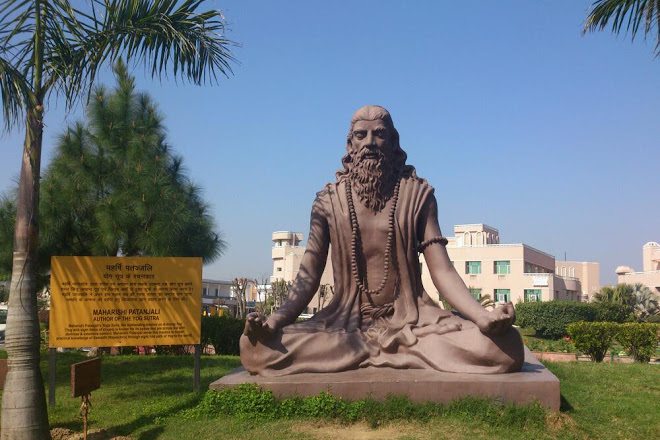
Avoid Baba Ramdev. Learn yoga from the ancient rishis. The supreme text on yoga is Maharshi Patanjali’s *“Yoga Sutra”*, upon which the best commentary is Maharshi Vedavyasa’s, which is available only in Sanskrit. A simple and concise Hindi translation of the *Yoga Sutra* along with Vyasa’s commentary, as well as the commentaries of Bhartrihari and Vijnanabhikshu, is Swami Omanand Teerth’s *“Patanjal-Yoga-Pradeep”* published by Gita Press; it is the ultimate book on complete yoga.
Ignore the commentaries of Bhartrihari and Vijnanabhikshu, and ignore Swami Omanand Teerth’s own views as well. They are authors of the Kali Yuga. Try to understand only Maharshi Patanjali’s *Yoga Sutras* and Maharshi Vedavyasa’s commentary upon it; this will set right everything from this world to the next. Only after understanding these two maharshis and practicing practical yoga sufficiently will you gain the discernment to see which views are right and which are wrong among the commentaries of Bhartrihari and Vijnanabhikshu, Swami Omanand Teerth’s own opinions, or Vinay Jha’s opinions.
Marx was right when he said that merely interpreting the world is not enough; the world needs to be changed. But Marx never tried to reform himself. Marx betrayed the gullible wife who had cast off her noble family for a pauper like him, had an illicit relationship with their maid, and refused to acknowledge the child born of it, because Marx believed there was no God above to punish him for his sins. Therefore, Marx and his disciples became wholly absorbed in reforming others, with the result that they achieved nothing at all! The revolution is today further behind than where it started! Today there is not a single true party in any country of the world that genuinely cares for the poor!
Therefore, do not try to change the world. If every individual reforms themselves, the world will be reformed. This is the path of self-knowledge, which is called *Sanātana Dharma*.
Upon attaining self-knowledge, one realizes that an individual does not have an independent existence; he is merely a leaf on a vast tree! Then the vision develops to perceive that very cosmic Ashvattha tree as the Self. The dimension of prana expands. The periphery of the Self continues to grow—so much so that the entire earth becomes one’s family. If there is an agent of peace with cancer in the body of that Cosmic Being, the means for his cure also begins to reveal itself.
When the vision that equates the collective with the individual matures, and acting out of that vision burns away the aggregate of samskaras, only then does the leaf break away from the cosmic Ashvattha tree, dry up, and fall, while the self-element within it abides forever in its true nature. That is moksha.
He who is equal to the collective is called *samartha*. Nobody becomes *samartha* by doing *dand-baithak*. Nobody becomes *samartha* by doing yogasanas. The means to become *samartha* is samadhi. But before that, seven steps must be crossed. The third step is yogasana. *Dand-baithak* is not a step at all; understand them as nothing more than a special tool for a specific purpose.
If you do squats just to beat others up, you will remain trapped in doing squats life after life. If you feel ashamed to do squats to reform yourself, then in solitude for some time, grab your own ears and pull them; the left-vagus and right-vagus nerves will stretch, straightening and cleansing their subtle channels, which are called *Ida* (chandra-nadi) and *Pingala* (surya-nadi) in Tantra, and Ganga and Yamuna in the Vedas. They are purified through pranayama, which opens the doors of the central *Sushumna*, called Saraswati in the Veda; that very Saraswati brings about the confluence with the *Sarasvan* of the Sahasrara. In the Veda, the presiding goddesses of these three are called the ‘Three Goddesses’ — Ganga, Yamuna, and Saraswati, meaning “Bharati, Ida, Saraswati” (Bharati = Yamuna; Ida = Ganga). If the seven chakras are not purified, Saraswati dries up in *Vinashana* before meeting the *Sarasvan*!
Physical strength is merely a tool on the path of yoga. If you treat physical strength as the goal, you will attain a distorted physical strength that will also distort the mind. People are wrong to say that Advaita Vedanta is a philosophy of escapism. Advaita Vedanta is the philosophy of seeing the entire creation as the Self. When everything is ‘I’, from whom is there to escape?
Escape from desires, from *kama* (lust) and *krodha* (anger), etc. Even if one must wage a war against *adharma*, it must be done by setting anger aside, imbued with the spirit of *nishkaam karma* as taught in the Gita. But *nishkaam karma* is not easy; it requires the sanskaras of an Arjuna, a mere fraction of which can be acquired by modern man only through severe austerities.
– Acharya Shri Vinay Jha
Read also,
मोहनजोदड़ो और हड़प्पा की आसुरी सभ्यता की वास्तविकता
'मन्त्र' का अर्थ, प्रयोग और उसके फल
Cite this article
Shri Vinay Jha. “Yoga and Pranayama, Not Exercise, Are the Path to Elevation”. YugSamvad, 23 October 2026. https://yugsamvad.com/en/articles/vyaayaama-naheen-yoga-aura-praanaayaama-hain-utkarsha-kaa-raastaa
https://yugsamvad.com/en/articles/vyaayaama-naheen-yoga-aura-praanaayaama-hain-utkarsha-kaa-raastaa · accessed
Related reading
How is Om correctly pronounced?
The *Ashtadhyayi* (Panini's foundational Sanskrit grammar) (1.2.34) states that "except for *japa* (muttered recitation), *nyunkha* (a specialized prolonged chanting of the syllable 'O'), and *sama* (melodic Vedic chanting), *ekashruti* (monotone recitation) may be employed in *yajna-karma* (sacrificial ritual performance)." When a long "Om" (or short "u" or "o") has to be appended to any *veda-mantra* (Vedic hymn), that "Om" is called "*nyunkha*". *Ekashruti* means reciting by treating all accents as a single tone.
18 October 2026 · 2 min read
Yudhishthira's Dyuta: The Esoteric Vedic Akshavidya
It is wrong to call Dharmaraja Yudhishthira a gambler. How many times in his life did Dharmaraja Yudhishthira play dyuta (the traditional game of dice)? How many times must one play to be called a vyasani (addict)? It is also wrong to call dyutavidya (the science of dice) gambling. Why did Dharmaraja Yudhishthira have to learn dyutavidya from a rishi (seer)? Why was no teacher to be found other than a rishi? Shaku...
18 October 2026 · 1 min read

Be It Kanyadaan or Vardaan: What Is Wrong with It?
Is *kanyadan* (the ritual offering of the bride) merely charity? Why is *kanyadan* performed, and is it an insult to women? Understand the true meaning of *kanyadan* in the Hindu *vivaha sanskara* (marriage sacrament), along with its cultural and Vedic significance. Read the authentic exposition of *vardan* (boon) versus *kanyadan*, the mystery of *Brahma vivaha* (the Brahma form of marriage), and a definitive response to the fallacies that seek to misrepresent Hindu traditions.
18 October 2026 · 5 min read