YugSamvad · Sanskrit & Shastra
Sanskrit & ShastraReality of the Asuric Civilization of Harappa and Mohenjodaro
Shri Vinay Jha · English edition 23 October 2026 · Hindi original 18 October 2019 · 25 min read
The so-called 'scholars' of Europe described the Mohenjo-daro and Harappa 'civilization' as the oldest foundation of Indian civilization and declared it to be more developed and ancient compared to the Vedic pastoral people, which our policy-makers and so-called intellectuals, especially leftist historians, continue to accept to this day. In history books, under the 'Vedic Age', everything is taught except what is actually in the Vedas. Reading such books will destroy even the little remaining knowledge left in the brain.
Several Hindu nationalists have stood up against this belief, trying to prove that the Harappa 'civilization' itself is Vedic. These people are even worse than the Europeans and leftists, because proving the truth by distorting facts is foolishness, and as the saying goes, a wise enemy is better than a foolish friend, because no one knows what a fool will do and when; often, fools score goals against their own team. The people of both these camps are staunch materialists, hence they cannot understand Vedic civilization at all. Therefore, let us first define the word "civilization" itself.
Oxford Professor G.M. Roberts has defined Civilization: 'where cities, trade and commerce, etc., develop' (I have given the essence of his words). In Latin, civilis (civil) means 'related to civis (citizen) and civitas (city)'; from that, the French word civilisé (civilized) was formed in the 16th century, and from this French word, two hundred years later, the English word Civilization was formed in the 18th century. It will surprise many modern people to know that what is called 'Civilization' in English and 'Sabhyata' in Hindi today was called "History" in Latin, the language of the ancient Roman Empire, and in the concept of that ancient Latin History, there was a concept of "Gold-Silver-Bronze-Iron" ages parallel to the "Satya-Treta-Dvapara-Kali" yugas (cosmic ages) of the ancient Indians. Even in Shakespeare's era, the word "modern" was used in a derogatory sense; there was a feeling of respect for the ancient. The ghost of evolutionism is the fruit of materialistic development, which is a post-Industrial Revolution phenomenon that began with the plundering of India.
Materialists tried to prove Roman "History", but could not verify the Gold and Silver ages, so nowadays only the Bronze Age and Iron Age are taught in history! Those who define an entire era based on a single metal forget that the source of this four-age concept is the concept of "Satya-Treta-Dvapara-Kali" described in the Rigvedic text Aitareya Aranyaka, which is based not on physical metals or material development, but on a philosophy of life that defines civilization and culture on the basis of moral values of Sat (truth/righteousness) versus Asat (untruth/unrighteousness). The word "Sabhya" (civilized) is mentioned in the Atharvaveda and other texts, where it is used not in the modern European sense but in the ancient sense: "one worthy of participating in the assembly (cultured person)". Contrary to the modern mindset that leaps towards materialism driven by personal self-interest, the Vedic philosophy of life based on cooperation and harmony is the foundation of true civilization. Therefore, if we consider material criteria like cities and trade as the only measure of civilization, then all the rishis (sages) and munis (ascetics), from Buddha and Mahavira to Vivekananda, who renounced materialism and gave importance to spirituality, were uncivilized! If we examine the life philosophy, lifestyle, and value standards of the asuras (demonic forces) in ancient Indian texts, we will be forced to consider the modern concept of 'civilization' prevalent among historians today as part of an "asuric" philosophy of history.
The Harappan Civilization was a Worshipper of the Asura Mahishasura
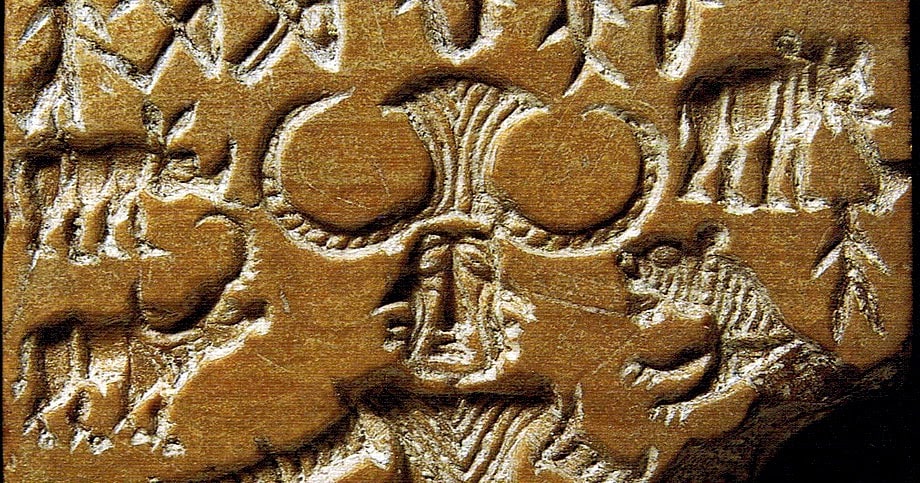
Whether the tail is attached below or above, a tail is a tail, even if the upper tail is called a "shringa" (horn) and declared a symptom of shringara-rasa (aesthetic flavor of love/beauty)! The husband of the chief queen, who wore buffalo horns on his head, was called Mahishasura. The main center of human sacrifice, where the asuric practice of sacrificing him and declaring him Sadashiva (the benevolent form of Shiva) began, came to be called the "mound of the dead" by the people—'Muan-jo-daro' in the Sindhi language, which the mlechchhas (barbarians) turned into 'Mohenjo-daro' and declared the Mahishasuric royal seal found there as the 'Pashupati seal'. The image in this so-called 'Pashupati seal' is not of Pashupati Mahadeva, but of a completely naked Mahishasura wearing the horns of a mahisha (male buffalo); Pashupati is neither naked nor does he wear buffalo horns on his head. The method of Vamamargi (left-handed tantric path) violent Durga Puja which is still prevalent today is published by Chowkhamba Vidyabhawan in the book 'Varshakritya'. In that, under the chapter 'Ashvinakritye Sharadiya-Durga-Puja-Paddhatih' in 'Atha Durgavahanadi-Pujavidhih', first there is the worship of Durga's vehicle, the lion, after which the following mantra for the dhyana (meditation) of Mahishasura is found:-
"ॐ महिषस्त्वं महावीर शिवरूप सदाशिव। अतस्त्वाम् पूजयिष्यामि क्षमस्व महिषासुरः।|"
"Om, O Mahisha, you are Mahavira, the form of Shiva, Sadashiva! Therefore, I shall worship you; forgive me, O Mahishasura (because I shall sacrifice you)."
After the dhyana, the pranapratishtha (consecration of life-force) of Mahishasura is done with this mantra:-
"ॐ ह्रीं ह्रीं हूँ महिषासुर इहागच्छ इह तिष्ठेत्यावाह्य , ॐ महिषासुराय नमः।"
According to the Vashistha Dhanurveda, tantric utterances like 'Hreem Hreem Hoom' should be used at the beginning of war. Here, it is a context of invocation and salutation for the worship of Mahishasura; therefore, some fool who did not have proper knowledge of Tantra (esoteric spiritual texts/traditions) composed these mantras.
Thereafter, the worship of Mahishasura is performed with panchopachara (five-fold worship) using this mantra:-
"ॐ महिषस्त्वं महावीर इन्द्रादिदेवमर्दक। देव्यस्त्रताडितो भूत्वा गतः स्वर्गम् नमोSस्तु ते।"
"O Mahisha, you are Mahavira, the crusher of Indra and other devas (deities). Having been struck by the weapon of the Devi, you go to heaven; salutations to you!"
This Vamamargi Durga Puja was prevalent among the anti-Vedic asuras, which is clear from their mantras themselves—the sacrifice of Mahishasura is offered with the wish that Mahavira Mahishasura, the crusher of Indra and other devas, upon being struck by the weapon of the Devi, goes to heaven and resides there in the form of Sadashiva!
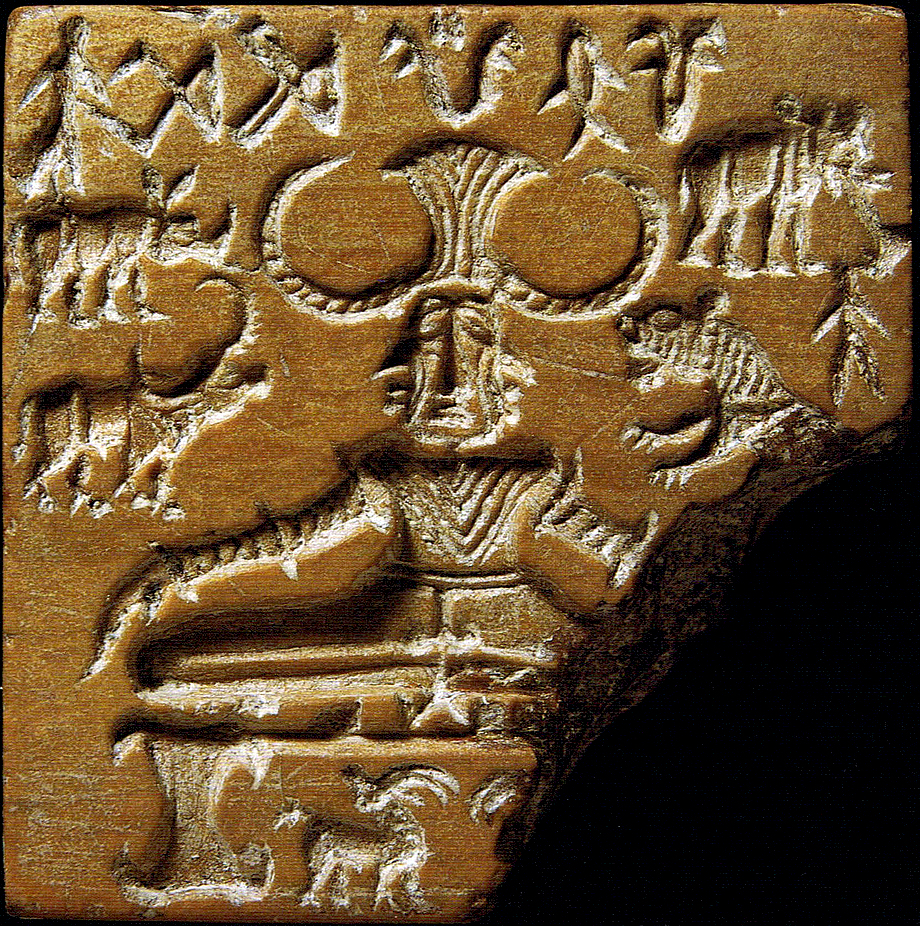 The so-called Pashupati seal, which in reality depicts Mahishasura
In the mound of the dead, the seal of this very Mahishasura was found, who used to have himself sacrificed with the desire of becoming Pashupati in heaven after death! Now Mahishasura is no more, so foolish people satisfy themselves with the sacrifice of only his vehicle, the mahisha! If asked, they will say that the sacrifice of Mahishasura takes place in a subtle form, and divine eyes are needed to see it! During this very worship, while sacrificing the mahisha, this asuric parody of the Gayatri mantra is whispered into the buffalo's ear:-
"ॐ पशुपाशाय विद्यमहे विश्वकर्मणे धीमहि। तन्नो महिषः प्रचोदयात्।"
"Om, I know of the pashupasha (tether of the beast) and meditate on the actions of the universe; may the mahisha inspire us towards that (knowledge and meditation)!"
In the Gayatri mantra, we ask Savita Deva (the solar deity) for such intellect that gives the capacity to meditate on the sin-destroying Brahmateja (divine spiritual splendor) (bharga) of Savita Deva, but in the asuric Durga Puja, they do not ask Savita Deva for intellect (dhi). The devas are driven away by 'Mahavira Indradidevamardaka' Mahishasura, so instead of asking the devas for inspiration, they ask the buffalo for inspiration: "…tat nah mahishah prachodayat" — O Mahisha, inspire us (so that we too mentally become buffaloes), know the pashupasha, and focus on all the actions of the world, meaning, perform all the actions of the world with the same buffalo-intellect, knowing the tether of the beast! If Mahishasura becomes Pashupati in heaven, then the followers of Mahishasura will also have to become buffaloes and go to serve him, right? Driving away the devas, there will be nothing but buffaloes in heaven! Wherever you look, buffaloes!
Some Vamamargis will interpret that "pashamukti" (liberation from bonds) should be the meaning here, but in the texts of the Vamamargis, pashamukti also meant behaving like a beast, free from the bonds of worldly morality, and declaring oneself as the bond-free Shiva. The regions where the followers of Mahishasura were most numerous are now filled with the followers of Mahamada, the incarnation of Tripurasura, and their secular supporters. Even today, Mahishasura is worshipped, some mantras of which I have quoted above! These mantras and this method of worship were added to some Puranas (ancient scriptural texts) by Kaliyugi (relating to the age of darkness) asuras; these portions are interpolations, because Vedavyasa was opposed to violence in religious acts. In the Mahabharata, he has clearly written that violence is prohibited in a Vedic yajna (ritual sacrifice), but in the Treta Yuga, some "scoundrels" (like Ravana) started violence in the yajna.
I have the archaeological excavation report of 'Muan-jo-daro'. The archaeological report says that 69 structural levels were detected in 'Muan-jo-daro', of which only 30 levels could be excavated because the lower 39 levels are submerged in groundwater! Yet, even today, textbooks deliberately teach the lie that the 'civilization' of 'Muan-jo-daro' arrived suddenly from some unknown place and established itself there in a highly developed state. Such a big lie—so that Indians can be taught that no civilization could ever be born on Indian soil! If the mlechchhas had their way, they would have picked up the entire 'Muan-jo-daro' and taken it to England or Greece. Another important fact is that even among the 30 levels that could be excavated, only 13% of the total ancient mounds were excavated. This fact also remained suppressed in the report and is not taught in books. Facts are not taught in books; the ideas of scoundrels are taught, which they present as (imaginary) facts to make fools of people.
During my college days, I had searched for and read the research works of several archaeologists from Finland and Russia, in which it was written that the royal family of 'Muan-jo-daro' belonged to the buffalo gotra (lineage/clan), whose royal seal was that seal with buffalo horns which the British wrongly designated as the 'Pashupati seal'. It is the 'Mahishasura seal', not the 'Pashupati seal'. Those same archaeologists also wrote that a Buddhist stupa was built four to five centuries BC over the palace of that buffalo-gotra royal family, hence excavation is impossible. Demolishing such an ancient Buddhist stupa would cause an uproar among Buddhists worldwide. The anti-Vedic so-called 'intellectuals' of Europe and India do not even mention the works and ideas of such archaeologists.
The Script of the Harappan Civilization
Some blind nationalists have imagined the script found on Harappa-related seals to contain Vedic mantras. Vedic yajnakundas (sacrificial pits) have not been found at Harappan civilization sites. In Kalibangan, sixteen pits were found in which bones of "bovine" animals were found, as I read in the report, but the report did not clarify whether those remains were of a bull or a male buffalo. That script has four distinct characteristics:-
(1) The script was boustrophedon (written in two directions); the first line was dextral (left to right) like Devanagari, and the second line was sinistral (right to left) like Kharosthi.
(2) The total number of distinct signs in it is equal to the total number of syllables, including conjunct characters, in Brahmi or Devanagari.
(3) This script was used only for the bija-mantra (seed syllable/mantra) of the kula (clan/family); hence, identical sentences are not found on any two seals.
This means that the Vamamargi Kaulamargi (follower of the Kaula path) asuric Tantra was the sect of these Harappan asuras. Goswami Tulsidas called the Kaulamargis the worst among the fourteen types of human beings. An example of how Kaulamargis were is presented from their primary text 'Kularnava Tantra' (7-100):-
"पीत्वा पीत्वा पुनः पीत्वा यावत् पतति भूतले। | पुनरुत्थाय वै पीत्वा पुनर्जन्म न विद्यते।|"
Meaning:— "Drink, drink, drink again until you fall to the ground / Get up and drink again (thrice) (then) there shall be no rebirth (liberation will be attained)!"
Dayananda Saraswati opposed this tantric shloka (verse), but could not see that in a verse of the Shrimad Bhagavad Gita, these Kaulas replaced devotion to the Supreme Lord with drinking alcohol as the means to moksha (liberation); that verse of the Gita is:-
आब्रह्मभुवनाल्लोकाः पुनरावर्तिनो-अर्जुन। मामुपेत्य तु कौन्तेय पुनर्जन्म न विद्यते।|8-16||
Just as in the Gayatri, the phrase “O Savita Deva, inspire us...” was replaced with “O buffalo, inspire us...”, similarly, in the above verse of the Gita, devotion to the Lord was removed to present excessive drinking as the means to attain moksha, the evidence of which is the theft of the last three words ("punarjanma na vidyate"). Dayananda Saraswati could not catch this theft.
(4) The greatest characteristic of the Harappan script is that the common people were completely deprived of the art of writing; it was used only for the Kaulik (relating to the Kaula sect) bija-mantras of the ruling class, which were attached to goods along with the yantric (relating to mystical diagrams) figures of Vamamargi Tantra to protect trade goods and other materials.
This asuric 'uncivilization' was completely saturated with materialism, and there was a total absence of any spiritual or intellectual effort in this uncivilization, except for the amusement of the ruling asuras through the exploitation of the common people. Even today, the name of a Harappan site in Sindh is "Asurkot"! 'Asura' was not a separate race. For example, Kansa and Shri Krishna belonged to the same lineage, but Kansa was an asura. The name of the modern country Syria is derived from the Latin "Assyria", whose actual pronunciation was "Asura". By writing the Greek letter upsilon (u) as "y" in Latin and adding the Latin region-denoting suffix -ia, the corrupted word "Assyria" was formed, where in their own language, "the state, the deity of the state, and the king" were all three called "Asura". The ancient scripts of the Middle East and Egypt have also been similarly distorted, read, and taught by modern Western 'scholars' to hide the connection of the world's ancient cultures with Vedic culture.
On the walls of the oldest pyramids of Egypt, there is a mural depicting the satiation of the hunger of the devas with the havi (sacrificial offering) of the Vedic yajna, but it is described as a picture of priests consuming cocaine! Romila Thapar called the yajnakunda of the Harappan civilization found in Kalibangan a tandoor oven, although how the geometry of a yajnakunda should be is clearly mentioned in the ancient Vedic texts of the Shulbasutras (ancient texts on geometry and altar construction). It is a different matter that the yajnakundas of the Harappan civilization are not Vedic but are pits of asuric Tantra. If Romila Thapar had known that they were not Vedic but asuric, then today chapters on "Jai Mahishasura" would be taught in our textbooks, and by declaring the Vedic Aryans as foreigners, attempts would be made to turn the whole of India into Asuravarta (land of the asuras) instead of Aryavarta (sacred land of the Aryans). These leftist fools do not know about the Mahishasuric connection of the Vamamargi 'Muan-jo-daro', yet they celebrate Mahishasura Jayanti! What would they do if they found out? Thinking this, despite knowing the above facts and ideas for the last thirty years, I did not write them down. Now there is a slight improvement in the atmosphere. But even today, there is a huge majority among Hindus who consider anti-spiritual materialism as their philosophy of life. About three decades ago, I wrote a detailed research article on the meaning of the figures on the jars and other pottery of the Harappan civilization at Lothal (Gujarat), in which I clarified the relationship of traditional folk art from Egypt, Crete, and Mehrgarh to ancient and modern India with Tantra, but I had no desire to publish it, so the manuscript was lost.
Calling the Harappan Civilization the Most Ancient is a Conspiracy
When in a dry region like Sindh, the excavation of 'Muan-jo-daro' could only reach a depth of seven hundred years, one can estimate how deep the ancient sites of the Ganga Valley must be submerged in groundwater! When the Archaeological Survey of India (ASI) excavated the fort of the Asura king Bali (Balirajgarh) in the Madhubani district of Bihar, the then Member of Parliament demanded a report. The Congress was in power at the Center. The ASI sent him a brief quarter-page report stating that the oldest level of the site was 150 BC. The MP was a scholar of ancient history and Sanskrit, and he did not believe it. Upon repeated inquiries, the ASI sent another letter stating that due to groundwater, excavation below the level of NBPW found was not possible! NBPW (Northern Black Polished Ware) is a special type of pottery whose period is considered to be from 600 BC to 150 BC.
Why did the ASI deliberately send a wrong report? Because the people in the ASI did not have the courage to refute the European theory of Aryan invasion from the West; they had to prove that the civilization of the Aryans in Aryavarta did not exist before Gautama Buddha, or was extremely negligible. There have been unbiased scholars like Professor Braj Basi Lal (B.B. Lal) in the ASI, but organized gangs of leftists and neo-colonialists suppress the views of such scholars, and people like Romila Thapar or Ram Sharan Sharma, who do not even know the ABCs of archaeology, displace the words of experts with their nonsense.
Just a short distance from Balirajgarh, in Vaishali (Basarh) and Banaras, PGW (Painted Grey Ware) was found decades ago, but to this day, textbooks teach that PGW is pottery from the period of the Yajurveda (one of the four Vedas) to the Mahabharata era, which has been found only in Western India. In textbooks, PGW is considered a symbol of the Later Vedic civilization (from the Yajurveda to the Upanishads and the Mahabharata era), whereas Professor Braj Basi Lal, who discovered PGW and was the Director of the ASI, made a list of the major sites of the main plot of the Mahabharata and conducted excavations, finding PGW at all those sites, which is why Braj Basi Lal considered PGW to belong to the Mahabharata era. There is no reason to link PGW with the Yajurveda or the Upanishads, except for the racist hypothesis of the Aryan invasion.
Leftist historian Ram Sharan Sharma has a book titled 'Material Culture and Social Formations in Ancient India', which has a list of archaeological sites in its appendix. In that entire list, the oldest PGW site is not in Western India, but belongs to the oldest city in the world—Kashi, where Ram Sharan Sharma has written that carbon dating proved the PGW level of Banaras to date back to the 33rd century BC, but Ram Sharan Sharma added on his own that it is not possible for PGW to be so ancient, so probably during some earthquake, some objects of the PGW level must have gone down to the lower level! When a site is devastated in an earthquake, archaeological experts have no difficulty in knowing this. Ram Sharan Sharma was not an expert in archaeology; who gave him the right to give his "expert opinion" on a subject of which he had no knowledge? The said book begins with several personal "expert opinions" of Ram Sharan Sharma on the comparative linguistics of the Indo-European family, whereas he had no knowledge of any ancient language of that entire linguistic family. He did not know Sanskrit at all, yet he shamelessly gave "expert opinions" on ancient Greek or Latin as well.
History students do not know that the history taught to them is rubbish written by scoundrels and fools. The physical remains of the materialist (Harappan) culture have survived, which today's materialists consider as evidence. The intellectual (textual) remains of the intellectual-spiritual culture have survived, which today's materialist historians refuse to accept as evidence; they insist that the texts of the rishis will be considered authentic only when "civilized" evidence of the rishis' palaces, cities, trade and commerce, etc., is found, otherwise they will be considered mere pastoralists!
In the Nadi-sukta (hymn to the rivers) of the Rigveda, on the basis of which these people have been talking nonsense about the Sapta-Sindhu (land of seven rivers) being in Western India, there is a description of three Sapta-Sindhus, i.e., twenty-one great rivers, and not just one Sapta-Sindhu, and in that list, no river is named Sindhu (there is a river named Sushoma in it, which according to Yaska Muni, the author of Nirukta (etymological text), came to be called Sindhu in Yaska's time)! Among those three Sapta-Sindhus, the main Sapta-Sindhu was the name of the Ganga-Yamuna-Sarasvati valley (because in the Mahabharata, the Sapta-Sindhu is said to flow towards the east), and not the river valley of Pakistan. My article on this can be found in detail on Facebook.
The Period of the Harappan Civilization
The Harappan "civilization" belongs to the Kaliyuga, while the Mahabharata is an event of the end of Dvapara (the third cosmic age). In the Harappan "civilization", 26 asura kings of two asuric dynasties ruled for 728 years (this is my view). 2200 BC was a time of global cultural transition, after which the asuras established undisputed rule over the entire world (this is also my view). For a total of 728 years, a total of 26 kings of two dynasties holding the title of "Mahishasura" ruled the Indian Asura Empire. The first dynasty was destroyed by the devas and their devotees under the leadership of Skandakumara in approximately 2114 BC (± 4 years), but immediately the second dynasty assumed the title of Mahishasura and took the throne, which was destroyed by seven hundred Shakti-worshipping janapadas (republics/realms) together in ~1750 BC. In the Mahabharata, there are two separate chapters: in one, there is the story of the slaying of Mahishasura under the leadership of Skandakumara, in which Durga is not even mentioned, and in the second chapter, there is the story of the slaying of Mahishasura by Durga Devi, which became more popular because this time the destruction was complete. Both chapters are interpolations, added later to the Mahabharata, but they are not false. There is a minor sectarian difference between the two, because Skandakumara is also called Kartikeya, who is the son of Shiva. Therefore, while one story belongs to the Shaiva sect, the other belongs to the Shakta sect. However, in Sanatan Dharma (eternal path/religion), different sects co-exist. But historians also say that the period of the Harappan "civilization" is from 1750 BC to 2350 BC, a period of six hundred years, and some time must have passed before 2350 BC in which the asuras took root. Not all the people were asuras!
Those who worship Mahishasura have not been destroyed; even today they number in the tens of millions. Some people will feel pained that calling such a 'great civilization' of Harappa an uncivilization will diminish the glory of India! Those regions where such worship methods are still prevalent today might even plan to sacrifice me after reading this article. The text of worship 'Varshakritya' that I have mentioned in the article is still used by a vast majority of people celebrating Durga Puja, even if they do not know the meaning of the mantras.
In the Mahabharata itself, Shri Krishna and Kansa were relatives, but Kansa became an asura. Asura was not a separate race. The racial view of history belonged to the British. Duryodhana was accompanied by all those who had asuric tendencies. All the states of modern Pakistan that existed at that time sided with Duryodhana, even Shalya, the maternal uncle of Nakula and Sahadeva, the reason for which was the vulgar culture of Madra, which Karna described openly. Sindhu, Sauvira, Gandhara, Yavana, etc., were also with Duryodhana. The Mahabharata war is an event before 3101 BC; the Harappan "civilization" is a much later thing. The ruling class was asura, not the common people. Seven hundred janapadas launched a combined attack from all sides and destroyed the Mahishasuric kingdom; the presiding deities of those janapadas numbered 700. Some forest tribes are carrying the legacy of those very asuras. The name of one forest tribe is also "Asur". The descendants of Bahadur Shah Zafar are tailors in Chandni Chowk today, so in what state should the remnants of the descendants of the asuras of thousands of years ago be? Do not call the forest-dwellers "Adivasis" (aboriginals); the true adivasis are the rishis and their descendants.
The Mauryan-era Buddhist stupa built right on top of the palace of Mahishasura in "Muan-jo-daro" is right in the middle of this webpage (other parts of the site can also be seen by dragging the map with the mouse). Mehrgarh (from 7000 BC), discovered in 1974, was until now considered the source of the culture of the Harappan civilization. So-called scholars of the West used to cite biology to prove that people had come there from around Western Asia. But in 2014 AD, the date of Bhirrana (Bhirrana or Bhirdana), a site in the ancient Sarasvati Valley of Haryana, was proved to be about six hundred years older than Mehrgarh.
Those who have not read the archaeological excavation reports of ancient India (and Egypt, Iraq, etc.) are under the illusion that European archaeologists were highly skilled and knowledgeable. With one or two exceptions, these were people ignorant of archaeology, plagued by racial prejudice. If you search the internet properly for Mohenjo-daro and Harappa, you will find many research articles lamenting that the excavation of major archaeological sites, such as Mohenjo-daro and Harappa, was done in an unscientific manner, due to which the chronology of different levels and structural features were destroyed forever because of the ignorance or haste of the excavators.
On this very pretext, the Pakistan government issued an order in 1964 AD that no one could excavate Harappa and Mohenjo-daro, and could only conduct surface surveys, etc. But this pretext is false; in reality, so much evidence had become available proving that this culture did not come from the West, but had developed from local ancient cultures, which is why, under pressure from Western nations, the excavation was banned so that the antiquity of Hindu culture could not be proved. In Mohenjo-daro, there is a Buddhist stupa at the highest point, and on the pretext of protecting it, the royal palace buried beneath it was not excavated, whereas at many Western sites, excavations have been carried out by tunneling, which does not affect the structure above. In coal mines, excavations are done by making miles-long tunnels; in Mohenjo-daro, the excavation of the entire palace is possible with a tunnel of only two hundred feet. But since that palace did not belong to any Christian, Jew, or Muslim, it was deemed best to leave the buried dead buried.
Vastushastric Analysis
The town planning of Muan-jo-daro can be seen from the above Google Earth or Wikimapia links. A complete Vastushastric (relating to traditional architecture) analysis is not being given here, only the most important details are being provided, which prove that the construction of Mahishasura's capital and royal palace, etc., was based on the "Mayamatam" composed by Danavaraja Maya (the king of the Danavas, Maya), which throughout the historical period has been the main classical foundation text for the construction of all temples, cities, buildings, sculptures, etc., in South India and many in North India. Maya was the lord of the Danavas (demons), but after being purified through penance, he was always a supporter of divine forces. The Surya Siddhanta (ancient treatise on astronomy), the foundational text of Indian astronomical theory, was also given to Maya by Suryadeva at the end of Satya Yuga (the age of truth); at the end of Treta, he was the father-in-law of Ravana and had tried to bring Ravana to the right path; at the end of Dvapara, the construction of Indraprastha was also done by Maya on the orders of Shri Krishna. Therefore, the propaganda of some people that Maya was not a Hindu is false. Modern historians have deliberately ignored Vastushastric analysis in the examination of ancient historical sites, because doing so would prove that most of the cities, buildings, etc., of not only India but also other major ancient civilizations of the world were based on Hindu architecture. It is good that these people did not pay attention to Indian Vastushastra (traditional system of architecture), otherwise they would have proved this shastra (scripture/treatise) also to have been imported from the North or South Pole.
An example of how ignorant the so-called "experts" are is presented here: Vidale has written an article on the royal palace of this site, emphasizing the importance of the "central" palace. By zooming out of the Wikimapia map, it can be seen that the palace of Muan-jo-daro was to the west of the central part (Brahmasthana) of the main city, not in the city center; according to Indian architecture, the Brahmasthana (central zone) should be at the center of a city, village, temple, or house. In a house, the Brahmasthana is an open courtyard where a Tulsi-chaura (altar for holy basil) or some deity's idol was installed. In a temple, the Brahmasthana was the garbhagriha (sanctum sanctorum) where the main deity's idol resided. In a city or village, there would be an ancient banyan tree and an attached shrine at the Brahmasthana. According to the Mayamatam (Chapter 10, Shloka 71), the king's residence should be at the desired spot to the west of the city's Brahmasthana: "ब्रह्मांशात्-अपरांशो यद्-अभीष्टम् तत्र नृप-वासम्" ("brahmānśāt-aparānśo yad-abhīṣṭaṁ tatra nṛpa-vāsam"). In the west of the residential Vastu-mandala (sacred architectural grid) is the place of "Varuna", hence to the west of Mahishasura's palace is the Bath (pushkara (sacred pond/pool), swimming pool). These are a few scattered examples. Nowadays, people who cheat others in the name of jyotisha (traditional astrology) and Vastu are distorting these sciences themselves.
– Acharya Shri Vinay Jha
Also read,
Superstitions of the Communist Ideology
The Conspiracy to Strangle India's Historical Consciousness in the Civil Services Examination
The Betrayal of India's History and Present by Marxist Ideology
Negationists – The Criminals Who Deny the Crimes of History
Cite this article
Shri Vinay Jha. “Reality of the Asuric Civilization of Harappa and Mohenjodaro”. YugSamvad, 23 October 2026. https://yugsamvad.com/en/articles/harappaa-aura-mohanajodaro-kee-aasuree-sabhyataa-kee-vaastavikataa
https://yugsamvad.com/en/articles/harappaa-aura-mohanajodaro-kee-aasuree-sabhyataa-kee-vaastavikataa · accessed
Related reading

Be It Kanyadaan or Vardaan: What Is Wrong with It?
Is *kanyadan* (the ritual offering of the bride) merely charity? Why is *kanyadan* performed, and is it an insult to women? Understand the true meaning of *kanyadan* in the Hindu *vivaha sanskara* (marriage sacrament), along with its cultural and Vedic significance. Read the authentic exposition of *vardan* (boon) versus *kanyadan*, the mystery of *Brahma vivaha* (the Brahma form of marriage), and a definitive response to the fallacies that seek to misrepresent Hindu traditions.
18 October 2026 · 5 min read
"The City of God" - Augustine's Attack on the Pagans
"The City of God" in A.D. 410 was a significant moment in Western history, when the Vandals, under the leadership of their king, Alaric, captured the city of Rome. Rome was known as the Eternal City because the Romans thought that it would truly never fall, and the year 410 shook this belief to its foundation
10 September 2026 · 6 min read