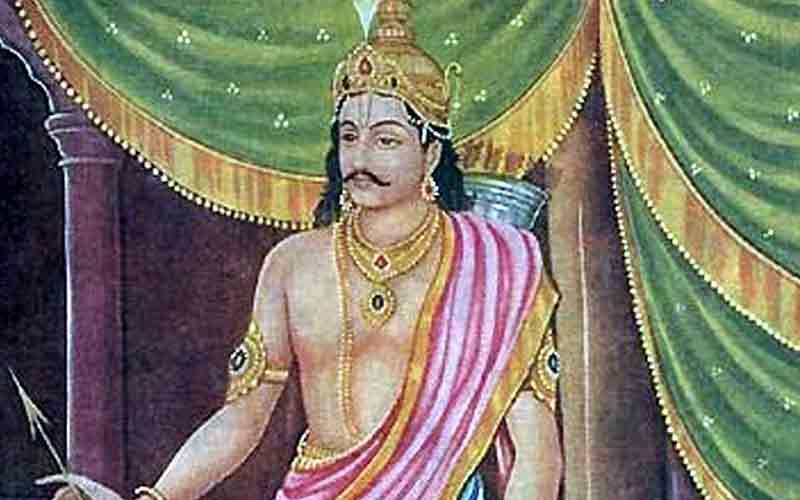
Krishna-paksha (dark fortnight of the lunar month)! On top of that, Ashtami (eighth lunar day)! And that too during Dakshinayana (southern transit of the sun)! Only a Purnavatara (complete incarnation) can endure this, and make it auspicious!
In one Mahayuga (great epoch), there are ten avataras (incarnations) of Shri Vishnu, of which only three are Purnavataras. Of those three, only the Krishna-avatara spans two yugas (epochs)—Dvapara and Kali, because there is no Purnavatara in Kaliyuga (the dark age). Kaliyuga simply cannot endure a Purnavatara .
Dharma (righteous order) is never relative to space, time, and circumstance. It is opportunism and pragmatism that are relative to space, time, and circumstance.
Dharma is only one, and it is Sanatana (eternal), timeless, and immutable. Dharma is the correct Vedic method of performing karma (action), and to identify whether that method is correct or not, there are ten characteristics of dharma—all of which are Sanatana, timeless, and immutable.
However, the methods of applying dharma in practice are relative to space, time, and circumstance, which is why those who do not understand the essence of dharma feel that there are many dharmas or that its relative forms are many.
The person who expounds the correct method of dharma is called a Brahmana (priestly/scholarly class), and the compilation of those methods is called the Brahmana-grantha (liturgical prose texts of the Vedas). Brahmana-granthas were not written down, because whatever is written down is incomplete.
Dharma is the correct Vedic method of performing karma—the Purnavatara Shri Krishna explained the correct method of dharma to Arjuna in Kurukshetra. But the Gita does not merely contain the instruction of duty relative to the immediate space, time, and circumstance; it also contains the eternal instruction of dharma for all four varnas (social classes).
If the ten characteristics of dharma are not understood, then remember just one characteristic—the karma which aids in the abidance in the true nature of the eternal Atma-tattva (soul-principle) is dharma, and that which hinders it is adharma (unrighteousness). Abidance in the true nature itself is not dharma; rather, the karma which aids in it is dharma.
To live in the world, one must perform karma; therefore, abandoning all duties to enter samadhi (meditative absorption) is not dharma—such a person will only meet with failure in samadhi. Only by crossing the avidya (non-knowledge) of duties through the avidya of dharma can one attain the state of vidya (knowledge), which is the abidance in the true nature beyond duties. Abidance in the true nature is not dharma; only after the purnahuti (final offering) of the dharma-purushartha (goals of human life) can one qualify for the fourth purushartha.
Lord Shri Krishna, the Supreme Guru of even the Gurus
Dharma is the ordinance of correct karma. Therefore, dharma is avidya. But among all avidyas, dharma is the only avidya that opens the door to real vidya. All other avidyas are to be abandoned.
Real vidya is also mentioned in the Gita—there is no knowledge like Samkhya (analytical philosophy)! But without attaining the strength of Yoga (spiritual discipline), it is impossible to reach there. Those who reach there easily have already acquired strength in their past lives. The mind is the most powerful, and control over the mind is the greatest strength.
Dharma is the first purushartha. Without it, all other purusharthas will remain unachieved. The three angles of dharma are—Lagna (ascendant), Panchama (fifth house), and Navama bhava (ninth house).
Lagna is that collection of the kriyamana samskaras (present-life impressions) of the gross and subtle bodies which gives a person their characteristic identity. Identity means the body—both gross and subtle.
Panchama represents worldly branches of knowledge, which make the gross and subtle bodies fit to live. Navama is the correct Vedic karma performed through that body and knowledge. All religious actions fall under Vedic karma, even if performed with an atheistic attitude. If an atheist performs selfless social service, it is dharma. If a theist turns theism into a business, then his theism is false.
Karma has two divisions. All religious actions are the Navama bhava. All other worldly actions are the Dashama bhava (tenth house). Both these types of karma become akarma (inaction) when they are nishkama (desireless). Including akarma, there are three divisions of karma.
The twelfth house from the Dashama, i.e., the house of loss, is the Navama. That is, when the Navama increases, the Dashama decreases. Therefore, with the increase of dharma, worldly sakama karma (desire-driven action) decreases, and the samskaras (latent impressions) for attaining moksha (liberation) begin to grow stronger.
The essence of Janmashtami is the Gita. And the essence of the Gita is nishkama karma. In Kaliyuga, people call even sakama karma "nishkama"; they charge fees even for discourses on the Gita; they relish and swallow food forbidden in the Gita; and forgetting the philosophy of the Gita, they stage the Rasalila (divine play of love)—without knowing the meaning of either 'Rasa' or 'Lila'.
To feel the experience of dissolution (laya) by drowning in rasa (nectar/essence), yet to emerge free from rasa like a lotus, is 'la' after 'li'. Drowning in desire (kama) is not dissolution; rather, the dissolution—meaning the destruction—of desire is 'li' or 'laya'. Desireless desire (nishkama kama) is the most difficult action in the world, but in the Gita, it is called Shri Krishna Himself. This is the essence of Rasa.