YugSamvad · Sanskrit & Shastra
Sanskrit & ShastraThe Vanishing Art of Sculpting Murtis from Shaligram Shilas
अविनाश भारद्वाज शर्मा · English edition 23 October 2026 · Hindi original 7 October 2018 · 4 min read
Since ancient times in India, there has been a tradition of selecting specific stones for the vigrahas (consecrated deity forms) of sacred temples. This tradition continued from antiquity up until perhaps a century and a half ago; ever since a market of sculptors arose in Jaipur, white marble pratimas (sacred icons) began to be installed in temples across almost the whole of North India. In earlier times, reaching back to the Pauranic age, stone from the Gandaki river in the Shaligram region of Nepal was chosen for the Shri vigraha. Across many renowned tirthas (pilgrimage sites) of India, pratimas carved from Shaligram-shila (sacred stone manifestation of Vishnu) are consecrated and worshipped. Several of these tirthas date back to Pauranic antiquity, and these murtis are described in the Puranas.
The image provided below is of Mehkar Balaji in Buldhana district; this tirtha is described in the Skanda Purana under the name Ghangkar. Here stands the Sharngadhara (wielder of the Sharnga bow) murti of Bhagavan Vishnu, approximately 11 feet in height. We had darshan (sacred viewing) here in 2005, and it is our claim that across all of India, extraordinarily unique and artistic pratimas of this kind are exceedingly rare. His vanamala (forest garland) and kirita (crown) are so richly ornate that one is left astonished upon beholding them. This temple stands on the banks of the Painganga river; many people say about it that the entire murti is carved from a single Shaligram-shila. However, our Acharya pointed out that Shaligram is a very soft stone, making it impossible to carve such a massive pratima from it.
In the deep South, many vigrahas are carved specifically from Shaligram-shila. Among them, a vigraha of Bala Narsimha is particularly celebrated. In the distant Shri Padmanabhaswamy Temple of Thiruvananthapuram, the murti of Bhagavan Padmanabhaswamy is likewise fashioned from several thousand Shaligram-shilas. That pratima was assembled by binding the Shaligrams together with the application of an Ayurvedic paste called “Kadu-sharkara Yogam” upon Bhagavan’s Shri vigraha. Centuries ago, there was a pratima carved of jackfruit wood, but when the temple once caught fire, the pratima too was consumed by flames. It was then that 12,000 Shaligrams were brought to create this pratima. Besides this, in Barshi, which was the capital of Maharaja Ambarisha, the murti of Vishnu worshipped by him—known as Bhagavant—is carved from Shaligram-shila. (Although newly emerged sampradayas (lineages of tradition) claim the icons at their own centers to be those worshipped by Ambarisha.) For the famous pratima of Bhavani Mata at Pratapgad, Chhatrapati Shivaji Maharaj dispatched his men to Nepal to procure a Shaligram-shila, from which, having brought a suitable stone, the pratima of Bhavani Mata was sculpted.
The pratima of Shri Yoganarayana Bhagavan at Badrinath is also of Shaligram-shila, though it is svayambhu (self-manifested). Likewise, the pratima of Bhagavan Narsimha in the Kaivalya Narsimha form at Joshimath is fashioned from Shaligram. Bhagavan Dhundhiraja Ganapati, situated right at the entrance of the Vishwanath temple in Kashi, was commissioned by Raja Divodasa from the stone of the Gandaki—that is to say, Shaligram-shila; this account is attested across several texts.
Among Shaktas (worshippers of the Devi), within the Shri Kula, the yajana (ritual worship) of Gopalasundari is of course performed upon a Shri Chakraraja carved on Shaligram-shila; but upon searching, you will find murtis sculpted from Shaligram-shila in numerous other temples as well, especially in the shrines of the Madhva sampradaya.
Similarly, in Vrindavan, Radharaman of Radharaman Bihari in the tribhangi (three-curved) posture manifested from just a single small Shaligram, which is an extraordinary murti.
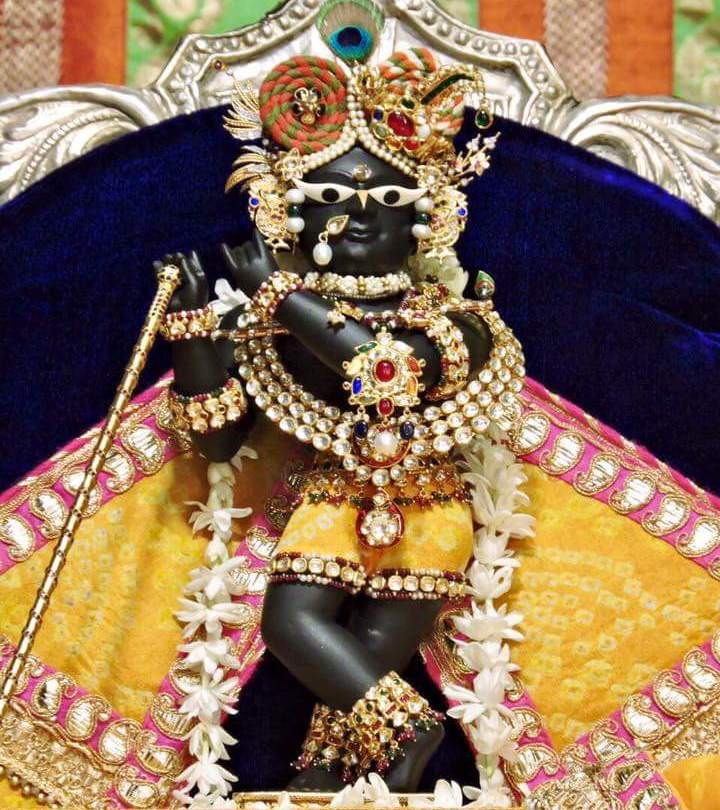
Shri Radharaman Bihari, Vrindavan
This discussion arose because we were desirous of having a special Shri vigraha sculpted for ourselves from a Shaligram-shila. By the grace of Devi Dakshinamurti, a sufficiently large Shaligram-shila had also been arranged for it. Then, to have the murti carved, we reached out to a friend of ours; the poor fellow suffered great trouble on this account. He spoke with several sculptors, but the answer the artisans gave was startling. At the very thought of striking a Shaligram-shila with a chisel and hammer, the artisans folded their hands, touched their ears, and uttered *shantam papam* (“may this sin be averted”). One artisan even went so far as to say, “Guruji, even if you weigh out gold equal to the stone, we will not be able to perform this task.”
While this might have been disappointing for us, we were, on the contrary, so delighted that every pore of our body thrilled with joy. We thought: this alone is the bhava (devotional sentiment) that ferries one across—that this stone is no mere stone, but the very body of our Lord, or the Lord Himself. A bhava that even we have failed to cultivate to this day! At a time when many so-called foremost sadhakas born of the Brahmavansha wander about running shops of Bagala Yantras, Shri Yantras, Lakshmi Yantras, and the like, merchandising their Ishta devatas (chosen deities), we were deeply moved to realize that no, sadhakas harboring genuine bhava toward the Supreme Being still exist on this earth. We told our brother to convey our dandavat (prostrations) to those artisans on our behalf.
Shaiva Sampradayas of Sanatana Dharma
Cite this article
अविनाश भारद्वाज शर्मा. “The Vanishing Art of Sculpting Murtis from Shaligram Shilas”. YugSamvad, 23 October 2026. https://yugsamvad.com/en/articles/shaaligraama-shilaaon-se-moortiyaan-banaane-kee-praacheena-kalaa-ho
https://yugsamvad.com/en/articles/shaaligraama-shilaaon-se-moortiyaan-banaane-kee-praacheena-kalaa-ho · accessed
Related reading
Determining the Jati of Shabari – Acharya Gangadhar Pathak
'Shri Ram's Devotee Shabari Was Not a Bhilni, But a Brahmani' Author: Pandit Gangadhar Pathak ‘Vedadyacharya’ Chief Acharya – Shri Ram Janmabhoomi Shila Pujan, Ayodhya Advisor: Shri Sarveshwar Jayaditya Panchang (traditional almanac), Jaipur Conducting the shilanyas (foundation stone laying) of the Shri Ram Janmabhoomi Temple in Ayodhya with Prime Minister Shri Narendra Modi m
18 October 2026 · 1 min read
The Meaning of Medha, Kautuhala, Jigyasa and Herd Mentality
*Medha* (intellect) and the Herd “He who protects *dharma* (righteousness/cosmic order), *dharma* protects him.” The meaning of *dharma* is Vedic *yajna* (sacrificial ritual), that is, the *karma-kanda* (ritual section) of the Vedas. There are ten characteristics of *dharma* — *dhriti* (fortitude), *kshama* (forgiveness), *dama* (self-control), *asteya* (non-stealing), *shaucha* (purity), *indriya-nigraha* (sensory control), *dhi* (intellect), *vidya* (knowledge), *satya* (truth), and *akrodha* (absence of anger). But these are merely characteristics on the basis of which we can recognize that a particular...
18 October 2026 · 8 min read