Very few people are aware that while Akbar used to have temples demolished in his kingdom, he did not permit the construction of temples. Even Sant Tulsidasji was not given permission to build a Hanuman temple. When Tulsidasji built a Hanuman temple within the perimeter of the palace in Varanasi, Akbar issued orders to demolish that as well. It was only due to the intervention of Raja Man Singh and Todar Mal, and the Maharaja of Varanasi stating that he had built the temple for his own worship, and that too inside the palace, that the temple was saved from demolition. Shri Krishna Janmabhoomi
During Babur's time, the temple at Shri Ram Janmabhoomi was demolished for the first time. Immediately after his death, during the reign of Humayun, Hindus drove the Muslims out of Ayodhya, demolished the mosque built by Baqi at Shri Ram Janmabhoomi, and rebuilt a temple using the very same materials. Shri Krishna Janmabhoomi
Akbar had a general named Husain Khan Tukriya. Kant-Gola and Lucknow were in his jagir (land grant). He was not a Mughal but an Afghan. He heard that Emperor Babur had demolished the temple of Ram, the deity of the infidels, in the year 1528, which the Chauhans of Mainpuri had rebuilt in 1540 when Humayun fled India. Then Husain Khan Tukriya sent word to Akbar that he was going on jihad (holy war). Shri Krishna Janmabhoomi
Husain attacked Ayodhya and demolished the temple once again. As soon as the news of the temple's demolition spread, the Hindus revolted. Raja Man Singh and Todar Mal were confronting Ali Quli Khan Khan-i-Zaman with their army. They also reached Ayodhya with their forces. There, Husain Khan Tukriya had already reconstructed the mosque. On one side were Husain Khan's forces, and on the other side were thousands of armed Hindus bent on a fight to the death. In between were the forces of Man Singh and Todar Mal.
News of the tension in Ayodhya reached Akbar in Agra. He found a middle path. The Hindus were granted permission to build a platform in front of the mosque where they could perform puja (worship) and prayers. Thus, the Ram Chabutra was constructed, and a massive bloodshed was averted due to Man Singh's mediation. Shri Krishna Janmabhoomi
The cycle of demolition and reconstruction of temples in Mathura also occurred several times. In the year 1018, Mahmud Ghaznavi had all the temples of Mathura demolished, but as soon as he returned, the temples were rebuilt. With the defeat of Prithviraj Chauhan in 1192, Muslim rule was permanently established in India. Temples in North India began to be demolished and could not be rebuilt. Tombs and mosques were constructed in their place.
For 350 years, Hindus lived in a Mathura devoid of temples. In 1555, Hemchandra Bhargava, the general of Adil Shah Suri, conquered Delhi, Agra, and the surrounding areas and declared his independence. He performed a yajna (sacrificial ritual) and assumed the title of Vikramaditya, establishing a Hindu kingdom in Delhi. Unfortunately, Hemu Bhargava's reign lasted for only one year, but within this single year, the local Jats and Yadavs joined forces and demolished every single mosque in Mathura. Mathura became a city of ruins, but after the establishment of Akbar's rule in 1556, new temples could not be built.
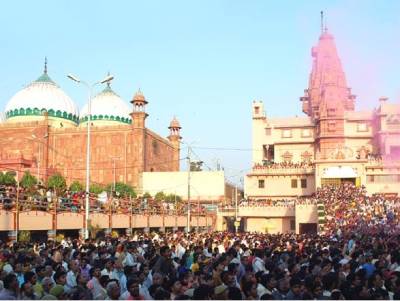
Near the haveli (mansion) of a Chaube (priest) of Mathura lay the ruins of the birthplace of Bhagwan Shri Krishna. This entire area was called Katra Keshavdev. Hindu pilgrims used to visit. Seeing the devotees perform parikrama (circumambulation) and worship of the ruins daily, the Chaube would sit in his haveli and shed tears. But what could the helpless Chaube do? The kingdom was Akbar's, the army was Akbar's, and the city kotwal (police chief) and qadi (judge) were Akbar's. When permission was not granted to build a temple even at a new location, who would allow a temple to be built on the ruins of the mosque constructed over the Keshavdev temple?
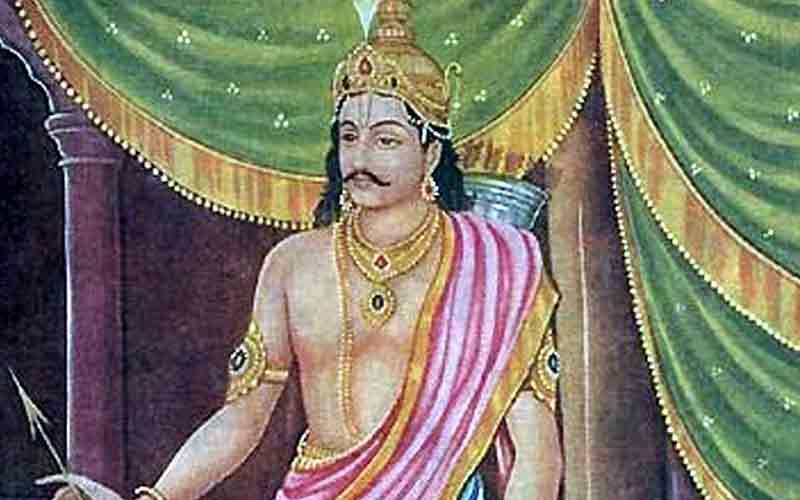
Around this time, Raja Man Singh returned after conquering Bengal. Until then, Babur, Humayun, and even Akbar had not been able to conquer the whole of Bengal. Man Singh was welcomed with great pomp in Agra. Akbar said to Man Singh, "On this occasion of victory, ask for whatever you desire." Akbar had already resolved in his mind to grant the governorship of Bengal, Bihar, and Odisha to Man Singh, but Man Singh requested the Hindu pilgrimage sites of Mathura and Vrindavan for his jagir.
Akbar was impressed by the devotion of this loyal Hindu. He immediately granted the pilgrimage sites of Mathura-Vrindavan to Man Singh as a jagir, and also renamed Bengal, Bihar, and Odisha as Veer Man Singh Bhumi. Currently, these regions are called Pargana Veerbhum, Pargana Manbhum, and Pargana Singhbhum. These very names are recorded in the official registers.
As soon as Mathura-Vrindavan were included in Man Singh's jagir, the Mughal soldiers were withdrawn from there, but the qadi remained entrenched in the post of judge. Akbar had appointed Sheikh Abdul Nabi to the post of Sadr-us-Sudur (chief religious authority). This very person oversaw matters of justice, Islam, and religious places, and distributed charity and endowments to mosques, tombs, mullahs, and maulvis.
As soon as the administration of Mathura came into the hands of the Kachwaha soldiers of Amer, the courage of the Hindus of Mathura returned. The Chaube of Katra Keshavdev gathered stones and bricks from the ruins of Shri Krishna Janmabhoomi and built a platform. Since there was a ban on building temples in those times, who would make murtis (deity idols)? There was no murti of Krishna, so the Chaube, in a hurry, performed the pran-pratishtha (consecration ritual) of a Shiva murti. This was the first Hindu temple in Mathura in the past 350 years of subjugation, so a massive crowd of devotees thronged the place.
When the city qadi found out, he summoned the Chaube to his court. But where did the Chaube have the time? He was busy day and night with worship, rituals, and managing the incoming and outgoing devotees. The work of constructing walls and a dome on the platform was going on in full swing. Enthusiastic devotees were offering heaps of money. There was no dearth of wealth or manpower.
There were long queues of laborers offering free voluntary service. There were no Muslim soldiers in the city, and the Kachwaha soldiers were thrilled to see the construction of the first Hindu temple outside Amer. A couple of bands of fanatical Muslim soldiers did arrive from Agra, but seeing the defiant attitude of the thousands of enthusiastic devotees, they quietly slipped away.
Upon receiving the news, the Sadr-us-Sudur and local as well as foreign Muslim chieftains surrounded Akbar in the court of Sikri, demanding that this defiant act of kufr (infidelity) be crushed. Two factions, for and against, formed in the court and the harem. All the Muslim chieftains were on one side, and the Hindu chieftains were on the other. While the Muslim begums (queens) of the harem spoke of demolishing the temple, the Hindu begums and chieftains argued that since the temple of Shri Krishna Janmabhoomi stood there originally, whatever has been built is built, and it should not be demolished.
The Muslim chieftains and Sheikh Abdul Nabi Sadr argued that since the state was Islamic, building a temple in an Islamic state was kufr. The temple there had been demolished to build a mosque. Whatever its condition, building a temple at that site was against Islam.
Akbar was caught in a dilemma. The Hindu resistance in India had ended, but the Mirzas of his own family and the Indian Afghans were raising their heads. Mirza Abdullah of Gujarat, Ali Quli Khan, Khan-i-Zaman and Bahadur Khan of Jaunpur-Chunar, Asaf Khan of Malwa-Kara, Daud Khan, the Afghan of Bengal, and his own brother Mirza Hakim of Kabul could only be subdued by the swords of Man Singh and Todar Mal.
He did not want to make enemies of the Rajputs, nor did he want to displease the local and foreign Muslims. For this reason, he told the Sadr, "This is a religious matter and you are its head; do as you wish. I will not interfere."
Sheikh Abdul Nabi Sadr issued a decree that the temple being built in Mathura without permission be demolished, and dispatched two thousand Mughal soldiers to Mathura. The news flying from Agra reached Mathura: "Now the temple will be demolished...!" The news spread like wildfire through the villages. The 'Ajgar' (python) residing all around Mathura hissed to life. 'A' for Ahir, 'Ja' for Jat, 'Ga' for Gadariya (shepherd), and 'Ra' for Rajput converged upon Mathura, ready to face death.
The Shri Krishna Janmabhoomi complex and the streets of Mathura were packed. Jains, Agarwals, and Kayasthas opened their purses. Every Hindu household in Mathura became a kitchen. Hindu women prepared puri-sabzi day and night, and their men, with folded hands, pleaded with and fed the warriors of dharma (righteousness/duty) who had arrived from outside. Merchants' carts went from house to house distributing flour. The whole of Mathura had turned into a festive town.
When the Mughal contingent reached Mathura, they were intimidated by the sight of armed Hindus packed into the streets and neighborhoods. The Mughal cavalry then circled around and reached Shri Krishna Janmabhoomi. There too, the Hindu populace was overflowing. Seeing the Mughals heading towards Shri Krishna Janmabhoomi, the Kachwaha soldiers of Mathura also mounted their horses and headed in the same direction. Seeing the Kachwaha soldiers, the Mughals gained some confidence. The Mughal commander said in a loud voice to the Hindus standing in the complex, "You people vacate this place; work is being done here without permission, otherwise there will be bloodshed."
But no one budged an inch. They had come to embrace death; who would retreat, who would bring shame to his mother's milk? Then the Mughals drew their swords. The Hindus standing in the complex also readied themselves with pickaxes, shovels, lathis, spears, stones, bricks, or whatever they could find. Before the Mughal cavalry could attack, the Kachwaha soldiers drew their swords and stepped between the Mughals and the public. The Kachwaha commander said to the Mughal general, "Miyan! If you dare to lay a finger on even a single Hindu, your graves will be dug right here."
In this changed situation, the Mughals were bewildered. They could have somehow clashed with the public, but overcoming the royal Kachwaha soldiers was difficult. The entire populace was with them. It was best to retreat. And so the reins were turned; the Mughals went back just as they had come.
Upon returning to Agra, the Mughal general narrated the rebellion of the public and the Kachwaha soldiers to Akbar with much exaggeration. The Sadr and Muslim chieftains also exerted pressure, but fearing a massive catastrophe, Akbar maintained silence. Meanwhile, in Mewar, Maharana Pratap was seizing one Mughal fort after another. Except for Chittor, Ajmer, and Mandalgarh, the Mughals were driven out from everywhere. Akbar thought that if fifty thousand Kachwaha soldiers joined Maharana Pratap, what would become of his empire?
Ultimately, it was decided that the Chaube should be summoned to Agra and questioned. Raja Birbal and Abul Fazl of the court were sent to Mathura. Assuring him on their part, they brought the Brahmin to Agra and submitted to the court that while some insolence had certainly occurred, building a temple at the birthplace of one's deity is no crime.
Now that the Brahmin (Chaube) had arrived in the capital Agra, and his supporting Hindu subjects and Hindu Kachwahas were not present here, he was thrown into prison by order of the Sadr.
Now, debates took place daily in the court regarding what should be done with the Brahmin. The Muslims insisted on the death penalty, while the Hindus suggested imposing a fine, humiliating him, parading him through the city, and then releasing him. Man Singh listened to the entire debate in silence. Man Singh's fiery eyes and silence revealed the resolve of his mind.
Akbar could see the Mughal Empire crumbling before him. Akbar called Man Singh and Todar Mal aside and said, "Raja Sahab! I will not give the order to demolish the temple in Mathura, and if you wish, you can build more temples in Vrindavan; I will not interfere in that."
On the other hand, he called Sadr Abdul Nabi and the fanatical mullahs and maulvis aside and said, "Mathura-Vrindavan are now under Man Singh's jurisdiction. There is no Mughal rule there, so do not say anything regarding that place. The Brahmin is in your custody; decide whatever you wish for him."
The next day, the Sheikh Sadr had the Brahmin executed. As soon as the news of the Brahmin's murder spread, the Hindu courtiers gathered at the lake of Sikri. The debate erupted again. When Fazil Bada'uni justified the murder, Akbar scolded him and expelled him from the court; Bada'uni never returned to the court for the rest of his life. The Emperor's teacher, Sheikh Mubarak, stated that all authority of imamate (religious leadership) and decision-making should rest with Akbar. Upon his saying so, all the powers of the Sheikh Sadr were stripped, and he was relegated to a mosque, but the Hindus were not appeased. Shri Krishna Janmabhoomi Shri Krishna Janmabhoomi
Man Singh's soldiers began patrolling around the mosque of Sheikh Abdul Nabi Sadr, and fanatical Muslim soldiers also began gathering in the mosque to protect the Sadr's life. Day by day, the fire kept raging. To save the Mughal Empire, Akbar quietly summoned Sheikh Abdul Nabi to Sikri one night and said, "The safety of the Mughal throne and your life lies in your quietly leaving for Mecca on the pretext of Hajj (pilgrimage), and do not return to India thereafter." (From Muhammad Husain Azad's 'Darbar-i-Akbari')
Akbar sent the Sadr off for Hajj with a large amount of wealth along with Makhdum-ul-Mulk, and granted permission to build 4 temples in Vrindavan. First, the temple of Gopinath, then the temple of Madanmohan, and in 1590, the temple of Govind Dev were built. Finally, the temple of Jugal Kishore was completed in 1627 during the reign of Jahangir. (Smith, page 479)
The Sheikh did not find peace in Mecca, and his impending death drew him back to India. He boarded a ship and arrived in Khambhat. Here, the situation had changed. The Sheikh went straight to Akbar's court. The very Akbar who once used to pick up his shoes for him to wear, whom the Sheikh had once struck with a stick and the Emperor had accepted it as prasad (consecrated offering), that same Akbar, upon seeing him in court, punched him hard in the face. The Sadr quietly said only this, "Jahanpanah (Emperor)! Why do you not just kill me with a knife?" Shri Krishna Janmabhoomi
Todar Mal was also nursing a grudge. While leaving for Mecca, the Sheikh had been given 70 thousand rupees from the treasury. Todar Mal demanded an account of that money. Until a decision was reached, he was kept under the supervision of Abul Fazl. Man Singh's soldiers began circling Abul Fazl's haveli. Akbar hinted, "My good man! The Rajputs are thirsty for his blood. Lest it happen that along with him, I and my empire are also ruined." Shri Krishna Janmabhoomi
...and one night, someone abducted Sheikh Abdul Nabi Sadr from Abul Fazl's haveli. The next day, the residents of Agra saw that the body of the Sheikh, the religious authority of Islam, lay abandoned in the field of towers. In the distance, some Kachwaha horsemen were patrolling; out of fear, no one dared to go near the corpse. (From Muhammad Husain Azad's 'Darbar-i-Akbari', page 299)
This incident makes it clear that Akbar was not generous towards Hindus. He was a selfish opportunist of the highest order. When he had to crush and enslave Hindus, he took the help of his fellow countrymen, the Mughals; and when he had to eliminate the rebelling Mughals and his own kinsmen, he took the help of the Rajputs. In return, he permitted them to build temples, abolished jizya (tax on non-Muslims), and removed the tax on pilgrimages.
According to Father Monserrate of the Jesuit Mission, Akbar was extremely cunning; no one could fathom his mind. When he wanted to get a job done by someone, he would praise and flatter them in every way, and once the work was done, he would turn away as if he did not even know them. He had behaved in the same manner with the priests of Goa. Shri Krishna Janmabhoomi