YugSamvad · Dharma & Culture
Dharma & CultureVivekananda Rock Memorial: Symbol of a Historic Struggle
Mudit Agrawal · English edition 23 October 2026 · Hindi original 17 July 2018 · 8 min read
Vivekananda Rock Memorial – Kanyakumari, Symbol of a Historic Struggle
Traversing the entire length and breadth of the country, the wandering sannyasi (renunciant monk) arrived at the southernmost tip of India, where the temple of Bhagavati Kanyakumari has stood since antiquity. The sannyasi fell prostrate at the feet of the Divine Mother. Out in the sea lay two rock formations severed from the mainland. Seeing no other way to reach the rock, the sannyasi leaped into the ocean. On that very rock of Kanyakumari, on 25, 26, and 27 December 1892, the sannyasi meditated at the sacred feet of the Mother. The past, present, and future of Bharatavarsha unfolded across his chitta (consciousness) like a moving scroll, revealing to him both the root cause of India’s wretched condition and its remedy. He had a direct vision of the mission ordained for him by God. Amidst the surging, tumultuous waves of the surrounding sea, the sannyasi’s troubled mind, weary from India’s suffering, found profound stillness. That sannyasi was Swami Vivekananda, and that place was the Vivekananda Rock, Kanyakumari. Resolutely proclaiming from that southern tip, “India belongs to the Hindus,” that rock has emerged as the fifth sacred center of the Hindu consciousness after the Char Dham (the four sacred pilgrimage abodes). It encapsulates within itself the history of Hindu victory, a vivid record of the deceit of alien creeds, and the saga of the struggle of Sanatana Dharma (the eternal order).

The Inspiration Behind the Construction of Swami Vivekananda Rock Memorial
In 1963, during Swami Vivekananda’s birth centenary celebrations, Dattaji Didolkar, the Prant Pracharak (provincial organizer) of the Rashtriya Swayamsevak Sangh, was inspired by the conviction that this rock should be named the Vivekananda Rock Memorial and that a statue of Swamiji ought to be installed upon it. The Hindus of Kanyakumari were galvanized with immense enthusiasm and formed a committee. Swami Chidbhavananda threw himself wholeheartedly into the endeavor. But this demand alarmed the Catholic Church in Tamil Nadu, which began to dread that such an undertaking would ignite a wave of Hindutva among the Hindus; the Church viewed the proposal as a formidable obstacle in the path of its evangelical mission. Renowned worldwide for its cunning, the Church swung into action immediately. Instead of Vivekananda Rock, the Church renamed the site ‘St. Xavier’s Rock’ and fabricated the myth that Saint Francis Xavier had set foot on this rock in the sixteenth century. To assert its claim over the rock, it installed a cross—the emblem of the Church—and marked crosses upon the stone. Converted Christian boatmen refused to ferry Hindus from the shore to the rock. Consider who this savage and ruthless missionary chosen by the Church really was—a man in whose name thousands of convent schools continue to run across India to this day.
Who Was Saint Francis Xavier?
Francis Xavier arrived in India in 1542 backed by the King of Portugal and the Pope. By then, Goa had fallen under Portuguese dominion, and the mission was aggressively engaged in proselytization. Such was the depth of his hatred for Hindus that Xavier proclaimed:
“The Hindus are an impure race; the gods of these black people are also black, which is why they make black idols of them. They smear their idols with oil, from which emanates a foul stench, and their filthy idols are hideous and terrifying.”
Because of their sacred icons, karmakanda (ritual rites), and varna, converting the Hindus proved difficult. Xavier therefore conspired with the Portuguese viceroy of Goa, Dom António de Noronha, to order the demolition of Hindu temples. Conversions were carried out at the point of the sword. Despite the destruction of their temples, Hindus remained devoted to their deities and worshipped sacred murtis (consecrated icons) within their homes. He subsequently outlawed murti worship altogether. In the eyes of Francis Xavier, Brahmins were his greatest enemies, for they constituted the sturdiest barrier against conversion. He therefore had Saraswat Vedic scholar-Brahmins burnt alive. Those who refused to accept the faith were cleaved in two. Those who failed to recite the baptismal rites had their tongues excised. Christian indoctrination was made compulsory for all Hindu children up to the age of 15. Beef was forcefully shoved down their throats. Recitation of the Vedas was banned. The janeu (sacred thread) of the dvijas (twice-born) was violently ripped off. The Portuguese subjected Hindu women to mass rape. To satiate the lust of the Arab and European worlds, women were loaded onto slave ships; countless women chose instead to leap into the ocean, casting themselves to marine predators. Women's breasts were mutilated with iron rods. Red-hot iron skewers were driven into their vaginas and rectums. Their fingernails were torn out and nails driven into the flesh. Hindu marriages and rituals were outlawed. Anyone caught performing public rites was flayed alive. Eyes were gouged out with heated irons. Flesh was torn away with pincers. Three hundred Hindu temples in Bardez were razed to the ground; within just two decades, Assolna and Cuncolim were stripped of every single temple. All deities were shattered; only Shri Mangesh and Shanta Bhavani stood firm at their seats.
The sheer ecstasy Xavier derived from demolishing their places of worship and smashing their sacred images while converting Hindus can be gauged from his own words:
“When all are baptized, I order that the temples of their false gods be pulled down and all their idols broken into pieces. I cannot describe the delight I experience when I see the temples pulled down and the idols shattered to pieces by the very hands of those who until yesterday used to worship them.”
In reward for swelling the flock of Jesus Christ by terrorizing, butchering, dispossessing, exiling, and torturing thousands of Hindus in inquisitorial dungeons, the Christian world conferred sainthood upon Francis Xavier. It was this very Xavier whom the Church chose in order to humiliate and demean the Hindus. Kanyakumari
The Struggle of the Hindu Society
Yet the Hindu heroes did not relent. Swayamsevaks (volunteers) Balan and Lakshman dove into the sea at Kanyakumari and swam across to the rock. One night, the crosses mysteriously vanished. A state of acute tension and conflict enveloped the entire Kanyakumari district, prompting the state Congress government to impose Section 144. The Congress Chief Minister, M. Bhaktavatsalam, was a devout man with deep reverence for the Kanchi Shankaracharya, yet for the sake of party self-interest and vote-bank arithmetic, he was unwilling to antagonize the Church. However, inspired by Dattaji, the All India Vivekananda Rock Memorial Committee was formed under the presidency of Mannathu Padmanabhan, with the solemn declaration that before the conclusion of Swami Vivekananda’s centenary year, which commenced on 12 January 1963, they would install his statue upon the rock. On 17 January 1963, the committee installed a memorial tablet on the rock. But on 16 May 1963, under cover of darkness, Christians smashed this plaque and flung it into the sea. The situation grew exceedingly volatile once again. As circumstances spiraled out of control, Sarsanghchalak (supreme head of the RSS) Shri Guruji had to step forward. Shri Guruji entrusted this historic task to Sarkaryavah (general secretary) Eknath Ranade. Eknathji was steeped neck-deep in Vivekananda's literature. Taking the blessings of Swami Madhavananda of the Ramakrishna Mission, he threw himself into the mission heart and soul. Out of Eknath Ranade's intense churning emerged the work, “हे हिन्दुराष्ट्र! उत्तिष्ठत! जाग्रत! (O Hindu Nation! Arise! Awake!)”
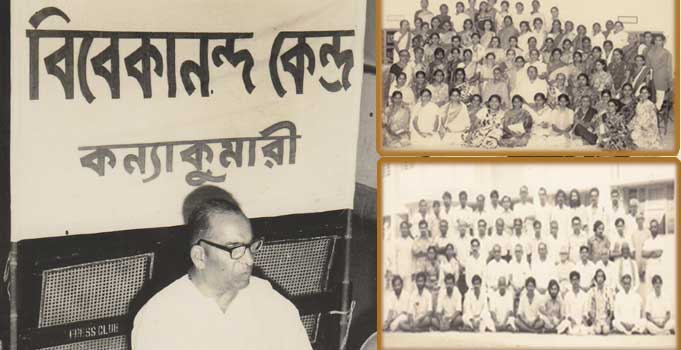
Shri Eknath Ranade and swayamsevaks
From Struggle to Consensus
Tamil Nadu Chief Minister Bhaktavatsalam was well-disposed toward the memorial. However, the Union Minister of Scientific Research and Cultural Affairs, Humayun Kabir, kept creating hurdles under the pretext of environmental clearances. Kabir hailed from Bengal, and the whole of Bengal was passionately yearning for the Vivekananda memorial in Kanyakumari. Eknath Ranade exposed all of Humayun Kabir’s underhanded maneuvers before the public, unleashing widespread fury against Kabir. Control slipped entirely from Kabir’s hands. Yet nothing was possible without the clearance of Jawaharlal Nehru, whose antipathy toward Hinduism was public knowledge. For this, Eknathji approached Lal Bahadur Shastri, who strongly favored the monument's construction. Backed by Shastriji’s support, Eknathji secured letters of endorsement from 323 Members of Parliament in just 3 days—a roster spanning figures from Communists to Muslims, all of whom held Swamiji in high esteem.
When Nehru received the signature letter from so many parliamentarians, he was compelled to grant his consent for the memorial to Bhaktavatsalam. Even so, disputes persisted between Bhaktavatsalam and the Vivekananda Committee over the dimensions, grandeur, and design of the memorial. Meanwhile, Christians left no stone unturned in throwing roadblocks in the way. While the committee envisioned a magnificent monument, Bhaktavatsalam adamantly insisted on a small, modest shrine. But Eknath Ranade surmounted every obstacle, achieved harmonious consensus, and erected a magnificent edifice—the Vivekananda Rock Memorial. It incorporated a Dhyana Mandapam (meditation hall), the bhagwa dhwaj (sacred saffron flag), the sacred footprints of the Devi, and an icon of Om. Betraying their deep petulance, the Christians constructed three massive churches right along the coastline facing the memorial. Yet, in the end, Hindu society triumphed, and this monumental heritage of the Hindu people stands before you today, delivering its message from the southern tip: “India belonged to the Hindus, belongs to the Hindus, and shall belong to the Hindus.”
The bhagwa dhwaj fluttering atop the Vivekananda Rock Memorial at the southernmost tip of India
Also Read:
Cite this article
Mudit Agrawal. “Vivekananda Rock Memorial: Symbol of a Historic Struggle”. YugSamvad, 23 October 2026. https://yugsamvad.com/en/articles/vivekaananda-roka-memoriyala-kanyaakumaaree-aitihaasika-sangharsha-kaa-prateeka
https://yugsamvad.com/en/articles/vivekaananda-roka-memoriyala-kanyaakumaaree-aitihaasika-sangharsha-kaa-prateeka · accessed
Related reading
Dr. Harvansh Lal Oberoi: Staunch Protector of Hindu Sanskriti
The great karmayogi (one devoted to selfless action) Dr. Harvanshlal Oberoi was born on October 21, 1925, in Rawalpindi, to a Punjabi Khatri couple, Shri Dharmachandra and Ramkaur Oberoi. Following the partition of the country in 1947, he had to come to India with his entire family. Harvanshlal Oberoi ji was a worker of the Rashtriya Swayamsevak Sangh (RSS). B
18 October 2026 · 5 min read
Determining the Jati of Shabari – Acharya Gangadhar Pathak
'Shri Ram's Devotee Shabari Was Not a Bhilni, But a Brahmani' Author: Pandit Gangadhar Pathak ‘Vedadyacharya’ Chief Acharya – Shri Ram Janmabhoomi Shila Pujan, Ayodhya Advisor: Shri Sarveshwar Jayaditya Panchang (traditional almanac), Jaipur Conducting the shilanyas (foundation stone laying) of the Shri Ram Janmabhoomi Temple in Ayodhya with Prime Minister Shri Narendra Modi m
18 October 2026 · 1 min read
The Meaning of Medha, Kautuhala, Jigyasa and Herd Mentality
*Medha* (intellect) and the Herd “He who protects *dharma* (righteousness/cosmic order), *dharma* protects him.” The meaning of *dharma* is Vedic *yajna* (sacrificial ritual), that is, the *karma-kanda* (ritual section) of the Vedas. There are ten characteristics of *dharma* — *dhriti* (fortitude), *kshama* (forgiveness), *dama* (self-control), *asteya* (non-stealing), *shaucha* (purity), *indriya-nigraha* (sensory control), *dhi* (intellect), *vidya* (knowledge), *satya* (truth), and *akrodha* (absence of anger). But these are merely characteristics on the basis of which we can recognize that a particular...
18 October 2026 · 8 min read