YugSamvad · Politics & History
Politics & HistoryBalasaheb Deoras: Sarsanghchalak Who Made Sangh Nationwide
विशाल अग्रवाल · English edition 23 October 2026 · Hindi original 23 March 2018 · 5 min read
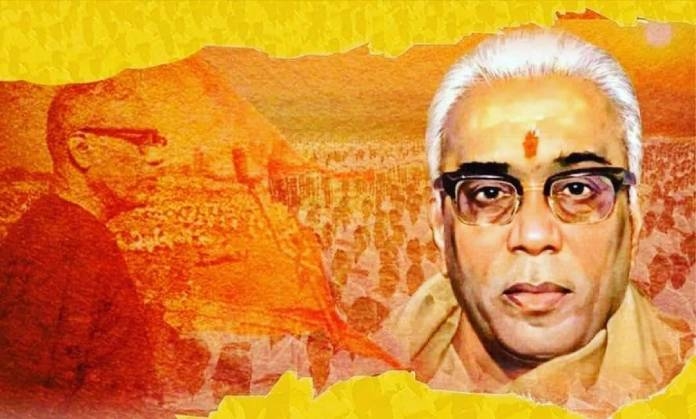
The third Sarsanghchalak (supreme head of the RSS) of the Rashtriya Swayamsevak Sangh, Shri Madhukar Dattatraya Deoras, alias Balasaheb Deoras, is renowned as the pioneer of ‘social upliftment through social harmony and constructive service’. From his boyhood to the final moments of his life, he conceived numerous initiatives to eradicate the social evils, inequities, and deprivations rampant in society, mobilized lokashakti (people’s power) to execute them, and awakened the social consciousness.
Such was Balasaheb Deoras, who was born on 11 December 1915 in Nagpur. His early schooling was at the New English School in Nagpur. Studying Sanskrit and philosophy, he completed his B.A. from Morris College in 1935. Two years later, he cleared his law examination. Blessed with a sharp intellect, Balasaheb passed every examination in his student years with first-class honors.
Shortly after the founding of the Rashtriya Swayamsevak Sangh, he came into contact with Dr. Hedgewar. He was inducted into the ‘Kush Pathak’ of the evening shakha (daily assembly) held at Mohite’s Wada in Nagpur, a squad reserved exclusively for exceptionally gifted students. After graduating in law, he also taught for two years at the ‘Anath Vidyarthi Vasatigriha’ (hostel for orphaned students) in Nagpur.
During this period, he was entrusted with the responsibility of Nagpur’s Nagar Karyavah (city executive), which he discharged with consummate skill. His affinity with the Sangh deepened, and inspired by Dr. Hedgewar, he resolved to dedicate his entire life to the service of the nation through the work of the Sangh.
When he became a pracharak (full-time worker) in 1939, he was deputed to Bengal to expand the Sangh’s reach; however, following the passing of Dr. Hedgewar in 1940, he was recalled to Nagpur. Thereafter, for nearly 30–32 years, Nagpur remained the primary epicenter of his activities. The credit for raising a formidable legion of pracharaks from Nagpur and deploying them across the entire country belongs uniquely to Balasaheb Deoras.
Among the contingents of pracharaks dispatched across the nation was his own brother, Bhaurao Deoras, who was sent to Uttar Pradesh. Operating from Lucknow, Bhaurao imparted great momentum to the Sangh’s mission and drew stalwart figures such as Pandit Deendayal Upadhyaya, the proponent of Integral Humanism, and Atal Bihari Vajpayee into the fold of the Sangh.

In 1948, when a ban was slapped on the Sangh under the fabricated pretext of the Gandhi assassination, Balasaheb Deoras played a central role in conducting the satyagraha (peaceful resistance) against it, and in subsequently reaching out to eminent dignitaries across society to secure the revocation of the ban. He also had a decisive hand in determining the Sangh’s constitution, ganavesh (uniform), physical and intellectual training curricula, and ganageet (choral songs).
He was appointed Sarkaryavah (general secretary) in 1965, and following the demise of Shri Guruji in 1973, took over as Sarsanghchalak. Thereafter, he toured extensively across the length and breadth of the country to galvanize the Sangh’s work. Barely two years later, under the contemptible political ambitions of Indira Gandhi, the Sangh was banned on 4 July 1975.
Under his stewardship, the Sangh faced this ban with supreme fortitude, and under his inspiration, virtually all social, religious, and political organizations—barring the Congress and the communists—rallied together to stage a massive nationwide satyagraha against the Emergency. Consequently, the ban on the Sangh was revoked, and the Congress suffered a catastrophic defeat in the elections of 1977.
In the year 1983, a mass conversion of Hindus to Islam took place in Meenakshipuram (Tamil Nadu). This incident jolted Hindus throughout the entire country. To confront this challenge, the nationwide Ekatmata Yatra was undertaken under the guidance of Balasaheb Deoras. Through this yatra, an unprecedented awakening swept across the country.
During his tenure as Sarsanghchalak, Balasaheb added several new dimensions to the work of the Sangh. Foremost among these were the seva (selfless service) projects launched in impoverished localities. This effectively checked the conversion activities underway there. Swayamsevaks (volunteers) had established various organizations at the provincial level; Balasaheb assigned senior pracharaks to them and transformed them into all-India bodies.

It was during the tenure of Balasaheb Deoras that the Sangh's reach penetrated down to the tehsil (administrative sub-division) level throughout the country. While shakhas proliferated extensively nationwide, the influence and strength of allied organizations also grew substantially during his 21-year period at the helm.
Selling his ancestral estate in Karanja (Balaghat), Balasaheb Deoras used the proceeds to purchase 20 acres of land in Khapri on the Nagpur-Wardha road, which he donated in 1970 to the Bharatiya Utkarsh Mandal. On this land, the Bharatiya Utkarsh Mandir (a school) for rural boys and girls, a goshala (cow shelter), and a hospital named Swami Vivekananda Medical Mission operate today in the service of local villagers.
Despite suffering from diabetes, he shouldered his responsibilities as Sarsanghchalak until 1994. When his physical frame could no longer endure the rigors of travel, he consulted senior karyakartas (functionaries) and handed over the reins to Shri Rajju Bhaiya, setting a sterling example of relinquishing high office. Not only that, before discarding his mortal frame in 1996, he explicitly directed that his cremation be conducted in a public crematorium, precisely like that of any common man.
His objective was to ensure that no monument would be raised in his memory. In the letter he penned during his lifetime, two stipulations were paramount: first, that no memorial be built anywhere in his name; and second, that portraits of no Sarsanghchalak other than the founding Adya Sarsanghchalak Dr. Hedgewar and the second Sarsanghchalak Guruji should ever be installed. On 17 June 1996, Balasaheb departed from this world. Millions of reverent salutations and humble homage to him.
– Vishal Agarwal (The author is an erudite scholar of Indian history and culture, an educationist, and a staunch voice for national causes. The author's series on eminent Indian figures, राष्ट्र आराधक, is essential reading.)
Read also,
Shri Guruji Golwalkar’s Views on the Dangerous Character of Christian Missions
Shri Guruji Golwalkar’s Views on the Muslim Crisis After Partition
Shri Guruji Golwalkar’s Views on the Hollowness of Communism (the Left)
Devendra Swaroop Is No More: The Extinguishing of a Beacon
Swami Vivekananda – Through Whom the World Recognizes Bharat
Binoy Krishna Basu, Who Slew Two British ‘IG’ Officers
Rash Behari Bose, Founder of the Azad Hind Fauj, Who Hurled a Bomb at Viceroy Hardinge
Cite this article
विशाल अग्रवाल. “Balasaheb Deoras: Sarsanghchalak Who Made Sangh Nationwide”. YugSamvad, 23 October 2026. https://yugsamvad.com/en/articles/baalaasaahaba-devarasa-sarasanghachaalaka-jinhonne-sangha-ko-deshavyaapee-banaayaa
https://yugsamvad.com/en/articles/baalaasaahaba-devarasa-sarasanghachaalaka-jinhonne-sangha-ko-deshavyaapee-banaayaa · accessed
Related reading
What Does the Rashtriya Swayamsevak Sangh Do and Believe?
What does the Rashtriya Swayamsevak Sangh (RSS) do and believe? When I was young, a person gave a speech on smoking at school. That speech was so powerful that for many years afterwards I used to think that smoking is the root of all the world's problems. I believed that the day smoking ends, the world w
23 October 2026 · 7 min read
Savarkar and Golwalkar on Hindu Sangathan and Casteism
Read both statements on jati (caste) and Hindu organization carefully and understand the difference. 1. "As long as the sense of jati does not end among Hindus, Hindu organization and Hindu awakening are impossible." — Veer Savarkar 2. "If the Hindu becomes awakened, he will automatically become organized and give a fitting response to the challenge of jati-bhed (caste division)..."
18 October 2026 · 1 min read
Dr. Harvansh Lal Oberoi: Staunch Protector of Hindu Sanskriti
The great karmayogi (one devoted to selfless action) Dr. Harvanshlal Oberoi was born on October 21, 1925, in Rawalpindi, to a Punjabi Khatri couple, Shri Dharmachandra and Ramkaur Oberoi. Following the partition of the country in 1947, he had to come to India with his entire family. Harvanshlal Oberoi ji was a worker of the Rashtriya Swayamsevak Sangh (RSS). B
18 October 2026 · 5 min read