YugSamvad · Dharma & Culture
Dharma & CultureDevendra Swarup Is No More: A Beacon Extinguished
Abhijeet Singh · English edition 23 October 2026 · Hindi original 14 January 2019 · 4 min read
This dates back to the very initial phase of the propagation of 'Rashtriya Swayamsevak Sangh' (RSS) work in Bihar. A pracharak (full-time volunteer) had been sent to Bihar to initiate the Sangh's work. When he went to contact a highly influential person, he could only meet him after several days. When they finally met, that person asked the pracharak: "What is the literature of the Sangh you have come to propagate? Who are its ideal personalities, and what is its darshana (philosophy)?"
The answer given by that pracharak laid a strong foundation for the Sangh's work in Bihar. He had replied: "The literature, the ideal personality, and the darshana of the Sangh is me, my behavior, and my character."
At that time, the Sangh was in its infancy, so no literature had been created, it did not have the name or face of any big leader, nor did it have any such established philosophy. Therefore, the answer given by that pracharak was indeed the reality, because everything of the Sangh was contained within that personality and character, and his reply completely won the heart of that influential person.
Well, that was the story of that era. But when it became necessary for the Sangh to have its own literature so that people could know about it, to have a shalaka purusha (guiding light) whose name could be used as a medium for the expansion of the Sangh, and to have a darshana that would represent the Sangh's dhyeya (ultimate goal) vision, the person who took up the mantle to fulfill this was "Devendra Swarup".
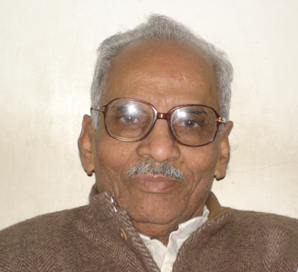 Late Shri Devendra Swarup
Devendra Swarup was a rishi (sage) in every sense. He was himself a pracharak of the Sangh, and Maa Saraswati had also blessed him with mastery in the art of writing, which he used solely to sing the glories of Mother India, awaken Hindu purushartha (righteous endeavor), and warn the nation against the conspiracies of pseudo-secular politics.
There must be hundreds of thousands of people in this country who bought Panchjanya solely to read Devendra Swarup's column. He wrote nearly 1500 articles in his lifetime, but each of his articles was complete in itself. It probably never happened that any doubt regarding the related subject remained after reading one of his articles.
The Rashtriya Swayamsevak Sangh has witnessed many changes and experiments in its long life. Even its own swayamsevaks (volunteers) sometimes doubted and raised questions about the Sangh's experiments, but Devendra Swarup always remained unwavering amidst all these experiments and changes. His dhyeya-nishtha (devotion to the goal) never wavered. He always used to say that there could be questions about the experiment, and about its results, but a swayamsevak must never doubt the intentions of his organization.
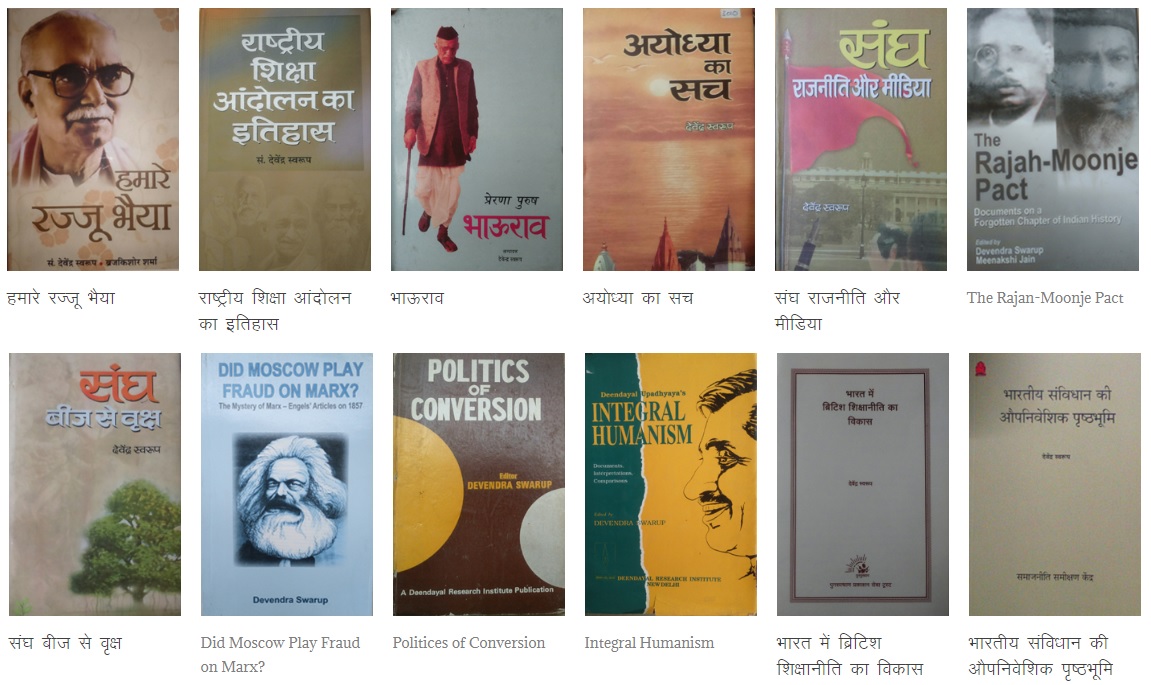
Devendra Swarup was the one who stood like Arjuna in the midst of the legal hearings of the Ayodhya case, when more than a dozen leftist historians were busy spreading venomous propaganda and serving false facts against the Ram Mandir. Devendra Swarup was also the one who had the courage to expose the cruel face of pseudo-secular politics in India at a time when the leftist camp did not consider intellectuals associated with the Sangh ideology even worthy of being compared to them. When the BBC and similar mouthpieces were bent on defaming the Sangh Parivar after the Gujarat incident, it was Devendra Swarup who opened a front against that propaganda from this side. When Murli Manohar Joshi, as the Minister of Human Resource Development, initiated an innovative effort to purify education, Devendra Swarup was the only one who clashed with the left-leaning media. Devendra Swarup also took charge of the front when preparations were being made to entrap the Sangh Parivar in the name of 'saffron terror'. The remarkable thing is that Devendra Ji was doing all these great works in the latter half of his life—standing as an unwavering traveler like Gangaputra Bhishma.
Devendra Swarup is no longer among us, but his hundreds of articles, preserved with great care, will continue to guide millions of people like me at every moment. Illuminated by his divine splendor, we will keep the flame of devotion to India burning like a firefly, and this will be the true tribute to him. Although the Sangh ideological family has lost a lighthouse today, even after becoming Brahmaleen (absorbed in Brahman), his splendor will continue to provide light to many.
Read also,
The One Who Made the Sangh Nationwide: Former Sarsanghachalak (chief of the RSS) Balasaheb Deoras
Do You Remember the Sacrifice of Swami Shraddhanand?
Swami Vivekananda – Through Whom the World Recognizes India
Sacred Remembrance of Vedamurti (embodiment of the Vedas) Pandit Shripad Damodar Satwalekar Ji
Cite this article
Abhijeet Singh. “Devendra Swarup Is No More: A Beacon Extinguished”. YugSamvad, 23 October 2026. https://yugsamvad.com/en/articles/devendra-svaroopa-naheen-rahe-eka-prakaasha-stanbha-kaa-bujha
https://yugsamvad.com/en/articles/devendra-svaroopa-naheen-rahe-eka-prakaasha-stanbha-kaa-bujha · accessed
Related reading
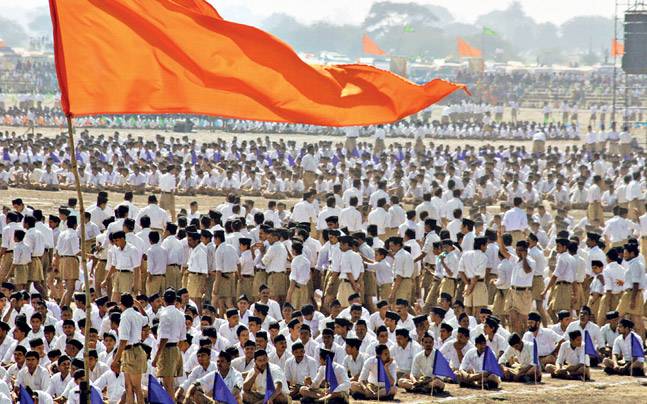
What Does the Rashtriya Swayamsevak Sangh Do and Believe?
What does the Rashtriya Swayamsevak Sangh (RSS) do and believe? When I was young, a person gave a speech on smoking at school. That speech was so powerful that for many years afterwards I used to think that smoking is the root of all the world's problems. I believed that the day smoking ends, the world w
23 October 2026 · 7 min read
Savarkar and Golwalkar on Hindu Sangathan and Casteism
Read both statements on jati (caste) and Hindu organization carefully and understand the difference. 1. "As long as the sense of jati does not end among Hindus, Hindu organization and Hindu awakening are impossible." — Veer Savarkar 2. "If the Hindu becomes awakened, he will automatically become organized and give a fitting response to the challenge of jati-bhed (caste division)..."
18 October 2026 · 1 min read
Dr. Harvansh Lal Oberoi: Staunch Protector of Hindu Sanskriti
The great karmayogi (one devoted to selfless action) Dr. Harvanshlal Oberoi was born on October 21, 1925, in Rawalpindi, to a Punjabi Khatri couple, Shri Dharmachandra and Ramkaur Oberoi. Following the partition of the country in 1947, he had to come to India with his entire family. Harvanshlal Oberoi ji was a worker of the Rashtriya Swayamsevak Sangh (RSS). B
18 October 2026 · 5 min read