YugSamvad · Politics & History
Politics & HistoryGeorge Fernandes: The End of a Golden Era of Nationalism
विशाल अग्रवाल · English edition 23 October 2026 · Hindi original 30 January 2019 · 4 min read
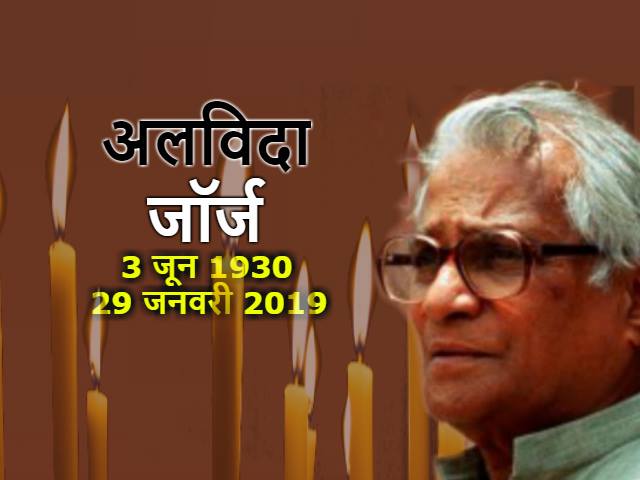
George Fernandes is no more. Having faded from our memories long ago due to Alzheimer's-induced forgetfulness, today he has vanished from this world forever as well. Left behind are his memories, which will surely continue to move those for whom he was the tireless rebel and the greatest pillar of non-Congressism. The photograph of him in handcuffs after his arrest during the Emergency became a symbol of resistance against dictatorship, and a case like the Baroda Dynamite Case became a mythical tale.
George, who led the largest railway strike involving more than 15 lakh railway employees, was once the uncrowned king of Mumbai's laborers. A man who, against his family's wish to make him a priest, arrived in Mumbai at the age of 19 in search of a decent job, spent his days sleeping on the benches of Chowpatty—how he became the greatest leader of Mumbai's laborers on the strength of his struggle and oratorical skills also seems like a cinematic tale.
Shri Pradip Singh writes,
The dynasts treated George Fernandes the same way dynasts across the world have always treated free-spirited personalities. Handcuffs were put on George's hands and shackles on his feet. His brother Lawrence was subjected to unbearable torture in police lock-up. People say Lawrence's death was the result of these inhumane tortures.
In later days, these very dynasts leveled the despicable allegation of coffin theft against such a brave and resolute patriot. The trouble is, those who spit at the moon never learned a basic lesson—that when you look up and spit at the moon, gravity brings that spit right back onto your own face, while the moon's image continues to shimmer just the same, up there in the sky and down here in the hearts of the people on earth.
Nothing else was expected from the swine swimming in the gutter of dishonesty. But take a look also at the behavior of the self-appointed custodians of journalism, the fourth pillar of democracy.
I remember, some seven or eight years ago in Banaras, I was sitting in Aurobindo Colony in the evening watching TV. There was sensational news about George. After all, what is news if it isn't sensational? At that time, George was going through the early stages of Alzheimer's. His memory was fading, and he often could not recognize faces. He had no physical illness, but the warrior George was now as helpless as a small infant. As is the way of the world, a war had broken out within his family over George's custody. The left side of George's body was being pulled by his former wife, Laila Kabir, who had lived apart for decades, had never cared for him, but had suddenly appeared on the screen. A sudden flood of love had welled up in her heart for George. And the right side of George's body was in the hands of George's brothers and Jaya Jaitly, his companion in the latter half of his life who had looked after him. The matter was in the high court, and journalists were reporting the details with relish. The learned judges were fully absorbed in the scholarly analysis of the world's precious legal technicalities.
Suddenly, George's picture appeared on the screen. Self-respecting and brave, the hero of our youth—George. Our George. George, bewildered and dazed, was staring into the void in front of him. Oblivious to the events happening around him. Outside of the world and its precious complexities.
A live course in inhumanity and insensitivity was running on Indian television. I could not bear to watch this humiliation of George. Seething with anger, I got up from my chair and went outside to breathe in the open air."
By 1950, George Fernandes had become the uncrowned king of the taxi drivers' union. With disheveled hair and a thin face, wearing a crumpled khadi kurta-pyjama, worn-out slippers, and glasses, Fernandes looked like a quintessential activist. Even back then, some people began calling him a 'tireless rebel' (rebel without a pause). In the 1967 Lok Sabha elections, by defeating S.K. Patil, one of the prominent Congress leaders of that time, from the Bombay South seat, he also earned the moniker 'George the Giant Killer'. He emerged as the very face of the resistance against the Emergency.
George Fernandes, who was completely rooted in the Indian milieu, was always dear to me because he was among those few individuals about whom, upon seeing, hearing, or reading, thoughts of their religion, caste, region, or language never crossed one's mind. After becoming the Defense Minister, the sensitivity he showed towards the soldiers always touched the heart. George Fernandes is no more; but the image of George in a crumpled kurta, holding files in his hand, fiercely attacking Congressism, will always remain in the hearts of his admirers.
Also read,
Devendra Swaroop is no more: The extinguishing of a beacon of light
Cite this article
विशाल अग्रवाल. “George Fernandes: The End of a Golden Era of Nationalism”. YugSamvad, 23 October 2026. https://yugsamvad.com/en/articles/jorja-pharnaandeesa-kaa-jaanaa-raashtravaada-ke-eka-svarnima-yuga
https://yugsamvad.com/en/articles/jorja-pharnaandeesa-kaa-jaanaa-raashtravaada-ke-eka-svarnima-yuga · accessed
Related reading
What Does the Rashtriya Swayamsevak Sangh Do and Believe?
What does the Rashtriya Swayamsevak Sangh (RSS) do and believe? When I was young, a person gave a speech on smoking at school. That speech was so powerful that for many years afterwards I used to think that smoking is the root of all the world's problems. I believed that the day smoking ends, the world w
23 October 2026 · 7 min read
Savarkar and Golwalkar on Hindu Sangathan and Casteism
Read both statements on jati (caste) and Hindu organization carefully and understand the difference. 1. "As long as the sense of jati does not end among Hindus, Hindu organization and Hindu awakening are impossible." — Veer Savarkar 2. "If the Hindu becomes awakened, he will automatically become organized and give a fitting response to the challenge of jati-bhed (caste division)..."
18 October 2026 · 1 min read
Dr. Harvansh Lal Oberoi: Staunch Protector of Hindu Sanskriti
The great karmayogi (one devoted to selfless action) Dr. Harvanshlal Oberoi was born on October 21, 1925, in Rawalpindi, to a Punjabi Khatri couple, Shri Dharmachandra and Ramkaur Oberoi. Following the partition of the country in 1947, he had to come to India with his entire family. Harvanshlal Oberoi ji was a worker of the Rashtriya Swayamsevak Sangh (RSS). B
18 October 2026 · 5 min read