YugSamvad · Sanskrit & Shastra
Sanskrit & ShastraWhy Are the Youth Mindset deteriorating? Is There a Path to Reform?
अजेष्ठ त्रिपाठी · English edition 18 October 2026 · Hindi original 4 November 2017 · 5 min read
According to the Yogasutra, *kusamskaras* (negative latent impressions) are formed by the continuous bad *karmas* (actions) of past lives and this present life. It is these kusamskaras that constitute the garbage that steadily accumulates upon the *chitta* (mind-stuff). This is why, what has the chitta become nowadays? A dustbin or a dump yard!! Often news arrives that so many people died when a mountain of garbage collapsed. In the same manner, lest we be destroyed by the overflowing garbage of kusamskaras in the dustbin of the chitta, must we not keep eliminating those kusamskaras? So how do we eliminate them? They are eliminated through *tapas* (austerity). What is tapas? The discipline undertaken for the purification of anything is tapas. For example, when milk is heated over fire, the impurities of the milk are destroyed through boiling, and it becomes fit for drinking. Similarly, gold is heated intensely, and only then does it attain its luster. This discipline is indeed painful; who finds being burned in fire tolerable? Yet it is fire alone that reduces all blemishes to ashes. Therefore, the *indriya-nigraha* (restraint of the senses) of the body—the fire-like suffering generated by it—alone burns away the impurities in the form of kusamskaras from our chitta and purifies it. There are many means to this tapas, such as *pranayama* (breath regulation) or *vrata-upavasa* (vows and fasting). Restraining the senses is not easy for us, but it is the senses that increase our kusamskaras by committing sins; therefore, must they not be brought under control by some means? The path shown by the Lord in the Gita for this is to fast. I will write a separate post on the more scientific details of tapas and fasting. My topic here was why girls, along with boys, are degenerating so severely nowadays. Let us speak of those "cool dudes" and "dudettes."
In Hindu dharma, fasts are prescribed across various occasions such as Chauth, Baras, Ekadashi, Janmashtami, Shivaratri, Mondays for Shiva, Tuesdays for Hanumanji, Navaratri, and up to Deepavali. Throughout the year, through one festival or another, the cycle of fasting continues. But nowadays, this cycle is being severely undermined. Whoever says, "Why fast on Krishna's birthday? Rather, one should cut a cake and feast on *chhappan bhog* (an offering of fifty-six delicacies)," has an immense amount of chaff in their head. Now dieting is a fashion, but vrata and upavasa are becoming outdated.
Woman is the pivot of society; the entire culture depends on that woman. To the extent woman is secure, educated, noble, dharmic, and pure, the reign of dharma remains equally secure. This very concern was expressed by Arjuna to Shri Krishna as well: that the greatest casualty of war is the peril brought upon women, and their corruption in the absence of protection. That is why in Hindu dharma there are more fasts for women than for men; that is to say, women are greater ascetics than men, who for thousands of years have held their families bound to the Sanatana tradition and have given birth to the noblest of progeny. Could a heroine like Panna Dhai be found anywhere else? How was all that valor acquired, enabling her to sacrifice her own son for dharma? The answer is this very tapas.
Men have fewer fasts compared to women, which is why it was observed in earlier times that boys were more corrupt, but not women. And the families that were devoted to dharma and practiced tapas and *sadhana* (spiritual discipline) were corrupted very little. Merely by reading Premchand’s novels from 100 years ago, one can recognize which communities produced people of corrupt conduct—those communities in which tapas (vrata/upavasa) was absent. But nowadays girls too, meaning the "cool dudettes," are degenerating in vast numbers. There is a virtual deluge of those who drink alcohol, smoke cigarettes, charas, and ganja, keep five boyfriends at a time, and consider wearing fewer clothes a mark of pride. They have also been intoxicated by a weed named feminism.
Why has all this suddenly surged? Because through cinema and westernization, sin has increased immensely while *samskara* (cultural refinement) and chitta-purification have plummeted completely. Earlier, families did not grant such leeway regarding vratas and fasts, but now everything has been left completely unrestrained. Even on the two days of Janmashtami and Shivaratri fasts in a year, the cool dudes and dudettes feel like dying; they mock it. It is only through tapas that the chaff clears from the mind; this is why women were kept safe from degeneration through vrata and upavasa. But complete laxity has been granted in this matter, and its consequence is now plainly visible. Therefore, boys and girls must be made to observe rigorous fasts and vratas on various festivals right from childhood so that kusamskaras are destroyed and good sense prevails.
Rushing with four types of biscuits the moment a child feels a little hungry is not right. Nowadays, even if a child wishes to observe a fast, they are not allowed to do so. This will only add to the garbage in the child’s mind. No one dies from not eating or drinking for a day; this much discomfort must be borne. Grinning greedily at pizzas and burgers is not the purpose of life. Whoever wishes to bring their mind to its right place must practice vrata, upavasa, and tapas according to their capacity. By not purifying the chitta through vrata and upavasa, the garbage in the minds of cool dudes and dudettes only keeps piling up, and they indulge in all kinds of vile deeds, becoming leftists, becoming feminists. There are other paths to chitta-purification as well, such as yoga, pranayama, *sandhyavandana* (daily twilight prayers), a *sattvic* (pure and noble) lifestyle, and worship.
Gradually, from childhood itself, children should be trained in the practice of vrata-upavasa, their importance explained to them, and a positive outlook imparted. In the pursuit of this license, numerous fasts like Chauth, Baras, Gyaras, etc., are perishing. How will they reach the next generation? In the cities now, these small festivals meant for chitta-purification through fasting are vanishing. Even during the few fasts that are observed, numerous delicacies are prepared just to gorge oneself. Then what meaning is left in it? Let no one misunderstand here that one should starve to death—no! Rather, one must undertake vrata and upavasa according to one's capacity, following the shastric injunctions. One should not observe arbitrary fasts that harm the body. This is also why in *jyotisha* (traditional astrology) there are distinct *vara-vratas* (day-specific vows), so that the corresponding kusamskaras may be destroyed and relief obtained from inauspicious karmic results. The destruction of sin and kusamskara through vrata and upavasa is entirely scientific.
Read also,
Pardon me, your filmi dance is not art, it is darkness
Cite this article
अजेष्ठ त्रिपाठी. “Why Are the Youth Mindset deteriorating? Is There a Path to Reform?”. YugSamvad, 18 October 2026. https://yugsamvad.com/en/articles/kyon-bigara-rahe-hain-yuvaa-kyaa-sudhaarane-kaa-koee
https://yugsamvad.com/en/articles/kyon-bigara-rahe-hain-yuvaa-kyaa-sudhaarane-kaa-koee · accessed
Related reading
Shastras: Only Surya Siddhanta Panchang Is Valid for Vratas
Author: Pandit Gangadhar Pathak ‘Vedadyacharya’ (teacher of the foremost Vedas) (Chief Acharya [preceptor] of the Shri Ram Janmabhoomi Shila Pujan [consecration of the foundation stone], Ayodhya) Chief Priest Acharya Shri Gangadhar Pathak conducting the Shilanyas (laying of the foundation stone) of the Shri Ram Janmabhoomi Temple in Ayodhya by Prime Minister Shri Narendra Modi. साङ्गोपाङ्गाय वेदाय ज्योतिषां ज्योतिषे नमः । सूर्याय सूर्यसि... (Salutations to the Veda with all its limbs and sub-limbs, and to the light of all lights [Jyotisha]. Salutations to the Sun, to the Surya...)
23 October 2026 · 6 min read
Panchang Editing Workshop at Central Sanskrit University
From the upcoming Samvat 2078, it has been decided by Shri Nimbark Parishad, Jaipur, in collaboration with the Central Sanskrit University, Jaipur Campus, to publish Rajasthan's sole Surya-siddhantic panchang (traditional almanac), 'Shri Sarveshwar Jayaditya Panchang'. For this purpose, regarding the vrat (religious fasts), parva (festivals), utsava (celebrations), muhurta (auspicious timings), etc., in the panchang
23 October 2026 · 4 min read
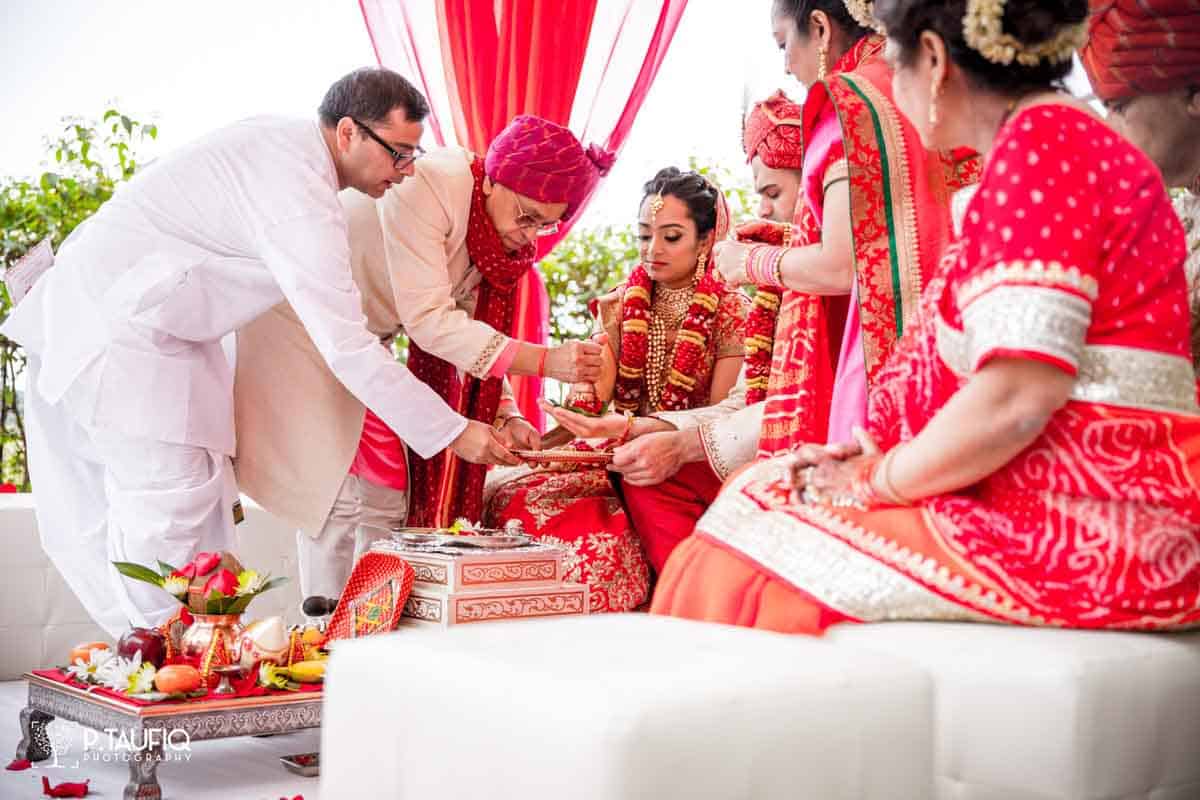
Be It Kanyadaan or Vardaan: What Is Wrong with It?
Is *kanyadan* (the ritual offering of the bride) merely charity? Why is *kanyadan* performed, and is it an insult to women? Understand the true meaning of *kanyadan* in the Hindu *vivaha sanskara* (marriage sacrament), along with its cultural and Vedic significance. Read the authentic exposition of *vardan* (boon) versus *kanyadan*, the mystery of *Brahma vivaha* (the Brahma form of marriage), and a definitive response to the fallacies that seek to misrepresent Hindu traditions.
18 October 2026 · 5 min read