YugSamvad · Politics & History
Politics & HistoryFasting non-stop for 26 days, this is how Veer Savarkar invited death
Mudit Agrawal · English edition 17 October 2026 · Hindi original 20 December 2019 · 3 min read
"Come, Death... Come... Come, O Death"
At the age of 83, Veer Savarkar, adopting the ancient tradition of Hindu ascetics, renounced food, water, and medicines on 1 February, on the *tithi* (lunar day) of Magha Shukla Ekadashi (the eleventh lunar day of the bright fortnight of the month of Magha). His view was, "When life's mission is fulfilled, and no strength remains to serve society, one should embrace death oneself, rather than wait for death to arrive." The yogi who practiced all his life to become like the tortoise described in the Gita now began to withdraw into himself at his final hour. Death, which lacked the courage to approach that unarmed man sentenced to two life terms of transportation, was finally called near by him as he saw death's helpless plight. That ascetic gave this act the name *atmārpaṇa* (self-surrender).
Before leaving his mortal frame after a rigorous 26-day fast without food, water, or medicine, Savarkar wrote a poem, a section of which is translated below:
"Come, Death, come, O Death
If you have set out to come
Then come right now
For fear of wilting
Flowers may tremble in fear
And grapes dripping with sweet nectar
May fear drying up
Why should I fear you?
For what reason?
In this cup of mine, even as I drink
Filled to the brim and never-ending
Is the wine of tears
Meant for me alone
Come if you are hungry
For a *naivedya* (sacred food offering)
And though my day is yet filled with youth
All my tasks, big and small
Have drawn to a close
Somehow, through every effort
I have discharged the debts
Accumulated across births
To repay the *rishi-rina* (debt owed to the sages)
By serving the holy waters at the feet of Mother Veda
And taking refuge in the firm realm of the saints
And in the cremation ground of hope
A stern *tapasya* (ascetic penance) of righteous conduct
To repay the *deva-rina* (debt owed to the gods)
Sounding the war drums with thunderous clamor
Advance forward and launch your assault
At the very moment
When the Lord gives His first order to battle
And in the fire of the war-*yajna* (sacred sacrifice)
Let every bone and every flesh burn
Like firewood
Come, Death, come, O Death
Having left your home
You must be on your way
So come right now"
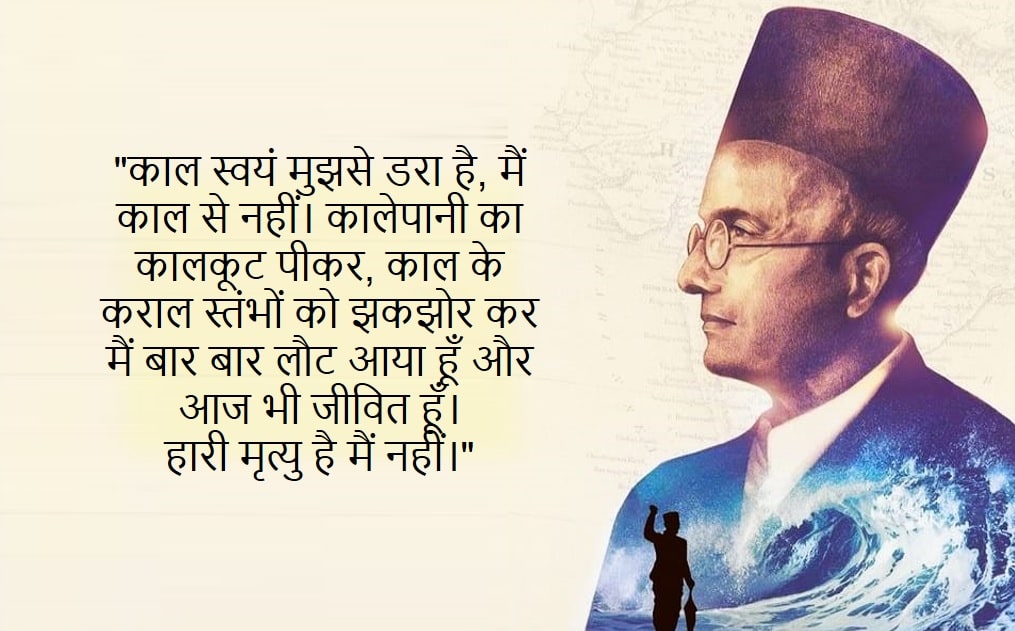
He asks: O Death! Why should I fear you? You yourself have feared me; I have not feared you. Having drunk the lethal poison of Kala Pani, shaking the terrible pillars of Time, I have returned again and again, and I am alive even today. It is you, Death, who are defeated, not I. But this fragmented independence continues to rend my soul even after 19 years; after independence, abuse and neglect became the new Kala Pani for this living *hutatma* (martyr). The wine of his tears has not yet run out. Such was the neglect and contempt that even after his passing, not even a single day of state mourning was declared for Veer Savarkar, not a single cabinet minister from Maharashtra attended his funeral, the request to pay tribute to him in the House was rejected by the Lok Sabha Speaker, and Nehru had spoken of demolishing Cellular Jail to build a hospital.
At the age of 83, having withered his body through 26 days of fasting, Veer Savarkar still finds himself youthful, standing on every page of freedom and proclaiming: My small and big tasks are finished!! Holding fast to the feet of Mother Veda, serving that pilgrimage of pilgrimages—Andaman—and walking in the footsteps of the saints, I am somehow discharging the *rishi-rina* accumulated over births. The *tapasya* performed in the desolate forest of Hindutva's boundless hopes shall discharge my *deva-rina*. Now come, sounding the war instruments, by the will of the Lord, so that after offering every single moment of my life as an oblation, I may offer up this remaining body as well. Come, Death, come, let me embrace you now... It was after this that Death obtained Savarkar...
If this *tapasvi* (ascetic practitioner), this yogi, this spiritual wearer of the *janeu* (sacred thread) who discharged the three fundamental debts is an atheist, then no one is a believer—no one at all...
Read also,
Cite this article
Mudit Agrawal. “Fasting non-stop for 26 days, this is how Veer Savarkar invited death”. YugSamvad, 17 October 2026. https://yugsamvad.com/en/articles/26-dina-upavaasa-kara-aise-veera-saavarakara-ne-bulaayaa
https://yugsamvad.com/en/articles/26-dina-upavaasa-kara-aise-veera-saavarakara-ne-bulaayaa · accessed
Related reading
Karpatraratnasamuchchaya and Tradition-ism | Including 'Kutarkakootnashak' (Destroyer of False Logic)
This following essay is written by @RamaInExile.Trad: The events of the past few months have shaken me to my core. I was completely unaware of the true nature of the elements within these events. Like a tadpole, my worldview began to undergo a metamorphosis. In the name of Trad vada (Trad traditionalism), dharma...
18 October 2026 · 63 min read

Be It Kanyadaan or Vardaan: What Is Wrong with It?
Is *kanyadan* (the ritual offering of the bride) merely charity? Why is *kanyadan* performed, and is it an insult to women? Understand the true meaning of *kanyadan* in the Hindu *vivaha sanskara* (marriage sacrament), along with its cultural and Vedic significance. Read the authentic exposition of *vardan* (boon) versus *kanyadan*, the mystery of *Brahma vivaha* (the Brahma form of marriage), and a definitive response to the fallacies that seek to misrepresent Hindu traditions.
18 October 2026 · 5 min read
Yudhishthira: Sovereign Emperor and Builder of Hindu Rashtra
Given the controversies often seen regarding Yudhishthira and others, we must look to the Mahabharata itself to determine whether Yudhishthira and the other Pandavas were powerful in their own right and embodiments of dharma (righteousness), or if, according to modern propaganda, they were merely dependent on the mercy of Shri Krishna. For the sages repeatedly call him Dharmaraj, and their words cannot be false.
13 September 2026 · 13 min read