YugSamvad · Dharma & Culture
Dharma & CultureShri Guruji Golwalkar on the Post-Partition Muslim Crisis
Mudit Agrawal · English edition 23 October 2026 · Hindi original 13 October 2020 · 4 min read
Shri Guruji's clear perception regarding the natural disposition of Muslims and the resulting imminent national crisis is found in his book "Bunch of Thoughts" (Vichar Navneet). Shri Guruji says,
"After partition, there are many people who say that the Muslim problem no longer exists. All those rioting elements who patronized Pakistan have gone forever. The remaining Muslims are devotees of our country. Now they have nowhere else to go and are bound to remain loyal.
But what is the fact?
Is it true that all pro-Pakistan elements went to Pakistan? Evidently, it was the Muslims of the Hindu-majority province of Uttar Pradesh who were at the forefront of the movement for Pakistan from the very beginning, and even after partition, they have all remained here. In fact, the Muslims of Punjab, Bengal, Sindh, and the North-West Frontier Province who went to Pakistan had completely rejected the Muslim League in the elections of 1937. In later years, due to the wrong policies of our national leadership, those Muslims were pushed back into the lap of the Muslim League.
And then, before partition, elections were held for the establishment of the Constituent Assembly. The Muslim League contested those elections making the creation of Pakistan their electoral plank. The Congress also fielded its Muslim candidates across the entire country, but in every such place, Muslims voted only for the candidates of the Muslim League, and the Muslim candidates of the Congress were badly defeated. The North-West Frontier Province was an exception. This only means that the crores of Muslims who are living here now, all of them had voted for Pakistan.
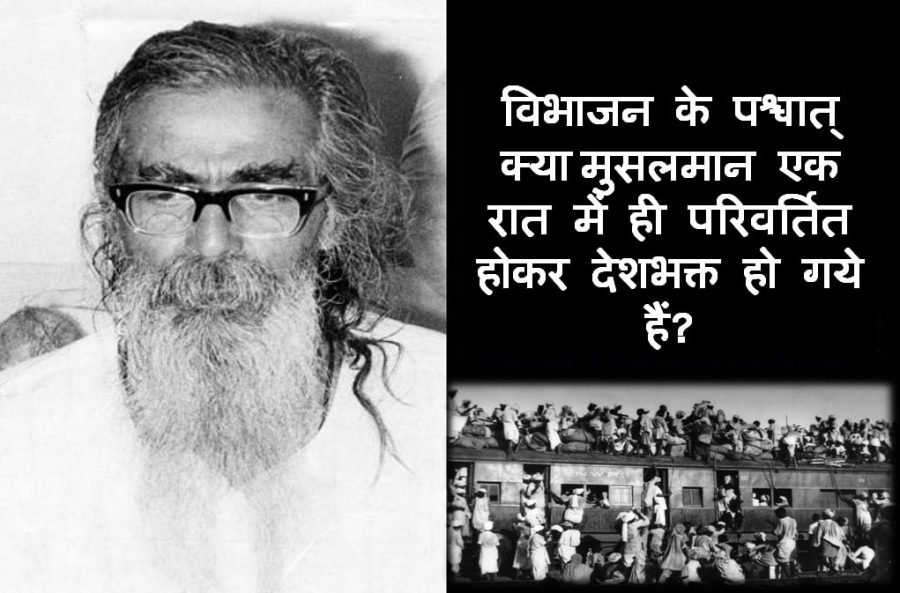
Have those who remained here even after partition changed themselves? Has their old hostility and murderous attitude—which resulted in widespread riots, looting, arson, rape, and other such frenzied acts on an extremely large scale in 1946-47—ended? Have they transformed into patriots overnight after partition? To live in the delusion of such a belief would be suicidal.
On the contrary, with the creation of Pakistan, this Muslim menace has increased a hundredfold, which itself was created as the basis for plans of future aggression against our country. Ever since Muslims set foot here twelve hundred years ago, their sole aspiration has been to convert and enslave this entire country. But despite state power remaining in their hands for centuries, this aspiration of theirs did not bear fruit, because the victorious spirit of the Rashtra (nation) continued to awaken from time to time in the form of great, valorous men, which became the cause of the death of their empire here.
The world-renowned historian Prof. Arnold Toynbee wrote an essay presenting a pure, historically realistic picture of partition. In it, he has unequivocally stated that the creation of Pakistan in this twentieth century is the first successful step towards realizing the 1200-year-old dream of Muslims to completely subjugate this country.
Increasing their population in socially important parts of our country is the second front of their aggression. After Kashmir, their second target is Assam. In a planned manner, a flood of their population has been rising in Assam, Tripura, and the rest of Bengal for a long time. Our own government encourages Muslims everywhere in their divisive and destructive activities. Our leaders and political parties also encourage them in this task.
In fact, wherever there is a mosque or a Muslim locality in the entire country, Muslims believe that it is their own independent territory. If any Hindu procession passes there singing and playing music, they get angry, claiming that their religious sentiments are hurt. If their religious sentiments have become so delicate that they are perturbed even by sweet music, why do they not relocate their mosques to the forests and worship there in silence?
Before it is too late, we must immediately stop this long and suicidal hypnosis of this desired notion, and firmly grasp the harsh realities of the situation, giving supreme importance to the interests of the security and integrity of the nation."
- Bunch of Thoughts, Shri Madhavrao Sadashivrao Golwalkar (Shri Guruji)
Read Also,
Shri Guruji Golwalkar's Thoughts on the Dangerous Christian Character
Shri Guruji Golwalkar's Thoughts on the Hollowness of Communism (Leftism)
The One Who Made the Sangh Nationwide: Former Sarsanghachalak Balasaheb Deoras
Basis of Hindu Muslim Unity According to Veer Savarkar
Cite this article
Mudit Agrawal. “Shri Guruji Golwalkar on the Post-Partition Muslim Crisis”. YugSamvad, 23 October 2026. https://yugsamvad.com/en/articles/vibhaajana-ke-baada-musalamaana-sankata-para-shreegurujee-golavalakara-ke
https://yugsamvad.com/en/articles/vibhaajana-ke-baada-musalamaana-sankata-para-shreegurujee-golavalakara-ke · accessed
Related reading
Savarkar and Golwalkar on Hindu Sangathan and Casteism
Read both statements on jati (caste) and Hindu organization carefully and understand the difference. 1. "As long as the sense of jati does not end among Hindus, Hindu organization and Hindu awakening are impossible." — Veer Savarkar 2. "If the Hindu becomes awakened, he will automatically become organized and give a fitting response to the challenge of jati-bhed (caste division)..."
18 October 2026 · 1 min read
Dr. Harvansh Lal Oberoi: Staunch Protector of Hindu Sanskriti
The great karmayogi (one devoted to selfless action) Dr. Harvanshlal Oberoi was born on October 21, 1925, in Rawalpindi, to a Punjabi Khatri couple, Shri Dharmachandra and Ramkaur Oberoi. Following the partition of the country in 1947, he had to come to India with his entire family. Harvanshlal Oberoi ji was a worker of the Rashtriya Swayamsevak Sangh (RSS). B
18 October 2026 · 5 min read
The Meaning of Medha, Kautuhala, Jigyasa and Herd Mentality
*Medha* (intellect) and the Herd “He who protects *dharma* (righteousness/cosmic order), *dharma* protects him.” The meaning of *dharma* is Vedic *yajna* (sacrificial ritual), that is, the *karma-kanda* (ritual section) of the Vedas. There are ten characteristics of *dharma* — *dhriti* (fortitude), *kshama* (forgiveness), *dama* (self-control), *asteya* (non-stealing), *shaucha* (purity), *indriya-nigraha* (sensory control), *dhi* (intellect), *vidya* (knowledge), *satya* (truth), and *akrodha* (absence of anger). But these are merely characteristics on the basis of which we can recognize that a particular...
18 October 2026 · 8 min read